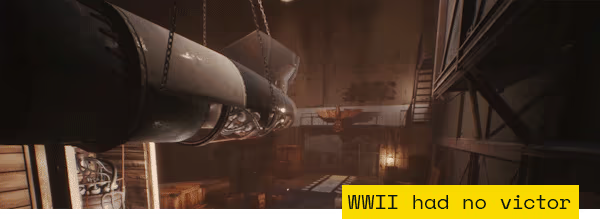
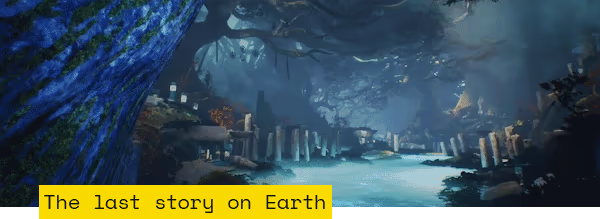
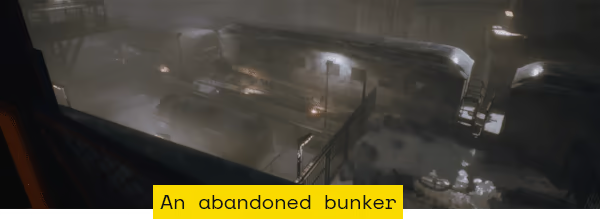
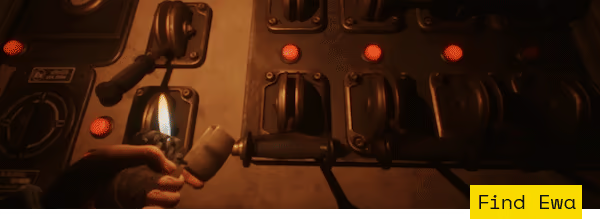
It's winter, 1980. Szymon, a boy raised in a post-apocalyptic wasteland, finds an abandoned Nazi bunker. Will he find what he’s looking for? Play Paradise Lost and explore an underground world, where Slavic mythology mixes with retrofuturistic technology. Discover the last story on Earth.
Modeled estimate, not a reported figure. How we estimate →
Media
About
Genres
Stats
All-time low is the lowest price we've recorded for this game since we started tracking it.
Languages: English*, German, Polish, French, Japanese, Portuguese - Brazil, Russian, Simplified Chinese, Spanish - Latin America*languages with full audio support
Engagement
Hours played at review time, across 42 reviews with recorded playtime.
Reviews
Themes across 42 recent reviews and how positive each mention is. A keyword signal, not full sentiment analysis.
positive critical· bar length = how often the theme comes up
Reviews
A beautiful and unique game! Yes, the walk speed is slow, and the sprint function doesn't actually seem to.. Function. Yes, there is a bug that locks you in place after loading a saved game, which requires you to turn off the head bobbing effect in settings. However, I don't think those two issues are enough to justify the negative reviews. If you enjoy atmospheric walking simulators - definitely give this one a go!
Paradise Lost, developed by PolyAmorous and published by Walkabout, is a narrative-focused first-person exploration game that builds its identity around atmosphere, speculative history, and quiet emotional storytelling. Set in an alternate version of post-World War II Europe—where the conflict stretched far longer and ended in nuclear devastation—it presents a world that feels both familiar and deeply unsettling. You play as Szymon, a young boy wandering through a frozen wasteland who discovers a vast, abandoned bunker hidden beneath the surface. From there, the experience shifts into a slow, introspective journey through a place that was once meant to preserve a vision of the future, but now stands as a relic of failure. The story is the central pillar of the game, unfolding gradually as Szymon explores deeper into the bunker. Rather than delivering its narrative in a direct or linear fashion, the game relies on environmental storytelling, scattered documents, and interactions with a mysterious voice that accompanies the player throughout the journey. The bunker itself tells much of the story—its architecture, its abandoned systems, and the remnants of those who lived within it all contribute to a broader picture of what this place once represented. Themes of loss, control, ideology, and human fragility are woven into the experience, giving it a reflective tone that lingers long after the game ends. Gameplay is intentionally minimal, aligning with the structure of a walking simulator. Players move through the environment, interact with objects, and occasionally solve simple puzzles that serve primarily to maintain pacing rather than challenge. There is no combat or traditional fail state, and progression is driven entirely by exploration and discovery. This design allows the narrative and atmosphere to take center stage, but it also means that the experience lacks mechanical depth. For players who value interaction and challenge, this can make the game feel limited, while others may appreciate the focused, uninterrupted storytelling. The bunker itself is one of the game’s strongest elements. It is not just a backdrop, but a carefully constructed space that evolves as the player moves through it. Different areas introduce new visual themes, from cold, industrial corridors to more elaborate sections that reflect the ambitions of those who built it. This variety keeps the environment engaging and reinforces the sense of uncovering something layered and complex. The design balances realism with subtle surrealism, creating a world that feels grounded yet slightly distorted, as if shaped by the ideologies that once defined it. Atmosphere plays a crucial role in maintaining immersion. The game uses lighting, sound, and pacing to create a persistent sense of unease. Even without traditional horror elements, there is a constant tension in exploring spaces that feel abandoned but not entirely empty. The slow movement speed contributes to this, encouraging players to take in their surroundings, though it can also make traversal feel sluggish at times. This deliberate pacing is effective in building mood, but it may test the patience of players looking for a more dynamic experience. Narratively, the game offers a layered but sometimes fragmented experience. Much of the story is optional, requiring players to actively seek out details to fully understand what happened. This approach rewards careful exploration, but it can also result in a narrative that feels incomplete if certain elements are missed. Additionally, the delivery of dialogue and voice acting is uneven, with some moments carrying emotional weight while others fall short of their intended impact. The game’s relatively short length works in its favor, allowing it to maintain focus without overstaying its welcome. The experience can be completed in a few hours, making it well-suited for a single, uninterrupted session. Multiple endings provide some incentive for replay, though the overall structure remains largely the same, limiting how much the experience changes on subsequent playthroughs. Despite its limitations, Paradise Lost succeeds in creating a memorable and thought-provoking journey. Its strength lies in its ability to build a compelling world and invite players to explore it at their own pace. While it does not offer the depth or interactivity of more traditional games, it delivers a focused narrative experience that stands out through its setting and themes. Ultimately, Paradise Lost is best appreciated as an atmospheric story rather than a gameplay-driven title. It offers a unique perspective on history and human ambition, presented through a carefully constructed environment and a reflective narrative. For players who enjoy slow-paced, exploration-heavy experiences, it provides a compelling and immersive journey. For those seeking more active or mechanically complex gameplay, it may feel too restrained to fully engage. Rating: 7/10
Primeira vez que eu jogo um walking game. O jogo te prende de modo surpreendente com o desenrolar da história e com os cenários. Ele tem finais alternativos de acordo com suas escolhas finais. Bem interessante e intrigante.
Unfortunately "stuck in the ground" each time you exit game and after that is reloaded on last checkpoint on each new game opening to continue it. To pass level where you at in this move you must redo all implied level. Also "running" mode is no running at al, just same walk. Until major checkpoint bug is not fixed I'll not recomment at all. Otherwise game have a lot of potential in future if DevOps team fixe those bugs. An optional Save/Load feature on each point would be nice too.
Vary slow start, and a bit underwhelming "Walking simulator" - very accurate tag It's just not for me
If your just here for the atmosphere and to slowly uncover the backstory of our main character, this is the game for you. If you want some gameplay or challenges, you're completely wrong here. You mainly just walk (or walk a bit faster) through the story, flipping a few switches, getting some hints what happened here, and what happened with the main char's mom. And after some time playing I got stuck in her grave and had to restart.
I'm sorry, i really didn't want to put this as negative. but when it's so buggy that loading a checkpoint makes the character stuck and sometimes gets stuck on geometry, too, leaving the only way to get unstuck is restarting the chapter, which can undo almost an hour of walking if it happens near the end of the chapter, it's just frustrating, but if it ever gets fixed i will change this review because the story is somewhat interesting, it's just impossible to enjoy it fully with all these bugs
✔️✔️✔️
Also... erstmal zum Spiel selbst: Wer auf Laufsimulatoren mit cooler Story steht, für denjenigen ist das Game definitiv was. Grafik ist für Unreal 4 Verhältnisse wunderschön. Sound design überzeugt und ich habe jetzt keine harten Bugs gehabt die mir den Spiel durchlauf unmöglich gemacht haben, wie etwa das in den Boden buggen etc. was viele hier bemängeln. Ich bin nun zweimal durch gelaufen und wollte eigentlich nur beim zweiten lauf alle restlichen Erfolge holen. Da das Spiel aber anscheinend 4 unterschiedliche Enden hat, muss man das spiel (etwa 2-3 Stunden je nach dem wie viel man sich anschaut) 4 mal durchspielen. Das wäre für mich jetzt erstmal kein Problem, aber wieso fällt meine Rezession negativ aus? 1. Wieso hat man nach dem Ersten durchlauf keine Möglichkeit auf Kapitel oder auf Speicherpunkte (die das spiel selbst erstellt) zuzugreifen? Wenn man es durch hat, kann man es nur wieder von Vorne starten....wtf 2. WIESO läuft der Junge als wäre er ein 80 Jähriger Rentner?! jetzt mal nichts gegen Alte Menschen hier, aber ernsthaft... da ist mein Opa mit 90 schneller am laufen. Wieso die Dev's auf Shift einen "Sprint Modus" eingebaut haben, ist mir ein Rätsel - man läuft gefühlt nicht schneller sondern die Sicht wird etwas nach unten geschoben als würde man rennen und ja etwas schneller wird man, aber kaum bemerkbar - WTF?! 3. WIESO darf man NICHTS aber auch GARNICHTS überspringen?! Beim ersten durchlauf sehe ich das noch ein, es geht um die Story - aber wieso muss ich mir das alles noch weitere dreimal gegeben wenn ich alle Erfolge holen möchte? Gespräche, Zwischensequenzen - alles muss man sich komplett noch einmal geben... sowas nervt mich gewaltig - lasst mir als User doch selbst die Entscheidung ob ich das alles noch mal hören möchte oder eben nicht. Zumindest in den darauffolgenden Durchläufen. Wieso sind mir die Erfolge so Wichtig?: Das ist einfach mein anliegen das ich gerne viele Games 100% fertig mache - muss ja jeder für sich wissen was er möchte. Aber einem dann so "Steine" in den weg zu legen. Das nervt. Ja, ich habe Online gelesen, dass man am besten am Ende einen Speicherstand erstellt, aus dem Game raus geht und ihn Lokal irgendwo abspeichern soll damit man es nicht 4 mal durchlaufen muss. Da aber überall wo ich nachgeschaut habe stand, dass ich für die 4 Enden nur die 4 Entscheidungen jeweils einmal machen muss, dachte ich, ich muss es nur noch mal spielen und ich hätte alles (vier Entscheidungen am Ende, man muss zwei anwählen) Ergo muss ich nun zum dritten mal durchlaufen... mir alles noch einmal anhören und am ende dann doch noch einen lokalen Speicherstand sichern damit ich dann das vierte mal nicht durch muss... Unnötig viel Arbeit für wenig Erfolge. Wer also auch, so wie ich, gerne alles Erledigt, also auch die Erfolge der sei gewarnt!!! Lokaler Speicherstand sichern!!! Cheers
An amazing surprise Seeing the Mixed reviews i was expecting just some ♥♥♥♥♥♥ blank experience but no... I really loved the story, it was like experienced a very good and engaging 5hour movie Just simple, 0 combat, 0 puzzle, story game The one bad side for me is the voice acting, if someone told me that the of the two main characters were made by two of the developers because they diddn't have the budget for actual VA's i wouldd believe it. Other than that, 100% recomend it
Related
Related
Trends
Concurrent players on Steam, sampled daily since tracking started.
Audience
Estimated from the language of this game's reviews — a proxy for where players are, not official Steam demographics.
Related
| Tales & Tactics | $990.5K | 2.2K | 78% | $17.99 |
| Element TD 2 - Tower Defense | $990.3K | 3.2K | 90% | $14.99 |
| Get To Work | $990.3K | 3.5K | 89% | $12.99 |
| Landlord's Super | $990.1K | 1.7K | 81% | $19.99 |
| Expeditions: Conquistador | $992.3K | 1.6K | 79% | $19.99 |
| Task Force Admiral - Vol.1: American Carrier Battles | $990K | 713 | 90% | $35.99 |