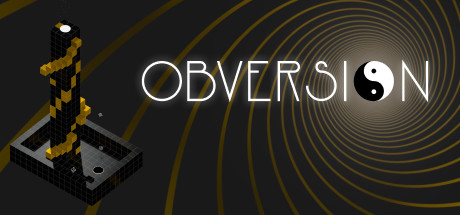
Obversion is a challenging yet accessible abstract first-person puzzle platformer set in a vibrant universe of cubes.
Modeled estimate, not a reported figure. How we estimate →
Media

About
Genres
Stats
All-time low is the lowest price we've recorded for this game since we started tracking it.
Languages: English
Reviews
[b]edit:[/b] a patch added some quality of life stuff (resolutions, rebindable keys, bugfixes, etc.), so I edited relevant parts of the review. [b]obversion[/b] is a minimalist 1st-person puzzler with [b]optional automove, autojump and unlimited undo[/b]. not something you see often. or ever. until now, that is. I had no idea how they would work in 1st-person, or why anyone would like to play that way, and that's from someone who despises platforming, even more if it's 1st-person. still, being able to [b]remove skill requirements so even a loser like me can focus on the puzzles is something to applaud[/b], especially these days when adding an exit button is considered a major update for some lazy devs, if it ever happens. settings in the main menu and while playing include look sensitivity, volume sliders for music and sound, invert y-axis and full screen toggles, plus resolution options. you can also look at and change the controls in the menu (controller or keyboard and mouse) and they pop up after starting a new game as well: wasd to move, space jumps, q/e for undo/redo, x/c to toggle automove and autojump, [b]left click to create a block after picking up star-like objects as 'ammo', right click to destroy one with cube-shaped ammo[/b]. so without any assists the game plays as you'd expect. [b]what I didn't expect is autojump and automove to be such a gamechanger.[/b] literally, as it feels like playing an entirely different game. the former mostly says goodbye to space, as you'll [b]jump onto blocks automatically[/b] (duh!), and the latter is simply awesome: it displays a path highlighter (or whatever its official name is, I guess it could just be 'cursor') and you can [b]move to whichever block it's pointing at by pressing space[/b], instead of walking around like a pleb. sure, the platforming aspect is mostly gone this way, but I'd definitely play a lot more puzzle platformers without all the annoying platforming, so as I said above: I applaud the dev for making it happen in this game. and if you think playing with assists turns the game into a cakewalk (or cakejump), think again. you [b]can't leap to places you couldn't get to otherwise and still have to figure out how to reach the exit with limited resources[/b], though after some struggling, a prompt comes up and holding undo provides a hint. very nice, but still not easy at all, at least for the dimensionally challenged, someone like me who prefers 2d puzzlers and out-of-body experiences instead of a 1st-person perspective. [b]falling off the level[/b], accidentally or to pick up an out of bounds star or cube, [b]is not an issue[/b], you're put back to a safe spot instantly, ready to continue. and for an extra challenge, [b]grab yin yang symbols (optional collectibles) from hard-to-reach places[/b] and make sure to finish the level after for them to count. there are also transparent globes here and there with some philosophical quotes about duality and such. [b]as difficult as it is, it's still a lot of fun[/b], though undo/redo is a bit weird as well, as it doesn't simply make a removed block reappear or vice versa, but also moves you around, to the position where you created or removed said block. definitely needs some getting used to, but it's also necessary because it works for falling off platforms and everything else. it's great. [b]the presentation is excellent[/b], pleasant minimalist graphics, relaxing soundtrack (though there's a piece that got on my nerves with its extreme repetitiveness), no extra pressure from timers, move counters, ratings, enemies, dying or falling, and the [b]28 levels in 4 worlds[/b] with the occasional new mechanic should provide several hours of gameplay. no idea how many exactly, as I'm too dumb to figure most of it out, but I can only recommend giving it a shot for fans of the genre.
Related
Related
Trends
Concurrent players on Steam, sampled daily since tracking started.
[h1]Follow our curator for similar games[/h1] https://store.steampowered.com/curator/35180752-3-point-play/ Puzzle platformer + music + undo button = Abstract first person puzzle to reach the exit of each level by destroying or creating blocks. A enjoyable challenge with piano music to increase your senses.
Obversion commits one of the most prominent puzzle game sins: it has a move limit. The main player actions involve deleting and creating blocks but you cannot do those without one of two numbered pickups that either allow you to create N blocks or destroy N blocks. The puzzles that result are no different from rat mazes (literally in the case of one early level) that give you just enough resources to get one place only to give you enough resources to get to another place. Puzzles games, I believe, should be generous with their mechanics. It allows for more designer and player creativity. I just wish Obversion had more faith in their own design and resisted keeping the player on a leash.
This is a well executed puzzle game. The concept is easy to understand, the controls are intuitive, and features like undo make it play smoothly. The minimalist yin/yang theme and piano music both work. And, most importantly, the levels are clever and make you want keep playing like you're in some kind of flow state. I've only just finished the first world, but if I had one gripe, it's that some solutions are a bit fiddly. As in, you might have to try a bunch of combinations in a way that is less fun than if you could proceed quickly once you've grasped the rough solution. A second gripe might be there should be a bigger visual effect or change to the level screen after you've collected the ying/yang for the level so you can feel accomplished.
I'm only a few levels into the second world, but I've been having a lot of fun with this game so far. The current price is a bargain IMO, there are a lot of puzzles to solve. The game itself is based around a limited creation and destruction ability. The world is built out of cubes you can walk on, certain colored cubes can be destroyed, or you can create new cubes adjacent to cubes of that color. The goal of each level is to use this ability to get to reach the end of the level. I've played far enough to see that a couple modifiers to these mechanics introduced over time but that's the core of it. The puzzles aren't easy, but the game is very forgiving as you have unlimited undo/redo. If you make a mistake or want to try out something different you can always just go back a few moves to where you were before. You can also undo jumping/falling off of ledges and stuff which is super nice. If you had described the mechanic to me prior to my having tried the game I probably would've found it hard to imagine that very many interestingly unique puzzles could be generated from it, but so far, every puzzle has felt new and fresh, and I've had to learn something new to solve each one. When I first started playing I would get stuck a lot, but at some point something "clicked" and I sort of have a strategy for figuring out the puzzles, but even so I keep encountering new situations and having to adjust my strategy. I definitely recommend checking it out!
I have really enjoyed playing Obversion. It creates an atmosphere that gets me into a nice, meditative flow state. I really appreciate the time and effort put into creating the many different puzzles in the game, and I'm pleasantly surprised by the number of different variations on puzzles the developer found within the constraints of the mechanics of creating and destroying blocks. The progression of the game through the different worlds has a feeling of slowly descending deeper into the depths of the analytical mind, and the shifts in aesthetic and mood as the game progresses have mysterious tone, like peering further into the void. The different quotes on duality peppered throughout the game are insightful and apropos. I highly recommend this game, especially if you are the introspective and inquisitive type.
A simple but well flushed out puzzle game around the mechanic of adding and removing blocks to reach a destination. Visuals are simple but with enough flair to remain interesting to look at. The mechanics evolve a fair amount, but remain committed to the same theme. There are surprisingly robust undo and auto-jumping systems. While I initially turned off auto-jump, I realized that it removed some of the frustrating platformer execution problems that this type of setting would normally create. As with many puzzle games there were a few levels that I found frustrating to solve, but that was made up for by the levels I really enjoyed. Each level has an additional, harder objective to complete which made some of my favorite levels really shine. I'm not a completionist and thus collecting all of them did not appeal to me. Each level was structured around a visual or structural theme, which kept levels feeling different. One side thing I look for in puzzle games is an interesting puzzle packed into a small design space, and some of the levels in Obversion particularly scratched that itch for me which was great.
Wonderful little puzzle game. By the end, there are some real brain busters, in terms of logical complexity. The procedural and mathematical art style is pretty, technically impressive, and compliments the gameplay well, and the philosophical musings scattered about give the whole proceeding a little more personality than it otherwise could have had. The accessibility features are definitely a nice touch, and let you focus on the puzzle aspect, which is the crux of the experience. The soundtrack is lovely and well-composed, though I would've probably liked some more upbeat tracks interspersed throughout to give the whole thing a little energy boost every now and again and keep things interesting. Some puzzles (usually the optional "challenge" ones) require some kind of esoteric movement or block maneuver that I wish was telegraphed more later in the main game, such that I could come back to them and re-ponder with new knowledge in tow. (though, full disclosure: I have not FULLY beaten the game yet, but have made it 20 or so levels in). Overall, the difficulty curve feels good - not to tough, not too gentle. Anyhow... long story short: this game is great for any fan of puzzles, and is criminally overlooked. Its a good deal for the money, even more so when on sale. Recommended for gamers of all skill levels and backgrounds.
Obversion is a complex yet elegant platform puzzler. You can work your way through it without significant struggle or you can take time to ruminate on the puzzles. The difficulty does ramp up through the worlds and you may find yourself with a puzzle that requires more thought than blindly barreling forward. The music is a special gem. I wouldn't want to spoil it for prospective players, but what I can say is that it compliments the levels and builds on itself as you progress. The dev put a lot of thought into movement mechanics and it seems that the puzzles have been mapped out and thoroughly thought through. I found myself stumped in one place or another until I noticed a pattern or subtle hint. I really love the undo/redo system. It makes messing up easily fixable and it enhances exploration. All in all, Obversion is a Fantastic 3D puzzler that will give you challenge and Great Joy upon finding your Yin Yangs.
Obversion is an outstanding and fiendishly difficult pure puzzle game. It takes one of the smallest movesets one can think of, i.e. mostly just the abilities to a) create a block or b) to destroy one, and builds an entire meaty game around them. Puzzle games typically introduce significant new powers over time to keep things fresh. Obversion opts for the more interesting approach of making only minor new additions to the moveset, while keeping the gameplay remarkably varied due to exceptional level design. (And as a neat aside, by centering the game around two opposing abilities, it neatly parallels its yin-yang motif.) Level Design Regarding that level design: the levels become much weirder than the first few might lead one to believe. And the puzzles constantly make you feel that "this is impossible". This is in large part due to the tight resource management (like in another excellent hidden gem, [url=https://steamcommunity.com/id/MondSemmel/recommended/1581890]The Magic of Three[/url]): to use an ability, you must first find a pickup that lets you use it, and those pickups are not only very scarce but often also pretty challenging to find or reach in the first place. Difficulty The overall result is an unrepentantly challenging puzzle game. Just solving the levels is already hard enough, but each one also contains an optional yin-yang pickup, and obtaining those ramps up the challenge even more. I occasionally wished the dev had made an easier difficulty mode with 1-2 extra resources in some levels. Instead, you can get an optional hint for each level at no penalty. Those hints are good, but obviously there's a limit to how helpful a 1-liner can possibly be. Addendum: I ultimately figured it was a pity that the game couldn't offer more help if you got stuck, and thus wrote a hints-based [url=https://steamcommunity.com/sharedfiles/filedetails/?id=2840818550]Steam guide[/url] for it. Anyway, despite these tight resource constraints and the high difficulty, level solutions surprisingly aren't always unique - after 100%ing the game I watched a couple solutions by someone else, and at times the details of their solutions differed from mine. Observation A surprising amount of the challenge can be remedied by careful observation: the game lavishly rewards paying attention to detail. In particular, the level select screen provides an isometric view onto the actual level, so you can sometimes see pickups that might be obscured once you're in the level. A few maze levels can be understood much better from the bird's eye view before entering them; the pyramid level does something really clever with regards to observation; and e.g. the final level is incomprehensibly complex in-game but much more comprehensible from the level select screen. Finally, I solved 2-3 levels by semi-brute-force, then discovered afterwards that the game had hidden tons of information around the level. Other than that, the puzzles are also often cerebral enough, especially given the resource constraints, that they strongly benefit from taking some notes, which I enjoyed. Accessibility Putting the game's high difficulty level aside, it's otherwise surprisingly accessible: besides a robust undo-redo system, it optionally offers two powerful accessibility features: Firstly, with automove, if you point at a spot that would be reachable from your position with perfect control, you can make your character automatically move there at the press of a button. And secondly, autojump makes your character jump automatically if you move off a cliff or towards a wall. These two features let you remove all mechanical challenges from the game so you can concentrate just on the considerable cerebral ones. And these features also make the gameplay much smoother, e.g. stairs are faster to climb with autojump. Conclusion I highly recommend Obversion. I've played tons of puzzle games over the years, and this one was a favorite.
Related
| 7 Days to Die | $425.3M | 403.5K | 87% | $44.99 |
| Mount & Blade II: Bannerlord | $309.8M | 293.9K | 88% | $49.99 |
| Palworld | $279.6M | 445.8K | 94% | $20.99 |
| The Forest | $254.8M | 678.5K | 96% | $19.99 |
| Stardew Valley | $243.2M | 1M | 98% | $14.99 |
Related
| Roommate Corruption 😈 | $2.7K | 196 | 65% | $0.49 |
| Sexy Breakout | $2.7K | 64 | 84% | $2.99 |
| Progress Bar Simulator | $2.7K | 103 | 88% | $0.99 |
| Tree Hugging Simulator | $2.7K | 186 | 93% | $0.49 |
| BOT.vinnik Chess: Opening Traps | $2.7K | 68 | 87% | $1.99 |
| Sex with Teachers | $2.7K | 161 | 74% | $0.59 |