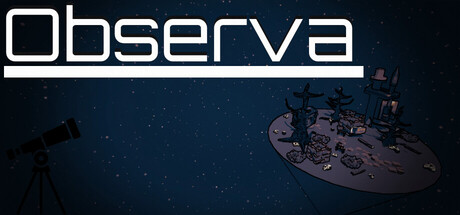
Alone on a floating island in deep space, you use your telescope to study the universe, capture what you find, and confront the growing sense that something out there is aware of you.
Modeled estimate, not a reported figure. How we estimate →
Media

About
Observa is a quiet space-photography game set on a small floating island suspended in endless darkness. You’re alone out here, with nothing but your telescope, a printer, and a silent sky full of things that shouldn’t always be there.
Point your telescope into the void. Search for planets, stars, drifting nebulae, and stranger objects that don’t have names yet. Capture what you find. Print your photos. Build up a gallery of discoveries that feel beautiful at first… and then start to feel like they’re watching back.
This world doesn’t tell you much. There’s no comforting voice guiding you, no busy city nearby, no hint of where “home” even is. Just quiet machinery, distant starlight, and the uneasy feeling that something out there knows exactly where you are. Somewhere in the darkness, something is moving. Something is coming. And you’re the only one who can see it getting closer.
Sell your photos, slowly improve your observatory, and expand what you can reach with your telescope. Not for power, not for glory, but because you need to understand what’s out there… and whether you have time left to escape.
Build your own gallery, fill it with proof of the universe around you, and decide whether your photos are comforting, or evidence of something you were never meant to witness.
Features
Capture astrophotography shots of stars, planets, nebulae, and unsettling cosmic phenomena
Explore a procedurally generated sky that feels vast, uncaring, and sometimes hostile
Build and curate your own gallery of discoveries
Sell prints to fund further exploration of the unknown
Atmospheric, lonely gameplay focused on discovery, unease, and the beauty of space
Genres
Stats
All-time low is the lowest price we've recorded for this game since we started tracking it.
Languages: English**languages with full audio support
Reviews
While a very short game, it's a neat one. I beat it in only 30 minutes but there are plenty of other celestial objects out there to discover. Funny that I was capturing images on my IRL rig while playing this. I wish real astrophotography was this easy!
[i]"Hungry, like stars are hungry."[/i] [b]tl;dr: This is a nifty little game that wins a lot of points for its atmosphere and sparse, sharp writing--that unfortunately suffers from a game-breaking bug.[/b] [hr][/hr] Where this game truly shone for me was in the writing, specifically the log entries you get for researching and cataloguing a new discovery. With the earliest / easiest discoveries, they start out fairly mundane, but as you upgrade your telescope and find rarer things, the writing starts to get under your skin, from [i]"Something did this. Recently."[/i] to a galaxy described as [spoiler]having a broken arm[/spoiler]. (I think the biggest disappointment for me here was discovering that, while you can view a record of all your discoveries, there's no way to revisit those little tidbits in the metagame catalogue. Dev, if you can add those, please do! I'd love to read them all side by side.) The art direction is equally as sparse and simple, but it does its job well. I can't tell you the number of times I stopped the telescope and went "what [i]is[/i] that?!?" Overall, the game is excellent at cultivating the sense that you're utterly alone in a dead or dying universe. And yet, at the same time, the feeling that there's [i]something out there[/i] - something your telescope can't quite capture - keeps tugging at your sleeve. As cosmic horror goes, it's fantastic. Loved it, and it's why my review is a recommendation despite what I'm about to say in the next paragraph. The audio does a lot of heavy lifting here too, from the quietly eerie soundtrack to the constant click-click-click of your telescope as you search the skies. Where the game stumbles is, unfortunately, with a show-stopper of a bug, where the photo copier stops working on a new run. This hamstrings your ability to generate funds and makes it impossible to reach the win conditions, and - worst of all IMHO - locks you out of the best telescopes and, thus, the best discoveries and the best writing. Resetting the game won't fix it; I had to wade into my UserData folder, find where the game stashed its save data, and wipe it all to resolve the bug. And this happened multiple times. If the dev can fix that issue, this is one I'd readily recommend as a sparse cosmic horror that punches above its weight and short run time.
A short fun game. A couple of bugs, bug nothing game breaking, and a fun, contemplative experience.
Exactly as advertised. I've only run once. Just made it, minutes to spare. Difficulty and vibe are the reason to be here and stay. Space....as usual, maybe some lights.... in unnatural places, well have to see.
Game is great, art style is awesome, there's a handful of janky bugs, but they don't make the game any less enjoyable. Very excited to see later editions of the game.
fun to mess around in for a little bit but the bugs start to pile up after a while :[ the photocopier completely stopped working for me a few minutes into starting the game, won't recommend buying in its current state unless you're prepared to deal with a lot of jank lol
Observa is a slow-burning cosmic horror experience that transforms the peaceful act of stargazing into something deeply unsettling. Developed by NorthRest Games, the title places players alone aboard a small observatory drifting through endless space, where the primary objective is simply to observe, photograph, and document celestial phenomena. What initially feels calming and meditative gradually evolves into an unnerving psychological experience as strange objects begin appearing in the darkness beyond the telescope lens. Instead of relying on traditional horror formulas filled with combat or nonstop jump scares, Observa creates fear through isolation, silence, and the terrifying realization that something incomprehensible may be staring back from the void. The atmosphere is easily the game’s greatest strength. From the moment the experience begins, players are surrounded by emptiness and silence broken only by subtle machinery sounds and distant cosmic ambience. The observatory itself is small and confined, creating a constant sense of vulnerability while the endless darkness outside stretches infinitely in every direction. At first, the process of scanning stars and photographing celestial objects feels relaxing, almost therapeutic. However, the longer players spend observing the void, the more unsettling the experience becomes. Tiny details begin to feel wrong, unfamiliar shapes appear where they should not exist, and the game slowly shifts from peaceful exploration into psychological paranoia without ever dramatically changing its core mechanics. The gameplay loop revolves around operating telescopes and observation equipment to discover and photograph unusual celestial objects. Players catalog planets, stars, anomalies, and strange cosmic formations while printing photographs inside the observatory to build a collection of discoveries. Captured images can be exchanged for money, which allows players to purchase upgrades and improve observational tools. The progression system is simple but surprisingly satisfying because every successful discovery contributes directly to expanding exploration possibilities. Searching the darkness for rare phenomena becomes oddly addictive, especially once the game begins introducing stranger and more disturbing discoveries. One of the most impressive aspects of Observa is how effectively it uses minimalism to create tension. The game never overwhelms players with excessive dialogue or exposition. Instead, it trusts atmosphere and implication to carry the horror experience. The fear does not come from constant danger but from uncertainty and the growing suspicion that the player is no longer alone in the darkness. Certain discoveries feel unnatural in ways that are difficult to explain, and the lack of direct answers makes those moments far more effective than traditional scripted scares would have been. Visually, the game embraces simplicity in a way that perfectly supports its themes. The observatory interior is intentionally limited and claustrophobic, while the surrounding void feels impossibly massive and empty. Celestial objects glow against complete darkness with striking contrast, making every new discovery feel mysterious and significant. Space itself becomes the source of horror because of how cold, endless, and indifferent it feels throughout the experience. The art direction focuses heavily on mood and scale rather than technical complexity, and that choice works extremely well for the game’s cosmic horror atmosphere. The sound design deserves enormous praise because it carries much of the emotional tension. Silence is used carefully and effectively, allowing small environmental sounds to become increasingly unsettling over time. Subtle mechanical hums, distant vibrations, and occasional strange audio distortions slowly build discomfort without relying on loud horror cues. Music is minimal throughout most of the experience, which makes moments where unsettling sounds emerge from the darkness feel significantly more impactful. The audio presentation constantly reinforces the feeling of isolation and vulnerability. The horror elements are handled with remarkable restraint. Observa avoids overexplaining its mysteries or fully revealing the nature of the strange phenomena players encounter. Instead, it relies on ambiguity and gradual escalation to create psychological tension. The game understands that cosmic horror becomes more effective when players feel insignificant compared to the unknown forces surrounding them. As increasingly bizarre objects drift closer into view, the fear comes not from immediate danger but from the realization that the universe may contain things humanity was never meant to witness. Despite its strengths, the game does have limitations. The most obvious issue is its short runtime. Many players will likely complete the main experience fairly quickly, which may leave them wishing for more expanded mechanics or additional narrative development. While there are optional discoveries and replay value through experimentation, the overall amount of content still feels somewhat limited compared to larger atmospheric exploration games. Gameplay depth is also fairly minimal. The photography mechanics and upgrade systems remain enjoyable throughout the experience, but they do not evolve dramatically over time. Players expecting advanced simulation systems or deep exploration mechanics may eventually find the gameplay loop repetitive. Observa prioritizes atmosphere over mechanical complexity, and whether that works will depend heavily on what players expect from the experience. There are also some small technical rough edges. Minor bugs and occasional interface inconveniences appear during gameplay, though they are generally not severe enough to ruin immersion. The game’s minimalist structure helps prevent these issues from becoming major problems, but additional polish would still strengthen the overall experience. Even with those shortcomings, Observa succeeds because it captures a very specific kind of fear extremely well. The game understands how terrifying space can feel when stripped of adventure and wonder, replacing those emotions with isolation, uncertainty, and existential dread. It turns passive observation into psychological horror through careful pacing and atmosphere rather than traditional horror tricks. For players who enjoy cosmic horror, atmospheric exploration, and slow psychological tension, Observa offers a memorable and haunting experience. Its combination of astrophotography mechanics, quiet isolation, and creeping paranoia creates an experience that feels strangely peaceful while remaining deeply unsettling underneath. Though its short runtime and limited gameplay systems prevent it from becoming a larger-scale horror adventure, the originality and atmosphere make it a standout indie horror experience that lingers in the mind long after the credits roll. Rating: 6/10
A nice little game, I barely made it with seconds to spare, then did another run or two. There's a good amount of jank, but the game is short enough that the bugs don't get annoying (imo).
Related
Related
Trends
Concurrent players on Steam, sampled daily since tracking started.
Momentum
Pace estimated from the game's recent review growth (our daily snapshots) at its own sales-per-review ratio — a momentum signal, not booked sales.
Related
| Blood Ties | $2K | 94 | 62% | $0.79 |
| Aeve:Zero Gravity | $2K | 141 | 23% | $0.69 |
| Tiny Robots Recharged | $2K | 111 | 77% | $4.99 |
| Juken Jigoku | 受験地獄 | $2K | 52 | 65% | $2.99 |
| Try to survive Today | $2K | 79 | 68% | $1.09 |
| Eron | $2K | 235 | 66% | $0.49 |
Related
| House Flipper | $65.8M | 110.8K | 94% | $24.99 |
| Spilled! | $1.1M | 5.2K | 94% | $5.99 |
| OZMAFIA!! | $754.3K | 605 | 80% | $34.99 |
| A Webbing Journey | $459.4K | 1.3K | 99% | $9.99 |
| My Little Blacksmith Shop | $418K | 1.2K | 70% | $9.99 |
| Caravanners | $308.9K | 802 | 40% | $10.79 |