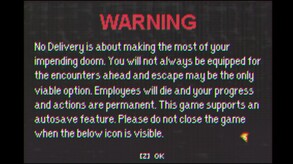
No Delivery is a procedurally generated CRPG, pizzeria simulator where you are the newest in a long line of employees for a local decrepit pizza parlor. Despite the rumors and shady history, you sign up for the night shift… Luckily, it’ll just be a boring job in an empty pizzeria… right?
Modeled estimate, not a reported figure. How we estimate →
Media

About
Stats
All-time low is the lowest price we've recorded for this game since we started tracking it.
Languages: English
Engagement
Hours played at review time, across 41 reviews with recorded playtime.
Reviews
Themes across 41 recent reviews and how positive each mention is. A keyword signal, not full sentiment analysis.
positive critical· bar length = how often the theme comes up
Reviews
No Delivery delivers, am I right? (Laughing track ensues.)
It's a game with good atmosphere, on a bad engine. The game just sometimes freezes since it's on an old version of RPG Maker. And there isn't anything you can do about it. That being said, the eerie setting is great despite not being overtly scary. It's not a game that will leave you shaking, but it leaves you with a constant sense of being unnerved that really works. Oh and it's a, narrative based game, with a bunch of spelling errors. Which is odd. The biggest reason I'm giving this a thumbs-up is that it has an option for people with visual impairments, which is great. Most games categorically refuse to do that, I'm looking at you Abiotic Factor, while putting in accessibility for every other problem in the world.
I played this right after playing "Sorry, We're Open" and enjoyed it a lot. Mechanically, I'd say this game is much better overall. I died more in this title than I did the former game, where I lost exactly 0 staff. I actually died a couple times in this one, but once you get specific items, it becomes very easy and breakable again. Overall though, the game is still very fun, with a neat setting and premise. The story and endings are a bit more confusing than "Sorry, We're Open" though. I get the overall lore and what happens in some endings, but the story as a whole, and some endings are very vague. None of them feel like they're supposed to be the 'canon' one either, which makes things a bit more confusing.
[b]Story:[/b] It's reasonably good, with layers of mystery. It's not exactly memorable, but I got 5 endings (I define ending when the game shows credit), but it feels like there's something I missed. [b]Gameplay:[/b] Exploring the pizzeria areas and discovering something new is somewhat fun, but I'm not a fan of roguelike mechanics. It's mostly balanced, but standard RPGMaker turn-based combat is too plain and I got bored after only an hour. [b]Visual/Audio:[/b] Both the pixel/VCR artsyle and the audio are fairly good. [b]Other:[/b] This game runs mostly well on my Linux device. But after playing for a few hours, the average FPS dropped and could only be solved by close and re-open the game. And on very few occasions, the text area doesn't show any text. No Delivery offers a unique blend of horror and rougelike using RPGMaker engine, although I would rather choose 'neutral' over 'positive' if such an option exists.
This is genuinely one of the best games I've ever played that immediately left me speechless on completion. Needs to be played to be understood.
Really great game. Lots of hidden content and funny gags. I highly recommend it and can't wait to try out more of the Dev's games. You may have to use a guide to find all the hidden stuff. Plays great on steam deck
Been a fan since it was released on itch. I wish the music wasn't taken out but otherwise a GOATED game.
I don't even know how to describe this game, it is an extremely surreal experience. But I HIGHLY reccomend the game
No Delivery, developed and published by oates, is an atmospheric indie horror RPG that transforms the familiar setting of a pizzeria into a surreal, unnerving descent into madness. Beneath its unassuming retro exterior lies a game that fuses psychological horror, roguelike mechanics, and cryptic storytelling into a singular, haunting experience. At first glance, it resembles a lighthearted job simulator, tasking you with working shifts at a struggling pizza restaurant. However, as you delve deeper into the nightmarish corridors and decaying side rooms of this establishment, it becomes clear that the job is far from ordinary. No Delivery uses nostalgia and simplicity as a disguise, concealing a deeply disquieting narrative about exploitation, decay, and the horrors that lurk behind a smiling mascot. From the moment the game begins, the atmosphere is heavy with unease. The pixel art and VHS-style visual filters evoke the look of an old, damaged recording, as though you’re watching a game that shouldn’t exist. The visuals flicker, distort, and occasionally blur in ways that make the world feel unstable. The pizzeria itself is both familiar and alien—an empty dining hall, a broken arcade, a flickering kitchen—all rendered in a style that recalls retro RPGs but tainted by grime and static. There is something inherently wrong about everything you see, yet the game rarely resorts to outright jump scares. Instead, it cultivates dread through absence, through the quiet moments between actions where the player feels most exposed. The sound design amplifies this tension with distant hums, looping background noises, and unsettling silences that stretch longer than they should. When the music does emerge, it often feels dissonant or warped, enhancing the dreamlike quality of the experience. The core gameplay combines elements of traditional turn-based RPG combat with roguelike progression. You play as an employee navigating shifts and “Wrong Turns,” which function as procedurally generated dungeons. Each shift presents a new layout filled with hazards, strange NPCs, and cryptic objects that hint at the pizzeria’s sinister secrets. Combat encounters play out through a familiar turn-based system, but resources are limited, and every action feels consequential. Characters can die permanently, and losing one means hiring a replacement to continue the job. This mechanic reinforces the game’s themes of disposability and corporate dehumanization, as employees are treated as interchangeable assets rather than individuals. The system creates a subtle form of tension that goes beyond traditional horror—every decision carries weight, not because of fear of a monster, but because of the cost of survival in a system designed to consume its workers. Exploration in No Delivery is equally compelling and unnerving. The pizzeria serves as both a hub and a labyrinth, filled with locked rooms, strange machines, and hidden areas that only reveal themselves after multiple playthroughs. The “Wrong Turns” serve as excursions into nightmarish distortions of familiar places, where enemies and scenery morph into grotesque versions of normal life. These sequences are not only the game’s combat arenas but also narrative devices, representing the deeper psychological rot beneath the pizzeria’s cheerful surface. Each new area feels like peeling back another layer of a corrupted memory. The writing leans heavily on implication rather than exposition, leaving players to piece together the fragmented story through item descriptions, environmental clues, and strange encounters. This lack of explicit direction can feel disorienting, but it also invites curiosity and engagement. The more you explore, the more you sense that the horror isn’t just about what’s happening inside the restaurant—it’s about what the place represents. The game’s retro aesthetic works to its advantage, bridging nostalgia with discomfort. The low-resolution sprites and dim lighting create a claustrophobic sense of place, while the VHS overlay adds an uncanny authenticity, as if the game itself were an artifact from a forgotten era. Every detail, from the flickering neon signs to the looping animations of mechanical mascots, contributes to the sense of unease. There’s a deliberate contrast between the cheerful, colorful branding of the pizzeria and the decaying reality of its interiors. It’s a visual metaphor for the way the game presents its horror—not through overt violence, but through the rot that festers beneath a smiling façade. The attention to aesthetic detail is remarkable, and it captures a kind of analog dread rarely seen in modern horror games. Mechanically, No Delivery rewards patience and experimentation. Because much of the game’s content is hidden behind procedural generation and player choice, no two playthroughs feel exactly the same. There are multiple endings, secret areas, and subtle variations that only reveal themselves through repeated exploration. Some runs might feel manageable and even optimistic, while others descend into complete chaos, with new enemies and corrupted spaces replacing familiar ones. This replayability gives the game a sense of mystery that persists long after completion. At times, however, this design can feel opaque or even frustrating. The lack of clear guidance, combined with the game’s intentionally cryptic systems, can make it difficult to discern how to progress. Yet this ambiguity feels purposeful—it mirrors the confusion of the protagonist and reinforces the feeling of being trapped in an environment that refuses to make sense. Thematically, No Delivery goes beyond surface-level horror to explore the dehumanizing effects of modern labor and consumer culture. The endless cycles of work, replacement, and failure reflect a grim satire of corporate life. The pizzeria becomes a microcosm of a system where human effort and identity are consumed in the pursuit of meaningless productivity. Even as you succeed, the game constantly reminds you that your victories are temporary and your survival inconsequential. This undercurrent of existential dread gives the game a philosophical weight that elevates it above standard horror fare. It’s not just about monsters or jump scares—it’s about the quiet horror of being trapped in an unending loop of expectation, failure, and erasure. No Delivery is a haunting and unconventional experience that challenges the boundaries of what an RPG can be. Its blend of psychological horror, surreal world-building, and roguelike mechanics creates an atmosphere that is both deeply unsettling and strangely compelling. It’s a game that doesn’t explain itself easily, demanding players engage with its mysteries on their own terms. Though it may frustrate with its opacity and rough edges, these imperfections contribute to its authenticity and charm. For those willing to embrace its strangeness, No Delivery offers a truly original exploration of fear—not the fear of the unknown, but the fear of familiarity twisted into something grotesque and unrecognizable. It’s a modern cult classic in the making, a surreal nightmare that lingers long after the credits roll. Rating: 8/10
Cool little game, not too long or complicated. Everything fits together nicely. Only real criticism is you should be able to pick your class as I played through the whole game and only played 3/4 of the classes, only getting the last class with my last character. Otherwise, neat game.
Related
Related
Trends
Modeled estimate over time, reconstructed from Steam's monthly review histogram.
Momentum
Pace estimated from the game's recent review growth (our daily snapshots) at its own sales-per-review ratio — a momentum signal, not booked sales.
Audience
Estimated from the language of this game's reviews — a proxy for where players are, not official Steam demographics.
Related
| NitroRage | $7.9K | 83 | 47% | $4.99 |
| DARK FABLE | $7.9K | 143 | 59% | $2.99 |
| Mythos: The Beginning - Director's Cut | $7.9K | 52 | 73% | $5.99 |
| WeakWood Throne | $7.9K | 78 | 59% | $4.99 |
| Jack N' Jill DX | $7.9K | 78 | 94% | $4.99 |
| Masked Forces 2: Mystic Demons | $7.9K | 78 | 76% | $4.99 |