Save the Imperial Capital from supernatural invasion in a 90s-style adventure that uses real deduction and research skills. Explore Tokyo, snap photos and analyse evidence for 40+ landmarks, from prehistory to the present. Confront a cast of wandering spirits to separate truth from fiction.
Modeled estimate, not a reported figure. How we estimate →
Media

About
In Mysteries of Old Tokyo, you’re the brand new investigator for the Tokyo branch of the secretive Rare Items Acquisitions Ltd. Puzzle your way through 11 chapters that each explore a different aspect of the city's history.
Mysteries of Old Tokyo is inspired by the CD-ROM "multimedia experiences" of the 1990s like Encarta '96 and Cosmology of Kyoto, as well as modern detective games like The Roottrees are Dead and the Golden Idol series.
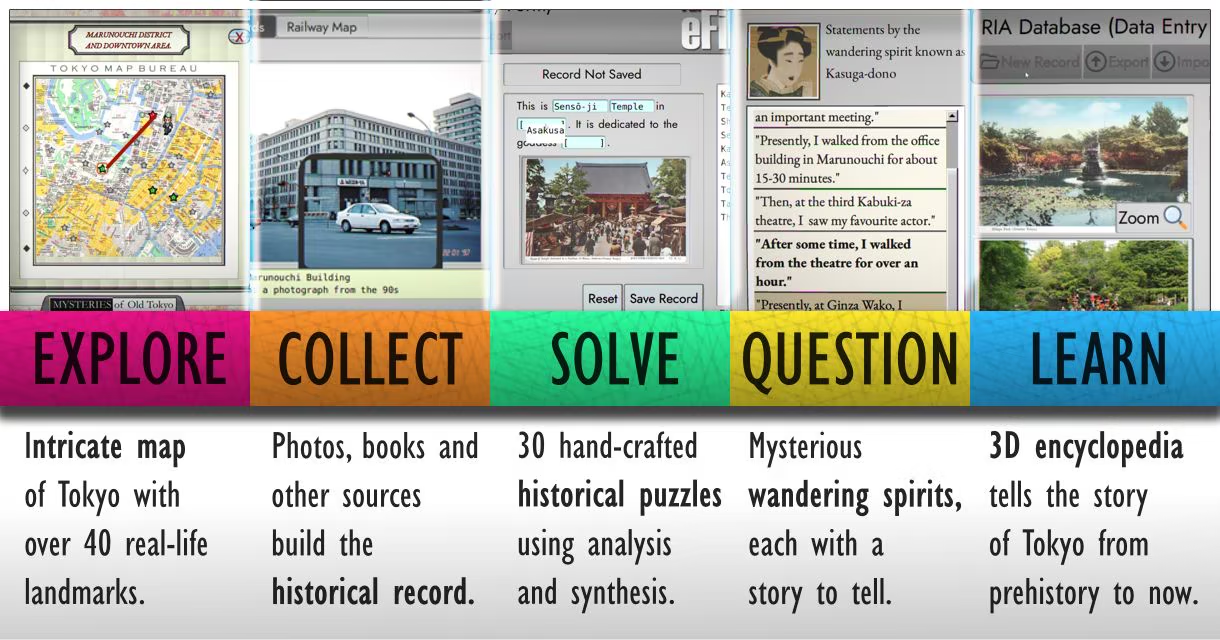
You’re a historian now! 30 hand-crafted puzzles explore the fascinating history of the Imperial Capital. Each week, you'll explore three new locations based on a 1930s postcard:
Take a photo to show the present day view at the very same spot.
Collect evidence linked to the site: books, magazines, maps, paintings, archive photos, and more.
Use analysis and synthesis to build the complete picture from multiple sources, just like a real historian.
Extract words to correct the historical record in "fill-in-the-gap"-style gameplay.
Why did the Forty-Seven Ronin kill [ ]?
Why is [ ] vital to the spiritual defence of the entire city?
What became of the Three Human [ ]?
Analyse your photos to compare the changes between the 1930s to the 2020s.
You’ll fill in the gaps for each postcard and help your mysterious employer create a detailed database of Tokyo’s history, all based on real historical sources.
You won’t be alone as you explore Tokyo. A supernatural dam has burst, spilling confused ghosts from the Iron Age to the 1980s across the city. As they tell their stories, not everything they say will add up.
Encounter spirits of the "Edokko" ("children of Tokyo") at new and old locations as you explore the city.
Build up their story bit-by-bit in the Spirit Report.
Explore 15 hand-crafted narratives each telling the story of a single day in Tokyo's long history.
Use the Encyclopedia and your personal experience of Tokyo to identify the errors and lies.
Chigau! I object! J'accuse! Highlight the inconsistencies and catch them out to help them clear up their memories.
Each time you submit a Spirit Report, you'll build up trust with the spirit and unlock more of their backstory, based on the real lives of the Edokko: there are five uniquely-written spirits to meet, from flirty courtesan Kasuga-dono to bubble-bound salaryman Yoshida-san.
After you finish the main storyline, continue playing in the post-game to unlock all 15 narratives and character stories.
You're not just a desk jockey. Each week, with PDA and digital camera in hand, you’ll set out from your office to visit three new locations.
Go by foot or by train from your home base in Marunouchi to view each postcard in its real-world geographical context across four maps: Central Tokyo, Downtown Marunouchi, Tama River and Haneda.
Discover each location using your PDA Directory and a nearby station's Location Board.
Revisit old haunts based on paranormal analysis to discover new stories for the Spirit Report.
Plot a route to some of the most famous Tokyo landmarks:
Ginza
Asakusa Sensō-ji Temple
Ueno Station
Shinjuku Street
Haneda Airport
Meiji Shrine
And many more!
Unlock new evidence by visiting special points around the map.
Use the Similarity Finder to precisely line up present-day photographs with the original postcards.
With the Time Loupe in Direct Mode, compare past and present and identify common features.
In Parallels Mode, tease out the tiniest similarities in views that have changed almost completely since 1935.
And in the Treasure Browser, unlock ten hand-crafted artefacts in glorious 360 degree 3D, each telling their own story of the Imperial Capital: from a "Galapagos phone" to a samurai sword.
For lovers of Tokyo, this might just be the most authentic interactive recreation ever made.
Painstaking research reveals the history behind a set of antique 1930s postcards, discovered at a flea market in Shibuya and scanned in high quality.
Each postcard is complemented by the original description, human-translated from Japanese for the first time. Illustrations, modern-day photographs, and an author's commentary provide the full picture.
From Akabane to Zoshigaya: Ride the rails on a meticulous recreation of 18 real-world train lines and over a hundred stations in Tokyo.
Go back in time with a complex four-dimensional map of Tokyo's transit, covering every year from 1872 right up to the present day.
Hundreds more Tokyo locations in the landmark database, visited by mysterious spirits, from the Imperial Hotel to the Tokyo Skytree.
A huge encyclopedia based on extensive research, telling the whole story of Tokyo from prehistory, through the Edo period, to the 80s bubble and beyond.
Ancient fortresses crumble. Long-forgotten spirits flood the city. A powerful supernatural force threatens to upend the everyday lives of Tokyo’s 14 million residents. Each week, as you unlock more postcards, you’ll uncover more of the backstory with interludes and FMV cinematics, and ultimately save the city.
Genres
Stats
All-time low is the lowest price we've recorded for this game since we started tracking it.
Languages: English
Engagement
Hours played at review time, across 41 reviews with recorded playtime.
Reviews
Themes across 41 recent reviews and how positive each mention is. A keyword signal, not full sentiment analysis.
positive critical· bar length = how often the theme comes up
Reviews
Finally, a game that combines the autistic need to point out the flaws in people's arguments with the autistic need to hyperfixate on a subject like the history of Tokyo (and its railway system.) There seems to be some symbol/text issues on the Steam Deck for some location names but it works great on the Deck otherwise.
I previously played the demo and enjoyed it, so I was looking forward to getting this game when it released fully. Having done so, I am happy to say that it retains everything about the demo I enjoyed and then some. You can learn a lot about Japanese history and the story of the city of Tokyo that you would've never otherwise heard, and the game is very accessible while simultaneously not holding your hand all the way through. I found myself sad about the demolition and disappearances of buildings and places I hadn't even heard of before playing the game, and I became deeply invested in the narrative and the stories on display. The puzzles, while mechanically simple, can actually get pretty challenging and really tests your reading comprehension and ability to cross-reference the information you're given. My only criticism at the moment would probably be the decision to remove the stamina system: I felt like it was a good incentive to use the train lines and really plan your route rather than just walk from Point A to Point B all over the map. I still prefer to use the train lines wherever I can but since they cost money while just walking costs nothing it feels a bit like kneecapping myself. Otherwise I highly enjoyed this game and I strongly recommend it to those seeking a relaxing and educational puzzle game.
[h2]Є пам'ятки, про які не говорять[/h2] "Загадки старого Токіо" порівнюють сьогоднення з листівками з 1935, де сухі факти, легенди та приватні листи поєднуються в інформативному тексті. Гравець має заповнити пробіли в цьому тексті: десь легше, десь важче, десь більш логічно, десь треба вказати напрямок, куди дув вітер. Для різноманіття також є лінія духів, в якій треба дізнатись, що саме в їхній історіях є неправдою. Оформлення гри, ніби користуєшся старим софтом, є ностальгічним для тих, хто з ним знайомий, та незвичним для тих, хто бачив win95 лише у фільмах. Хоча для людей, які постійно працють з академічними та старими базами даних, такий софт — це буденність. Привіт, альма матер. Я би назвала цю гру інтерактивним гайдом по популярних і не дуже місцях Токіо. Якщо хтось планує туди поїздку або має слабкість до Place Japan, то це гарний ознайомчий довідник. Як бонус через ігрові механіки легко запам'ятовуються основні станції метро та шлях до них. [b]Важливо суб'єктивно! [/b] Інколи забагато тексту, тому за одну сесію важко виконати більше одного "тижня" завдань (усього в грі 11 тижнів). Проте гра дуже лагідно розслябляє мізки після робочого дня. [b]Важливо об'єктивно! [/b] Аніме немає. Згадка Такеші Кітано є. Найсу! Українська відсутня — не найсу — але тут в принципі тільки англійська доступна. Рівня B2 вистачить.
A pretty chill retro-styled edutainment experience (with a dash of supernatural), with the main focus being on early 20th century Tokyo. Core gameplay loop involves going through article excerpts and cross-referencing information, so some bare minimum reading comprehension skills might be necessary!
Very interesting game about the transformation from Edo into modern Tokyo. The game is revolving around a collection of postcards of Greater Tokyo made in the 1930s. It explores the locations of the cards trough historical events that transpired there or accounts of people and newspapers describing the surroundings. The game is a puzzler that makes your internal compass freak out at times trying to piece together where in gods name a certain place is somewhere out of view. It is very rewarding to get that green button to appear on the first try after reading trough the all the texts completeley 3 times over and looking at every pictures' miniscule details. And the puzzle at the end of the "week" gives you an interesting story to send you back in time showing how people and standings havent changed all that much. The menus are very nicely themed to fit right into that 1930s aesthetic but also feature some 2000s flavourings making it feel like you really are in a office of an unknown to the public organisation stuck some 20-30 years behind in tech. Altough to some it may feel repetetive, I find reading trough those documents and notes a very soothing and rewarding as I do this kind of digging trough different sources and linked themes on the daily and I think that every person used to dive into deeep rabbit holes that take hours will like to have a handcrafted directed rabbithole search with some collectibles scattered along the way(which also have massive texts attached to them). I am sure there is also alot of nuance and symbolysm that I am missing but I digress... The game deserves alot more attention seeing how its an interesting take on a puzzler.
Not my usual type of game but I enjoyed it throughout. I've learnt more about Japanese history through this game than I was expecting. Even some of the evolution of the Tokyo railway has been engraved into my mind. I am someone that does love harder games and some of the later puzzles in this game really are tricky and make you think. However, I did play the demo version of the game and it did used to have a stamina system involved and I wish that was still in the game just to make you think about your travel around the city a little bit more. All in all, a great little game and I am looking forward to any future updates and possible DLC.
This is a gamified [i]Microsoft Encarta[/i] or a [i]Cosmology of Kyoto[/i]-like, and it's great. The text you read clearly comes from someone who is passionate about Japanese history and is willing to get into some of its more divisive aspects. I was surprised to see a decent overview on Mishima Yukio's life for example. I do think the puzzles are too simple for my taste, and the gameplay loop can be too repetitive. But I really enjoyed the game, and I want to see more content for the game (maybe a future title exploring my favorite city, Osaka, perhaps?). It's exciting to play an edutainment game that is actually entertaining. Highly recommended if you want to know more about Japanese history or just enjoy learning something new.
Updated Update: I recently played a much worse game and I thought about this one, and while I stand by everything in my review, I think I would probably recommend this now. It’s a mess and it’s going to be a struggle for me to pick it up again, but that’s probably because I have the literary palate of a 12 year old and not really a failing of the game. I just kept thinking about those darn cursed postcards holding the developer hostage. I think for a debut game and a solo developer, this is definitely a game of all time, with a beginning, middle, and end. Anyway, if you like non-fiction fiction and (1) trains or (2) postcards or (3) Tokyo, you’ll enjoy the first level which is as far as I got. Bob help you if you like all three things you will lose your mind. Update: Adjusted review to reflect that some of the design choices I thought were negligent were actually intentional, per Developer note. Game is a DNF and I can’t really recommend it as an investigation game or as a supernatural game. It’s not objectively *bad* but it is not what I was sold, the very light narrative driving it is not engaging, and it lacks polish. That being said, if you’re super into Tokyo or you’re a crazy weeb that thinks they’re super into Tokyo, definitely grab it. What I’ve gathered from devlogs is the developer was possessed after acquiring some cursed postcards that show photos of neat places in Tokyo and now he can’t leave Tokyo until someone else accepts them voluntarily, so he made this game. Despite its supernatural origins and the store page’s ad copy, this isn’t really a game about saving Tokyo from ghosts. This is a game about how cool the postcards and trains in Tokyo are. The research that went into studying them is…intense. I agree that the postcards and trains are cool but this is a lot and it doesn’t add as much to Mysteries as it could have. Red Pearls of Borneo is another fill-in-the-blank game with supernatural elements that is fueled by the same level of intense research. There, I was hooked by the story and there was some *reason* to keep going (getting all the hot gossip). The historical research was a lens for me to see the world as it was, in a place I know nothing about. Here, the historical research is the point, which made me feel like I was gathering information that ultimately went nowhere. The developer was dedicated enough to actually go out to all the postcard locations and get current photos in person, which is a level of investment you really don’t see in indie games because indie game developers are depressed bridge trolls that don’t want to leave their hovels while they code and badger their artists. This makes the game’s rough edges all the more tragic. I understand the developer was going for a particular aesthetic from the era where cocaine flowed freely through software and game developers’ offices and computers still had floppy disks that weren’t floppy anymore. I accept that and see the design for what it is. I was really disappointed by: [strike] What I can never get behind is (1) yellow font color for any reason (2) drop shadows on text for any reason [/strike] (3) completely phoning it in on button design and the “boring” parts of the UI (settings menu, notes button, etc) (4) like seven different interfaces to juggle for a straightforward task, none consistent with each other, and most with no explanation of their purpose before they’re just there (why do I have coordinates or a time slider on photos on Day 1???) (5) an absolutely wild disregard for basic proofreading (6) the ability to zoom in some places but not others (sorely needed on the map, I can’t see anything on it) [strike] (7) a fake feedback button that just opens a popup with a link to a discord server, (8) dubious combinations of fonts, sometimes four or five different ones that don’t complement each other on the same page, and many other issues that are relatively minor on their own, but together just make me step back and wonder how this made it through a pretty extensive demo testing period without getting raked over the coals. This developer badly needed a reality check (and still does) on typography, UX, and editing.[/strike] Developer needs to hire a proofreader and work on UX. I am loathe to DNF a game but I really just have such little interest in non-fiction entertainment, and Mysteries does little to keep me interested, so try as I might I can’t force myself to go through the motions of completing it. Maybe another time.
While Mysteries of Old Tokyo is not what we typically think of when we hear the term "Immersive Sim" i found the descriptions of the weather, the places, the people and the emotions extremely well executed and really well underlined by the music and soundscapes. It's a mystery puzzle game that lets you really dive into the cityscape and its history! My favorite little thing about the game is the "www" button that sends you to a japanese site about whatever you're looking at rn. It is absolutely wild that this is a single person dev effort and I feely very honored to have been able to help playtest this game!
Fun and interesting puzzle game with a great atmosphere!
Related
Related
Trends
Concurrent players on Steam, sampled daily since tracking started.
Audience
Estimated from the language of this game's reviews — a proxy for where players are, not official Steam demographics.
Related
| Wait - Extended | $8.6K | 57 | 89% | $7.99 |
| Tyran | $8.6K | 66 | 44% | $5.99 |
| Sugar Lust Harem | $8.6K | 50 | 92% | $9.99 |
| Inspector Waffles Early Days | $8.6K | 50 | 100% | $9.99 |
| Dragon Maiden: Blossoms of the Past | $8.6K | 65 | 78% | $6.99 |
| The Dark Legions | $8.6K | 174 | 86% | $1.99 |