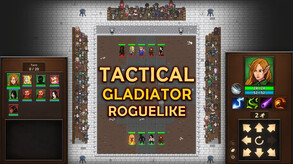
Manage a team of traveling gladiators in this turn-based fantasy roguelike. Find the best recruits, discover powerful item combinations and come up with clever tactics on the battlefield. The tournament awaits those who desire MORTAL GLORY!
Modeled estimate, not a reported figure. How we estimate →
About

Roll an explosive barrel at your enemy, throw them into a pit or take out two enemies by knocking them into each other. With a wide variety of tools available to you, your creativity will determine how you deal with the competition. Unique arenas, randomized environments and occasional special rules ensure that each fight offers new tactical opportunities.

A wide variety of fantasy races are seeking glory, each with their own unique racial strengths. Whatever your tactics are, finding the best recruits is essential!

There is a vast collection of unique relics, character perks and more to discover. Finding clever combos and deadly synergies will unlock new strategies and occasionally turn your gladiators into unfairly strong demons.

Various difficulty settings will accommodate your preferred playstyle and there are increasingly harder challenges to master. But beware... The AI is brutally talented at the highest levels.

With every step comes a new challenge or perhaps... an opportunity? It is up to you to guide where your team should travel next... and suffer the consequences.

Each playthrough is different! With various tactics to try and additional increasingly harder challenges to master, the arena will keep welcoming you back again and again. Thanks to conveniently paced combat, Mortal Glory 2 is also great to play if you only have a moment to spare.

Genres
Stats
All-time low is the lowest price we've recorded for this game since we started tracking it.
Languages: English*, French*, German*, Finnish*, Japanese*, Korean*, Simplified Chinese*, Turkish*, Portuguese - Brazil**languages with full audio support
Engagement
Hours played at review time, across 40 reviews with recorded playtime.
Reviews
Themes across 40 recent reviews and how positive each mention is. A keyword signal, not full sentiment analysis.
positive critical· bar length = how often the theme comes up
Reviews
7/10, or 5/10. Judged as a standalone game, this is a fun little roguelike gladiator game. 7/10 As the sequel to Mortal Glory 1, this was 1 step forward, 2 steps back. 5/10 Let's start with the game itself. The game itself was enjoyable, and distinguished itself from bare minimum gladiator games and many other gladiator games (including Mortal Glory 1) by having a wide array of environmental objects you could interact with, alongside abilities and items specifically geared towards environmental objects. The variety of abilities and items, while not at all unique or anything, was quite well done. Players can have hours and hours of fun with this. Reaching higher Glory levels seems like just grinding more of the same, but I can let it slide. Now we get to the comparisons. The environmental objects and the strategies around them were an improvement on the previous game, as was the additional item slot and the separate ability slots for racial abilities and abilities granted by items. So that was good. But somehow, the original game "felt" more like a roguelike than this game, which actually is a roguelike with path choices and all. A key aspect of roguelikes with path choice is that you can see what lies on each path, and you can feel like your choices mattered. The original let us choose which fights we wanted to take, and each fight came with different rewards, different restrictions, different special rules, and different bonus objectives, not just different opponents. We got to make a choice every time we picked a fight. MG2 has none of that. Occasionally, you'll get to choose between "fight", "elite", "shop", and "unspecified event", but you have no idea what exactly you were choosing or skipping. You're more or less just given your opponents, and you can choose whether to take the challenge or not. Speaking of restrictions, special rules, and bonus objectives, the original had all 3 and they were fun to play around and also added variety to the gameplay. MG2 kind of merged special rules with bonus objectives into "optional handicaps", and without the ability to scout ahead and choose different fights, it became just a "yes/no to extra hassle for extra loot". Being able to access shops and recruitment stations at any point (MG1), not just at designated shopping areas (MG2), also felt more convenient and I didn't find gameplay value in making players wait, especially when there was so little to choose from when the shops did come up. MG1 was better. There were several other changes which I am neutral about. I don't think they made the game worse, but I don't think they made the game better either. So in conclusion, 7/10 if judged by itself, 5/10 if judged as a sequel to Mortal Glory 1. The first game was better and cheaper, so my recommendation is to just buy that one instead.
(っ◔◡◔)っ ♥ Fight with fun ♥
Like MG, MG2 is a turn-based gladiator style of game. You may eventually have a team of up to four toons, each equipped with skills and equipment granted at level-up or gained through battle. The big change from MG seems to be the addition of a StS node-based system of progression through three areas. After each battle, you are awarded some loot (more if you took the harder version of the fight) and some experience. At level-up you have the choice to add a skill or increase a variety of stats. The run ends after you lose twice in a given area or after you beat the third boss. Pros: +++ Event-based dialogues contains no randomness and show you the consequences of your choices, as my personal preference is not to layer random outcomes on top of a random event. +++ The option to take a harder fight for better loot is appreciated and does add to the strategic aspect of the run. ++ Level-ups are fun and meaningful. ++ Game mechanics (buffs/de-buffs) are unspectacular, but solid. ++ Tactical play is still strong (as it was in MG). + Equipment is fair. Cons: -- Game is way too hard at highest difficulty levels. It took me ~10-15 tries to beat "10", and then I realized that there is an 11. -- As with many games where you gain characters as you go, the toons you buy later are almost always better than the ones caringly leveled-up from scratch. This makes me feel like I am not so much progressing as just buying a team. -- Replayability is limited as the artifact pool isn't so deep and doesn't have near the passive effects of relics in StS. Summary: While I haven't done a deep-dive comparison, my impressions of MG2 aren't much different than those of MG. The added node-system is appreciated, but much like MG, ultimately I don't really have any reason to keep playing, despite the fact that I am not really bored with the game (as such). The difficulty is crushing at level 11, past the point of fun, and there is no real run-to-run diversity in terms of gameplay. Still, I got some good time out of MG2 (not quite my time shown as I often leave my games open and unattended for hours on end) and is pretty cheap. I guess if you liked the first one, you will like this one (just wait for a sale, of course). Overall: 7.0/10
Nice... I bought it with the DLC. Lots of variety to make every run feel different. You have to analyze what the enemy does in order to win the rounds... Thumbs Up! :)
1591 hours in - near perfect game. Brutally unfair in all the right ways
I didn't play the first game but I'm really enjoying this one. it's like a more easily digestible Tales of Maj Eyal
If only there was excessive gore to simulate a furry getting punched 44 spaces irl....
Fun little arena tactics game. I'll recommend it at full price, but I also want to list a few gripes I had that may color your experience as well: The individual runs are a bit too long for me. I have about 17 hours played and that was only 4 runs (3 normal wins with the tutorial run being a loss on the last phase.) Also, your run isn't saved in the cloud, so if you start on your desktop and want to finish on a different device like your steamdeck later, you're going to have to transfer the files manually. With each run being 3-4 hours for me, this was pretty inconvenient. Lastly, I didn't feel like there was much room for build variety. You could do it, in theory, but loot was just too random to ever make something truly different from "everyone does a lot of damage in one turn". Whenever I did manage to build a fun character it was purely luck of the draw. The units were also pretty interchangeable. A level 1 Gnome and a level 1 Minotaur could basically be the same thing by level 4, minus the racial ability, but you can choose to outright ignore those since most are not spectacular to begin with. Even the fun in the randomness was drained a bit just because there seems to be nothing separating stats, skills, or items other than rarity. The most egregious example for me was a perk that I took that would replace any skill I used with a random one after I used it. I ended up having 2 spells that needed a minion to be summoned (which I never got) and 2 that were just heals that would end your turn. Just by percentages, you are destined to get a few skills that you'll either never want to use or simply can't use. All that ranting aside, I still enjoyed Mortal Glory 2. It just felt like I was enjoying myself despite the game instead of with it sometimes.
One of my fav games love it. Great turn based game.
Mortal Glory 2, developed and published by Redbeak Games, is a turn-based tactical roguelike that refines and expands upon the foundations of its predecessor while maintaining the series’ core identity: brutal gladiatorial combat driven by smart decision-making and high replay value. Set in a fantasy world where warriors fight for fame and survival in deadly arenas, the game places players in the role of a manager and tactician, assembling a team of gladiators and guiding them through a branching sequence of encounters. While its premise is straightforward, the depth emerges from its layered combat systems, character synergies, and roguelike progression structure that rewards experimentation and long-term mastery. At its core, Mortal Glory 2 revolves around compact, grid-based turn-based battles where positioning, timing, and ability synergy are far more important than raw numerical strength. Each gladiator brings distinct traits, active skills, and passive bonuses to the battlefield, encouraging players to think carefully about team composition. Some fighters excel at absorbing damage and controlling space, while others specialize in high burst damage, ranged attacks, or status effects. Success hinges on understanding how these roles interact. A well-timed stun or area attack can turn the tide of battle, while poor positioning can lead to swift and punishing defeat. The combat is fast-paced for a turn-based game, with encounters designed to feel decisive rather than drawn out. One of the most notable improvements over the original game is the addition of a structured progression map reminiscent of modern roguelikes. Instead of simply moving from one fight to the next, players choose their path through a branching series of nodes that include battles, shops, events, and special encounters. This structure introduces meaningful strategic planning outside of combat. Deciding whether to take on a risky elite fight for greater rewards, visit a shop to improve equipment, or trigger a random event adds layers of tension and agency to each run. These decisions accumulate, shaping the strength and flexibility of your team as you approach increasingly difficult encounters. Character variety plays a central role in the game’s replayability. Gladiators come from different races and archetypes, each offering unique abilities and playstyles. As players progress, additional traits, relics, and modifiers unlock, allowing for increasingly creative builds. Some runs may revolve around stacking defensive synergies and counterattacks, while others lean into aggressive burst strategies or status-effect stacking. The interplay between relics and character skills can produce powerful combinations, and discovering these synergies is one of the most satisfying aspects of the game. While some abilities may feel similar in function, the cumulative effect of multiple systems interacting ensures that no two runs feel identical. The game’s presentation adopts a clean and functional pixel-art style. The arenas are simple but readable, with clear visual indicators for movement and attack ranges. Character sprites are distinct enough to communicate their roles without overwhelming the screen. This emphasis on clarity supports the tactical nature of the gameplay, ensuring that players can quickly assess the battlefield and plan accordingly. Audio design complements the experience with impactful sound effects and restrained music that enhance tension without distracting from strategic focus. Mortal Glory 2 does not aim for cinematic spectacle; instead, it prioritizes usability and responsiveness, which are crucial in a strategy-driven title. Replay value is arguably the game’s strongest feature. Randomized encounters, varied enemy compositions, and numerous unlockable upgrades ensure that each run presents new challenges. The difficulty curve gradually increases, and optional modifiers allow players to tailor the experience to their skill level. Whether pursuing a relaxed strategic session or tackling higher difficulty settings for a greater challenge, players have room to adjust the intensity. This flexibility makes the game accessible to newcomers while still offering depth for veterans of tactical roguelikes. However, Mortal Glory 2 is not without minor shortcomings. The narrative framework remains minimal, functioning primarily as context for the arena battles rather than a fully developed story. Players seeking rich world-building or character-driven storytelling may find the focus heavily skewed toward mechanics. Additionally, while the systems are layered, the visual presentation remains relatively understated, which may feel modest compared to more elaborate strategy titles. Some abilities and perks can also appear incremental rather than transformative, though the broader system synergy often compensates for this. Ultimately, Mortal Glory 2 succeeds by doubling down on what makes turn-based roguelikes compelling: strategic depth, meaningful choices, and high replayability. Its refined combat mechanics, expanded progression system, and wide array of character builds create a rewarding tactical sandbox that encourages experimentation. By balancing accessibility with complexity, Redbeak Games has delivered a sequel that feels both familiar and evolved. For players who enjoy thoughtful positioning, team optimization, and the thrill of overcoming escalating arena challenges, Mortal Glory 2 offers a satisfying and enduring strategic experience. Rating: 8/10
Related
Related
Trends
Modeled estimate over time, reconstructed from Steam's monthly review histogram.
Momentum
Pace estimated from the game's recent review growth (our daily snapshots) at its own sales-per-review ratio — a momentum signal, not booked sales.
Audience
Estimated from the language of this game's reviews — a proxy for where players are, not official Steam demographics.
Related
| 夏目友人帳 ~葉月の記~ | $119.2K | 114 | 86% | $49.99 |
| Stairs | $119.2K | 363 | 70% | $12.99 |
| Warp | $119.2K | 425 | 67% | $9.99 |
| Stone Simulator – Just Be a Rock | $119.2K | 1.7K | 95% | $2.24 |
| Unfair Flips | $119.2K | 2.5K | 89% | $1.99 |
| Strategic Command WWII: War in the Pacific | $119.2K | 118 | 88% | $27.99 |