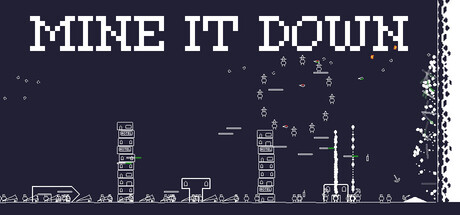
Mine It Down is an incremental game about mining an evil wall inspired by other games like (the) Gnorp Apologue and Tower Wizard. Chip away at the wall with the mouse first, hire masons to work that rock and build different buildings to grow your rock-destroying arsenal.
Modeled estimate, not a reported figure. How we estimate →
Media

About
Mine It Down is an incremental game about mining an evil wall inspired by other games like (the) Gnorp Apologue and Tower Wizard.
Chip away at the wall with the mouse first, hire masons to work that rock and build different buildings to grow your rock-destroying arsenal.

Do whatever it takes to Mine It Down!
Genres
Stats
All-time low is the lowest price we've recorded for this game since we started tracking it.
Languages: English
Reviews
The main objective in this idle/clicker game is straightforward. You chip away at a massive wall by clicking on it. Each click knocks loose a small stone that tumbles down to the bottom, where workers collect it. Those stones are the backbone of your economy. You can hire gatherers from the building closest to the wall, but you also need enough houses to accommodate them. New building options appear to the left of the wall, and these are preset so you can’t choose. Most of the available structures are houses, while the rest are buildings designed to hire workers who actively help destroy the wall. The first type is pickers, who throw pickaxes at the wall, followed by ballista operators who fire massive arrows, and then you unlock a few more. There are only a handful of structures so there’s not a lot of variety. These wall breakers work constantly, but they have an important limitation. After every attack, they must return to their house to restock ammunition before heading back to the wall. Since all buildings expand to the left, this means later workers often have a long walk back and forth, which directly affects efficiency. This is where upgrades come into play. Investing in larger houses early on is usually a smart move, as bigger houses attract more people. Houses are also essential for unlocking additional building options, making them a key part of long term progression. Once housing is stable, attention shifts to gatherers. You can improve their speed, increase how much they can carry, and enhance other efficiency related stats. Upgrade costs increase with each purchase, but the max upgrade limit rarely shows up because of the high cost of later upgrades. After the basics are established, the gameplay loop becomes simple and a bit repetitive. You continue upgrading wall breakers and constructing new buildings that introduce even more ways to accelerate progress. Almost every structure offers a haste upgrade that shortens travel time between houses and the wall, along with improvements to ammunition or attack power. Even so, manual clicking remains surprisingly effective for quite a while, especially if you click near the bottom of the wall. Clicking higher up causes stones to fall slowly, which delays their collection. Destroying the first wall is only the beginning. Several stronger walls stand behind it, each more resilient than the last. While you can attempt to chip away at them directly, doing so is painfully slow. Instead, the game encourages you to use the prestige system. Prestiging resets all progress back to the beginning, leaving you with a single house, one worker, and the first wall once again. In return, prestige rewards you with a star that can be invested into one of three perk columns. Each prestige unlocks a new row of perks, and there are three rows in total, resulting in nine perks overall. You must purchase perks in order within a column, so you cannot simply cherry pick the strongest options. Many of these perks are extremely helpful, particularly those in the first column, such as gaining a free person every three minutes or receiving a free house for every five houses built. In theory, prestiging nine times allows you to unlock every perk and stop worrying about the system altogether. In practice, it is not that simple. The number of stars you can earn depends on the strength of the wall you defeat. The first wall grants one star, the second grants two, and so on. You can earn only one star per run, which means you must prestige as soon as you obtain it. One frustrating detail is that prestiging sends you back to the desktop. While this is meant to emphasize the wall’s victory over you, it quickly becomes annoying. The difficulty curve also ramps up noticeably. The second wall feels almost invincible at first because it actively heals itself. Clicking still produces stones, but no visible damage is dealt. The solution is to overwhelm it with sheer numbers. Later in the game, mages become available, and they do not need to return home for ammunition. With enough upgrades to their firing speed, they provide consistent damage that finally pushes progress forward. Overall, it takes a few hours to reach the final wall and complete the main content. After that, you have to grind for a few hours more to unlock the final achievements. While the upgrades are not particularly exciting and the prestige cycle can feel repetitive, it is a solid idle game that works well as something to run quietly in the background while you do other things.
No Savegames, no menu, no settings that's not enough...
Send the children down the mines, They are good value, just like this game. 0.5 hours played. 1 wall destroyed. Still, the wall won.
When you fly your inspiration flag proudly, you tend to doom yourself unless you end up making a better product, and (The) Gnorp Apologue is very very difficult to beat. Mine It Down is not a better product. It's amateurish, and not in a mean way, but in a "yeah this is definitely somebody's first project that they put out because they wanted to make one project before they can push on to greater things." I get it, I really do, but I also think it rather brave to put a $4 price tag on something like that, especially when the aforementioned Apologue is both higher-quality and has a LOT more content at only $7. Truthfully, I would've hard recommended against it before, but good old Topito Games added music (WOW!!!) in an update a couple days after I finished the game, so I figured I'd finish out the rest of the achievements, and the music makes it feel a lot better. I still have plenty of issues with presentation, lack of explanation for basically everything, strange design decisions (why do some numbers round to the nearest thousandth?), and the other certain aspects, but I enjoy the incremental genre, and the game as a whole is interesting enough that it's worth $4 and three (3) active hours of your time if you're already slightly inclined to buy it.
pretty chill, has a decent grind. kinda short tho wish it was longer/endless yk
A little short, but great game!
Nice short game, was fun :) Love the art style.
Oh no, the wall is takaing over! Take action against that individual. Relax, I'll handle it. I am the angry ballista! The Mason and the Picker arrive calmly from their huts with the sense of purpose. They are playing at their residence. The trebuchet is soaring!
Good Game to pass by the time!
Cute little incremental fun game
Related
Related
Trends
Concurrent players on Steam, sampled daily since tracking started.
Related
| Defense the Farm | $1.5K | 77 | 56% | $0.99 |
| mmmmm donuts arhhh...... | $1.5K | 85 | 74% | $0.99 |
| looK INside - Chapter 2 | $1.5K | 106 | 71% | $1.04 |
| Vessels | $1.5K | 123 | 95% | $0.99 |
| Doodle Harmony | $1.5K | 80 | 92% | $1.99 |
| Art of Murder - The Secret Files | $1.5K | 103 | 15% | $0.99 |