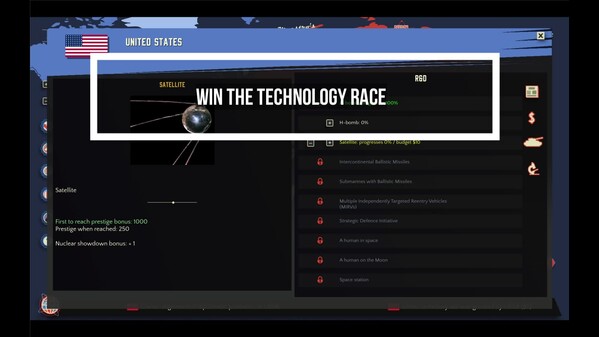
Addictive yet chill. An immersive Cold War sandbox. Revive the Cold War in this classic strategy game—easy to pick up, yet challenging and deep, offering endless replayability.
Modeled estimate, not a reported figure. How we estimate →
Discounts
Every price cut of more than 20% we have observed, in each market that quoted one, with this game's chart position on either side of it. These are episodes, not a model: a sale is one event, and one event cannot tell you what the next one will do.
Reviews, worldwide (the counter carries no country): 0.13/day in the week to Aug 3 → 0/day in the week after.
For scale, across Steam · Top Sellers · Brazil over the last 30 days: the 26 chart moves that followed a price cut of more than 20% went a median of 7 places towards #1, and the 2,400 moves with no price cut behind them went 2 away. One store, one chart, one country — it is the only place we have enough observations to say even that.
Prices outside the United States have been collected since 6 August 2026 and chart positions since 19 July 2026, so a cut older than that has no market to compare and a market that joined later has no history yet. Nothing here is converted between currencies.

About
Maestro’s Cold War 2 is a replayable grand-strategy sandbox about the world’s tensest standoff of the Cold War.
Play as the USA or the USSR, manage Prestige, Budget, and National Policies, and bend history through policies, proxies, diplomacy, and brinkmanship.
Easy to pick-up but hard and deep enough to offer a challenge, this is the kind of game you will keep coming back to.
The objective is simple: earn more prestige points than your opponent.
You gain prestige by improving diplomatic relations and signing treaties with countries across the globe. At the same time, your opponent will work relentlessly to undermine the nations in your bloc and shift the balance of power in their favor.
Beyond diplomacy, you must also manage your nation’s internal policies and carefully plan how to exploit the geopolitical landscape to weaken your rival over time.
Are you ready to lead your ideology to global dominance—or will history repeat itself?
If you're familiar with my work, you know I focus on crafting games you can enjoy in a single evening, yet with enough depth to offer endless replayability.
I’m confident the game's simple mechanics paired with historical events that force you to make impactful choices, will provide over 100 hours of entertainment.
Now:
Have fun! (this is an order, not a wish!) -Maestro Cinetik

You are looking for a deep simulation of the Soviet Politburo: Probably not. This game focuses on Cold War geostrategy rather than the internal politics of a single country. If domestic politics and government management are what you enjoy most, there are better games for that.
You love planning military campaigns: Probably not. Military intervention is rarely the objective. If you find yourself putting boots on the ground, something has probably gone wrong.
You don't enjoy reading: Probably not. The game expects you to read tooltips, event reports, and occasionally the in-game wiki. Much of its strategic depth comes from understanding the information the game provides.
You enjoy making long-term plans: Then this game is probably for you. Success often depends on thinking years ahead rather than reacting to next month's events.
You enjoy indirect strategies: Then this game is probably for you. The best move is not always the most obvious one, and achieving your goals often requires patience, subtlety, and careful planning.
You enjoy adapting to uncertainty: Then this game is probably for you. There is rarely a perfect solution, and strategies must evolve as the geopolitical situation changes. (If 90% of your actions are economic aid because every other option feels too risky, you're probably missing a large part of what the game has to offer.)
Add-ons
Each DLC is estimated with the same model as a game, then summed — a modeled figure, not reported DLC sales.
Engagement
Reviews
Themes across 68 recent reviews and how positive each mention is. A keyword signal, not full sentiment analysis.
Reviews
banger world history class simulator 10/10 would fk up the timeline
TLDR: There isn't enough here. even on sale skip this -GUI is weak af -espionage actions are always rate impossible -espionage system doesn't make sense --the AI is running schemes globally but I cant get opposition in 1 target nation -standoffs seem to always lead to nuclear war, even when i tried to negotiate. -war's aren't wars. no action there --its algorithmic. numbers only, no tech -speaking of tech all the rd stuff is prestige only --nothing that actually helps
Media

Related
Related
Price dynamics, follower growth, revenue and sales trajectories with interactive tooltips
This and every other Pro feature is free until October 20, 2026. A free account is all it takes.
Genres
Stats
All-time low is the lowest price we've recorded for this game since we started tracking it.
Languages: English*, French*, German*, Spanish - Spain*, Spanish - Latin America*, Simplified Chinese*, Portuguese - Brazil*, Italian*, Polish*, Indonesian**languages with full audio support
Hours played at review time, across 68 reviews with recorded playtime.
positive critical· bar length = how often the theme comes up
A very well crafted game from what I can tell. The developer is very active and receptive which is a big plus. One big thing I appreciate about this game is it gets straight to the meat, I don't have to spend an hour building my nation up like a lot of nation sim games; and it has a good balance between complexity and simplicity. I haven't gotten many hours into it yet, but I am already in love with this game, would recommend.
Maestro's Cold War 2 is a geopolitical strategy game built around the decades-long rivalry between the United States and the Soviet Union. Developed by Maestro Cinetik and published by Gaming at work and Cinetique, it focuses less on battlefield micromanagement and more on the political maneuvering that defined the Cold War. Diplomacy, ideological influence, economic priorities, intelligence, national policies, and competition for international prestige form the foundation of the experience. This focused approach gives the game a distinct identity, especially for players who enjoy grand strategy but do not necessarily want to manage hundreds of military formations or navigate overwhelmingly complicated government systems. The central objective revolves around Prestige, which effectively represents the success of your chosen superpower on the world stage. Playing as either the USA or USSR, you attempt to strengthen relationships with other nations, secure agreements, maintain valuable allies, and gradually expand the influence of your ideological bloc. The rival superpower is simultaneously pursuing the same goals, turning the world map into a constantly changing political contest. Instead of treating countries merely as territory to conquer, the game encourages players to consider their diplomatic and strategic importance. Resource and budget management prevent this struggle from becoming a simple matter of improving relations everywhere at once. Decisions have opportunity costs, forcing you to determine which countries, regions, policies, and initiatives deserve immediate attention. National Policies provide another method of shaping your strategy, while technologies and geopolitical advantages can influence how effectively your superpower responds to changing circumstances. The Soviet side also receives alternative policy possibilities, opening the door to campaigns that depart considerably from the historical timeline. Historical events strengthen this alternate-history element. Rather than functioning solely as flavor text, events can introduce situations requiring the player to reconsider existing priorities and react to new geopolitical conditions. Intelligence and regional information are equally useful because understanding where an opponent is gaining influence can determine where limited resources should be directed. A seemingly minor diplomatic setback can become important later if it allows the opposing bloc to establish a stronger position in a strategically valuable part of the world. The game covers a substantial portion of Cold War history, ranging from 1949 to 1989. Multiple scenarios allow players to enter the geopolitical struggle at different stages, while the larger Grand Campaign provides the opportunity to experience a much broader progression through the era. This structure is useful because a complete campaign demands different strategic thinking from a more concentrated scenario. Starting conditions and configurable options can also alter how events unfold, giving repeated campaigns room to develop into noticeably different versions of twentieth-century history. One of the game's most appealing characteristics is that its mechanics are relatively understandable by grand-strategy standards. The individual concepts are not especially difficult to grasp, yet complexity emerges from having to manage several priorities simultaneously. Diplomacy might appear straightforward in isolation, but the situation becomes more demanding when diplomatic objectives compete with budgets, policies, intelligence activities, technologies, events, and the opponent's actions. This creates strategic depth without requiring an enormous learning period before the player can begin making meaningful decisions. The artificial intelligence plays an important role because the entire concept depends on having an active geopolitical rival. Difficulty options make it possible to adjust the pressure according to experience, while online PvP offers an alternative for those interested in competing directly against another player. Human competition is particularly suitable for this design because anticipating another player's intentions adds uncertainty to diplomacy and strategic investment. Steam Workshop integration and a level editor provide additional value, allowing custom content to extend the experience beyond the standard scenarios. Visually, Maestro's Cold War 2 favors clarity and function over spectacle. Its 2D strategic presentation is appropriate for a game primarily concerned with information, international relationships, and long-term planning. Players looking for elaborate tactical battles or cinematic military action will not find those elements at the center of the experience. The abstraction also means that some political, economic, and military systems are less granular than those found in extremely detailed grand-strategy simulations. This can be a disadvantage for players who want every aspect of government represented, but it also keeps the game focused on its primary theme of superpower competition. Steam Deck compatibility is officially categorized as Playable rather than fully Verified. Performance with the default graphics configuration is considered suitable, and the game can run successfully on SteamOS. However, handheld players should expect compromises. Some functionality is not fully accessible through the default controller configuration, touchscreen interaction or a community controller layout may occasionally be useful, and text entry can require manually opening the virtual keyboard. Some interface text may also appear small, while certain prompts can display keyboard, mouse, or non-Steam Deck controller icons. It is therefore functional on the Deck, but the experience is less seamless than a fully optimized handheld release. The limited selection of playable superpowers is another consideration. Players accustomed to strategy games where nearly every nation is available may find the USA-versus-USSR structure restrictive. However, that limitation also gives the game its focus. Instead of spreading development across dozens of playable governments, the mechanics are organized around the specific pressures of bipolar Cold War politics. The resulting experience feels closer to an extended geopolitical duel than a conventional world-conquest game. Overall, Maestro's Cold War 2 succeeds by turning the Cold War into a strategic contest of influence, resources, policies, intelligence, and diplomatic positioning rather than simply another military campaign. Its historical scope, alternate possibilities, multiple scenarios, adjustable challenge, multiplayer component, and community-content support provide meaningful replay potential. It may be too abstract for players seeking exhaustive political simulation and too restrained for those wanting battlefield action, but its accessible interpretation of geopolitical strategy makes it an appealing choice for anyone fascinated by the strategic maneuvering of the Cold War. Rating: 8/10
An iconic, soon-to-be classic game that keeps re-inventing itself. It allows the player to pursue their imperialist (or pacifist?) fantasies in a defining period of contemporary history, one of mad nuclear engineers, charismatic guerrilla fighters, brave cosmonauts and shrewd diplomats. It is also the work of a brilliant indie game developer, as opposed to an faceless corporation headquartered in Panama. Strongly recommend the Pax Americana DLC and the France DLC for an enhanced game experience. This is not a game for those that seek the thrill of constant warfare: cunning strategy, careful planning and a bit of luck are the key to success! For beginners: please join the Discord community. Several veterans of the game are willing and able to help you make your global dominance dreams come true!
I can't believe that Balance of Power is finally dead
A very satisfying middle ground between Twilight Struggle and Paradox games.
Y2K Virus actually jumpscared me.
Interesting game. It can get redundant after awhile but it's worth full price for what it is. There are many events throughout the game with links to more info which are nice if you're interested in learning more about the time period.
sup maestro, very good very nice
Selling now
See how fast this game is selling right now — estimated copies and revenue per day from recent review growth.
Active players
Estimated daily and monthly active players (DAU/MAU) modeled from peak concurrency.
Players by region
Where this game's players are, estimated from review languages.
Players also reviewed
The games this title's players most often review too — audience affinity.
Related
| Game | Estimated lifetime revenue | Reviews | Review score | Price |
|---|---|---|---|---|
| $80.7K | 72 | 67% | $29.99 | |
| $893.2K | 1.3K | 77% | $19.99 | |
| $725.6K | 2.6K | 84% | $9.99 | |
| $149.7K | 167 | 76% | $19.99 | |
| $129.2K | 119 | 71% | $34.99 | |
| — | 0 | — | — |
Related
| Game | Estimated lifetime revenue | Reviews | Review score | Price |
|---|---|---|---|---|
| $92.7K | 355 | 90% | $10.99 | |
| $92.7K | 154 | 96% | $19.99 | |
| $92.6K | 235 | 75% | $14.99 | |
| $92.7K | 157 | 78% | $13.99 | |
| $92.7K | 154 | 77% | $19.99 | |
| $92.6K | 421 | 73% | $11.99 |