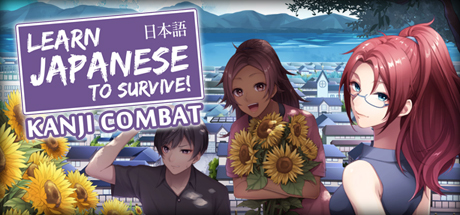
Learn Japanese kanji in this interactive role-playing game! No experience needed – start reading and writing in Japanese!
Modeled estimate, not a reported figure. How we estimate →
About
Genres
Stats
All-time low is the lowest price we've recorded for this game since we started tracking it.
Languages: English**languages with full audio support
Add-ons
Each DLC is estimated with the same model as a game, then summed — a modeled figure, not reported DLC sales.
Engagement
Reviews
Themes across 45 recent reviews and how positive each mention is. A keyword signal, not full sentiment analysis.
Reviews
This series has been a relatively relaxing introduction to the Japanese writting system. The first two games focused on the writing systems that only represent sounds and not meanings. This one focuses on Kanji, which is the writing system where each character can have multiple sounds in different contexts and different meanings when used by themselves or in a compound with other kanji. So while the first couple of games worked well enough as language introduction on their own, this one requires a lot more studying beyond just playing the game for an hour or two a day if anyone is going to remember everything. There are so many kanji to learn in this game that playing for a prolonged period of time and constantly being exposed to new kanji is very likely to burn out your brain, making learning the characters much more difficult than in the previous games. What makes this worse was that the game uses more than one font for the characters and some of the fonts completely change the characters to the point that they are unrecognizable from the font I was remembering earlier. There is also a type of battle where you have to select the kanji from your menu and it's so small that I have to lean into being less than a foot away from the screen to barely make them out. We needed a way to magnify the kanji so we can see them better. Many years ago I studied Japanese in high school and college and I find the organization of the kanji in this game sometimes makes sense, like paring the days of the week together and the numbers, but other times they introduce you to groups of unrelated kanji or have half of the characters that would make sense to go together with completely unrelated ones. This game might be taking its teaching order from how kids learn in Japan learn and maybe I was taught using a much different method, but from a western perspective, the organization of characters seems a little odd some of the time. It would have made things easier to remember when similar concepts are in a section together. There were also a number of points where the methods they would offer to remember one kanji would involve knowing another kanji that hadn't been taught yet. So as a study guide, this game has a number of issues. On top of that, this game decided it wanted to be a bit more of a game and have more aspects of a jrpg to challenge the player on top of the challenge of learning so many characters. Considering I found the lack of anything interesting to do in the first two games, I should have been care on what I wished for. This makes the experience of playing feel a lot more adversarial than the previous games. In one of the first dungeons I was being poisoned with no way to heal and the poison would not be removed after battle, making me return to town to heal repeatedly. Buying status healing items at the time were worth 3/4 of the money I had and about 4x what I would gain from a single battle, making them far too expensive to invest in. Since this game decided to try and be more in depth as a game, I found myself a lot more annoyed by things like the terribly flat, cliched, and uninteresting dialogue. The voice acting very difficult to listen to and I would have rathered they just not have included it if this was the quality we were going to get. Almost every sidequest just asks you to go through the dungeon you just completed all over again. The kanji token system is also quite unbalanced where you will need to grind for some orbs while being maxed out on others and having no way to exchange your abundant ones for less abundant. You can only trade the rare ones for other rares one and every trade is a net loss in orbs. I also found a few minor annoyances that were more on a technical level and might be common to more rpg maker games, but were still an issue for me in this game. There is a noticeable delay that looks like the game freezes every time poison is applied. The in-game clock is hopelessly broken. It consistently read far more time than steam recorded that I played for. The movement speed is also a bit overtuned and it is very easy to repeatedly walk past your target using a controller. The music is also low quality. Some recordings feel very much like midi files and others are obviously higher quality, but have blips or static that I recognize from low quality audio files I had as a kid. Overall, I feel this one tried to do too much. It tried to be an actual game while also being a teaching tool and ends up failing to do either one very well. I like the idea of the game, but the execution in this one doesn't make it easy to learn or fun to play.
Media

Related
Related
Price dynamics, follower growth, revenue and sales trajectories with interactive tooltips
This and every other Pro feature is free until October 20, 2026. A free account is all it takes.
Hours played at review time, across 45 reviews with recorded playtime.
positive critical· bar length = how often the theme comes up
[h2]Плюси[/h2] + велика кількість канджі (приблизно 200), і всі вони є базовими; + через постійну практику вивченого хочеш не хочеш, а щось та запам'ятаєш; + сюжет хоч і простий, але не дуже нудний; + непогана озвучка; + система будівництва. Теж дуже проста, але постійно було бажання щось побудувати/покращити. І ці будівлі є не просто декорацією; [h2]Наче плюси, а наче й ні[/h2] +- порівняно з попередніми частинами, гра стало явно легше, всякими хілками я користувався дуже рідко, всі вороги вбивалися з одного удару. Я думаю можна було б зробити гру трохи складнішою або додати рівні складності. Хоча тим, що всі вороги помирали з одного удару, я був задоволений. [h2]Мінуси[/h2] - хоч озвучка і непогана, але присутня лише в 5-10% діалогах; - на мою думку, не найкраща ідея в якості методу запам'ятовування канджі обирати саме візуальний (показувати на що воно схоже). Хоча, так як гра не претендує на ультимативний шлях вивчення канджі, то можна закрити очі на це; - враховуючи яка велика кількість канджі, то при бої з ворогами складно шукати саме те, яке тобі потрібно. Можливо варто було б додати якийсь пошук чи збільшити розмір кожного канджі в списку; - дуже одноманітний геймплей, проходження йде неначе в циклі, де кожна ітерація починається з вивчення нового набору канджі і закінчується проходженням локації. Але так як гра націлена саме на навчання, то вибір такого геймплею є виправданим, хоча й могли додати більше різномаїття саме при проходженні сюжетної гілки; - таке відчуття, наче озвучка канджі є машинною і через це місцями неправильною. Наприклад, замість того, щоб озвучувати きょう як "кьоо" з подовженою о, воно озвучує як "кьо у". [h2]Підсумок[/h2] Якщо ви бачите цю гру, як геймифікований варіант вивчення чи повторення канджі, то вона заслуговує на те, щоб на неї звернули увагу. Але вона явно не підійде, якщо мета - пограти в якісну JRPG й заразом можливо вивчити трохи японської.
Tentative review/impression of Learn Japanese To Survive! Kanji Combat. I've played the other two games already in the series. I gave the Hiragana game a not recommended, as I spent more time in the menu looking for the entry I wanted over learning hiragana characters. I ended up just going with flashcard instead. Katakana cleaned up menu navigation, the way combat encounters worked, gave a queue of turn order and was well balanced as a retro-turn based rpg in its own right. So, I recommended the katakana game. I was curious how this kanji game would handle things. As kanji is more complicated with characters having multiple means, and the system having literal 1000s of characters. So far what I have seen, this game does an okay job. I don't think the player is going to actually learn all the means of the 200 kanji it has. However, it will allow for some familiarization. My issue is with the rpg side of the game. The stats seem off. I'm a good 30+ kanji in, and I one shot all kanji. Good thing, because gone are previous game's 3 or 4 'monsters'. I'm often bombarded with 6 vs. my party's 4 characters. Meaning the monsters are going to get hits in. And this game hands my party poison, curses and bleed effects like candy. Meaning I spend a fair amount of time casting healing magic to keep my party going. But the worst part is that the monsters always seem to have a higher speed than all my party. Meaning I suffer 4-6 attacks from them before I get a chance to answer back. Which would be bad enough in any turn based rpg where HP/MP dedicate how far the player can explore before forced to return back. This is practically unforgivable in an education game where I'm delayed from learning waiting for my turn and have to take constant breaks to rest my party. So far, this game is clearly the weakest in the series from what I have seen. It's forcing a lot of grinding rather than letting the player self practice characters they might be weak with. All the while not letting the player play all that much. I'll give it a little more time. But if I can't get my party leveled enough where I start winning initiative more often than not, I'm not likely to change my opinion on this game. As it stands, their katakana game showed me the devs can do a pretty good job of making a decent retro turn-based rpg. That just happens to teach a Japanese writing system. But this game just feels like the game part is so unbalanced to the point it's interfering with the educational portion. And the nature of kanji aren't as straight forward as hiragana or katakana, either. So, I'm not sure of the educational benefits here as well.
le jeu est cool pour son objectif. Apprendre les Kanji. La choix de la difficulté (Romaji/Kana) est cool, et dans la continuité des deux précédents jeux. Le fait que le donjon de l'autre monde fasse gagner de l'xp et des orbes est un bon ajout, l'ancienne version était inutile. Pareil niveau ergonomie, le fait de pouvoir changer son groupe depuis l'inventaire est un plus. Par contre la courbe d'expérience linéaire est une purge. Si on a un personnage qu'on a laissé trainé au camp trop longtemp, pas moyen de l'entrainer rapidement en lui faisant affronter des gros Obake. La simplification des Statistiques est aussi un problème je pense. D'abord je me suis dis cool, plus besoin de taper plusieurs fois le meme obake en boucle, mais au final ca rend les stats quasi inutiles. En fait je me rend compte que quelque soit le niveau dans une stat, les Obake font plus ou moins le meme nombre de dégats, tape plus ou moins à la meme vitesse que les joueurs, meme dans les zones de départ. Malgré plusieurs personnage full level, full entrainement, full set, Full relation, j'ai encore des Obake qui vont plus vite que moi, et globalement, ils me font toujours entre 1/4 et 1/3 de dégats sur mes meilleurs perso, comme durant toute la partie. On dirait que les ennemis se scale sur le plus haut niveau du groupe. Si je me base sur la taille de la map, j'en suis à la moitié du jeu, peut-etre les 3/4, et j'ai déjà assez de perso pour faire une team full niveau max. La limite au niveau 40 est très frustrante. Les équipements j'en parle meme pas, mon village et mes sets ont été maxé dès la seconde où Claire et Shiro sont arrivés au village. Et à part les sorts de soin, globalement, la magie sert toujours à rien. Enfin, la redondance des boucles de gameplay est assez chiante. surtout dans le début de la phase 2 où il n'y a meme plus l'effort de scenariser les incursions des Obake. On enchaine juste la boucle apprentissage, invasion, boss, 3 fois sans avancée dans l'histoire. Du coup, meme si sur le plan technique c'est le plus abouti des trois opus, c'est paradoxalement l'opus où je m'ennuie le plus. Je le recommande quand meme, parce qu'il est efficace dans son role, mais sur le plan ludique, c'est vraiment bof. En plus le jeux est vieux, et il n'y a pas signe qu'un 4eme opus sur la grammaire ou sur d'autres kanji vienne rectifier le tir, c'est plutot triste.
e
I good game to learn ♥♥♥, however surprisingly poorly optimized for something that looks so simple. The deeper you get in the game the longer the load times. Maybe it's a bug the developers won't fix for over a year.
Engaging but the game crashes often so get used to saving if you don't want to be frustrated.
It's fine, but also very lazily made. You can't even move diagonally zzz
Learn Japanese To Survive! Kanji Combat is a thoughtful and determined attempt to turn one of the most intimidating parts of learning Japanese into an approachable and even enjoyable experience. Developed by Sleepy Duck and published by RIVER CROW STUDIO, the game continues the studio’s educational RPG series by shifting its focus to kanji, a writing system that often discourages beginners due to its volume, complexity, and multiple readings. Rather than simplifying the challenge or glossing over its difficulty, the game confronts it head-on, framing kanji mastery as something that must be earned through repetition, attention, and steady progress. The structure of the game is built around the idea that learning and gameplay should be inseparable. Each new area introduces a curated set of kanji, complete with meanings, readings, and examples, before placing those characters directly into combat encounters. Enemies are represented by kanji themselves, and defeating them requires correctly identifying their meaning or reading through multiple-choice questions. This design turns memorization into a functional skill: your success in battle depends entirely on your understanding of what you’ve studied. Mistakes are punished immediately, reinforcing the idea that guessing is not a viable strategy and encouraging players to slow down and genuinely learn the material. What sets Kanji Combat apart from many gamified learning tools is its willingness to introduce kanji in context rather than as isolated symbols. While each character is taught individually, the game frequently demonstrates how kanji combine into words, giving players an early sense of how meaning is constructed in written Japanese. This contextual approach helps bridge the gap between recognition and comprehension, making the learning feel more practical and less abstract. Over the course of the game, players are exposed to hundreds of kanji, providing a substantial foundation that aligns roughly with early academic levels of Japanese study. The RPG elements are intentionally lightweight, serving primarily as a framework to motivate progress rather than as a source of mechanical depth. Exploration, NPC interactions, and story segments exist to give structure to the lessons, but they never overshadow the educational core. Combat is frequent and repetitive by necessity, but this repetition is also what makes the game effective as a learning tool. By constantly testing recognition under mild pressure, the game reinforces memory through active recall rather than passive review, which can be more effective for long-term retention. Visually, the game is modest and utilitarian. Character sprites, environments, and menus are simple and clean, ensuring that nothing distracts from the kanji themselves. This stripped-down presentation may feel underwhelming to players expecting a polished indie RPG, but it suits the game’s purpose well. The interface is clear, readable, and focused on legibility, which is especially important when dealing with unfamiliar characters and multiple readings. The soundtrack and sound effects are understated, providing atmosphere without becoming intrusive during study-heavy sections. That said, the game’s ambition is also its greatest challenge. Kanji are inherently complex, and the game does not shy away from presenting multiple readings for the same character, which can feel overwhelming for absolute beginners. Some players may find the pacing demanding, particularly when large batches of new characters are introduced in quick succession. Without supplemental study outside the game, it can be difficult to fully internalize everything presented, and players who approach it as a traditional game rather than a study aid may feel fatigued by the constant quizzes. Ultimately, Learn Japanese To Survive! Kanji Combat works best when understood as a structured learning companion rather than a standalone solution for mastering Japanese. It excels at making repetition more engaging and at lowering the psychological barrier to studying kanji, transforming what is often seen as a dry academic task into an interactive routine. While it lacks the depth and polish of a full RPG and cannot replace comprehensive language study, it succeeds in its primary goal: making kanji less frightening and more approachable through consistent, game-driven practice. For beginners and early learners willing to treat it as both a game and a study session, it offers a genuinely useful and rewarding experience. Rating: 8/10
It does work as a learning tool; specially because it's a lot more entertaining than simple flashcards. Sure, it doesn't completely cover the whole kanji list as thoroughly as it should. However, if taken as an additional tool, rather than the whole framework, it works perfectly. As a game, it is quite unremarkable. It's true merit, nevertheless, lies on its effectiveness to learning a decent number of kanji in an entertaining way.
Selling now
See how fast this game is selling right now — estimated copies and revenue per day from recent review growth.
Players by region
Where this game's players are, estimated from review languages.
Related
| Game | Estimated lifetime revenue | Reviews | Review score | Price |
|---|---|---|---|---|
| $346.9K | 2.1K | 91% | $6.99 | |
| $75.4K | 438 | 94% | $6.99 | |
| $928.6K | 2.5K | 85% | $17.99 | |
| $880.2K | 2.1K | 91% | $12.59 | |
| $269.9K | 886 | 89% | $14.99 | |
| $189.1K | 748 | 73% | $14.99 |
Related
| Game | Estimated lifetime revenue | Reviews | Review score | Price |
|---|---|---|---|---|
| $85.3K | 119 | 78% | $24.99 | |
| $85.2K | 228 | 72% | $14.99 | |
| $85.3K | 193 | 25% | $14.99 | |
| $85.2K | 666 | 69% | $3.99 | |
| $85.3K | 332 | 86% | $19.99 | |
| $85.2K | 359 | 82% | $9.99 |