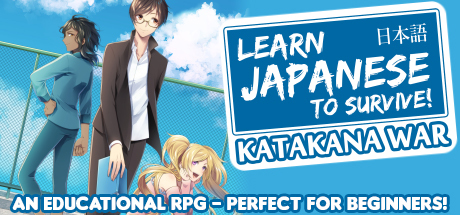
Learn Japanese To Survive! Katakana War
Learn the basics of Japanese in this interactive role-playing game! No experience needed – start reading and writing in Japanese!
Estimated lifetime revenueHigh confidence
$96.4Kgross
$57.9Klow → high range$163.9K
Net to developer$64.1K
Modeled estimate, not a reported figure. How we estimate →
Est. copies sold
21.2K
mid estimate
About
About the game
Learn Japanese To Survive! Katakana War is an educational game that is the ideal introductory course to the Japanese language! It's the sequel to the smash-hit Hiragana Battle – but you don't need to have played that!
This new game teaches you a separate part of Japanese: the Katakana writing system.
Compatible with PC & Mac, Learn Japanese To Survive! Katakana War launches you into a journey full of learning, action, adventure and intrigue. All you need to start learning Japanese is contained within the game!
Japanese is an exciting and interesting language. It looks a bit complicated to learn, right? After all, there's all those weird and wonderful written characters to memorize. Where do you even start to learn them? How do you remember which is which? If you're asking yourself those questions, don't worry – that's completely normal!
The best way to learn a new language is with a learning tool that's going to keep you interested, challenge you at the right pace, and most importantly, keep you coming back for more. Learn Japanese To Survive! Katakana War is your ticket to easy Japanese learning!
The Japanese language combines 3 different sets of characters to form written works: Hiragana, Katakana and Kanji.
This game focuses solely on Katakana, which is frequently used to write words with a foreign origin, as well as names of people, places and things. That makes it incredibly useful!
With this game, you'll learn to read and write every single Katakana character! You'll master pronunciation and be able to write words in no time at all.
At the start of each of the game's chapters, you'll learn a new set of Katakana characters. Following that, you're free to go on adventures and explore.
You'll encounter dangerous enemies that have taken the shape of Katakana. To defeat them, you'll need to correctly translate them! If you give the wrong answer, you won't deal any damage. It's a learn & live situation!
On your adventures, you'll also learn Japanese vocabulary! You'll see how Japanese words are constructed with Katakana, and the translations of useful words and phrases.
Luckily, you're not alone on your adventure. You'll make friends who will study with you and join you in battle. If you bring them along on lots of adventures, your friendship will strengthen and they'll unlock powerful abilities.
An exciting story based around the concept of learning Japanese. Save Japan from an invasion of shape-shifting monsters!
Ready to learn Japanese? You bet you are!
This new game teaches you a separate part of Japanese: the Katakana writing system.
Compatible with PC & Mac, Learn Japanese To Survive! Katakana War launches you into a journey full of learning, action, adventure and intrigue. All you need to start learning Japanese is contained within the game!
Japanese is an exciting and interesting language. It looks a bit complicated to learn, right? After all, there's all those weird and wonderful written characters to memorize. Where do you even start to learn them? How do you remember which is which? If you're asking yourself those questions, don't worry – that's completely normal!
The best way to learn a new language is with a learning tool that's going to keep you interested, challenge you at the right pace, and most importantly, keep you coming back for more. Learn Japanese To Survive! Katakana War is your ticket to easy Japanese learning!
What is Katakana?
The Japanese language combines 3 different sets of characters to form written works: Hiragana, Katakana and Kanji.
This game focuses solely on Katakana, which is frequently used to write words with a foreign origin, as well as names of people, places and things. That makes it incredibly useful!
With this game, you'll learn to read and write every single Katakana character! You'll master pronunciation and be able to write words in no time at all.
How does the game work?
At the start of each of the game's chapters, you'll learn a new set of Katakana characters. Following that, you're free to go on adventures and explore.
You'll encounter dangerous enemies that have taken the shape of Katakana. To defeat them, you'll need to correctly translate them! If you give the wrong answer, you won't deal any damage. It's a learn & live situation!
On your adventures, you'll also learn Japanese vocabulary! You'll see how Japanese words are constructed with Katakana, and the translations of useful words and phrases.
Luckily, you're not alone on your adventure. You'll make friends who will study with you and join you in battle. If you bring them along on lots of adventures, your friendship will strengthen and they'll unlock powerful abilities.
Game features
An exciting story based around the concept of learning Japanese. Save Japan from an invasion of shape-shifting monsters!
- Learn every single Katakana character, with detailed instructions on how to read and write each character.
- Visual animations display how to write each character.
- Audio speech examples demonstrate how to pronounce each character.
- Exciting gameplay with familiar RPG elements – collect items, complete quests, engage in battles!
- Form new friendships and get to know each character with unlockable story sequences.
- Earn experience points and level up your characters.
- Review completed lessons to brush up on your knowledge.
- In-game quizzes to test what you're learning.
Ready to learn Japanese? You bet you are!