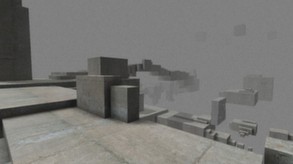
Kairo, developed by Locked Door Puzzle and published by Lupus Studios Limited, is a hauntingly minimalist first-person puzzle adventure that transforms architectural exploration into an emotional and intellectual journey. From the moment the player awakens in a desolate concrete structure suspended in a void, it becomes clear that Kairo is not interested in traditional storytelling or exposition. There are no cutscenes, no characters, and no dialogue—only vast, empty spaces filled with silent machinery and cryptic puzzles. This deliberate absence of narrative context is the foundation of Kairo’s design philosophy. It invites players to find meaning through observation and intuition, forcing them to engage directly with the game’s world rather than passively consume it. The result is an experience that feels less like playing a conventional video game and more like wandering through an abstract art installation brought to life.
The visual identity of Kairo is unmistakable. Its brutalist architecture, characterized by massive geometric forms and sparse color palettes, gives the game an oppressive yet mesmerizing atmosphere. Every structure seems ancient yet alive, humming with the quiet energy of forgotten purpose. The use of space is central to the experience—halls stretch endlessly, staircases spiral into darkness, and rooms open into breathtaking vistas of floating monoliths suspended in infinite void. Despite the lack of characters or explicit story beats, the world feels inhabited by a quiet intelligence, as if the very architecture itself is sentient. This architectural storytelling is one of Kairo’s greatest triumphs: it suggests a civilization that once thrived but has long since disappeared, leaving only cryptic machines behind. The environments are both beautiful and intimidating, evoking feelings of awe and loneliness in equal measure.
Sound design in Kairo is as integral to its atmosphere as the visuals. The ambient soundtrack, composed of subtle electronic tones and low resonant drones, reinforces the game’s meditative pacing. Environmental sounds—echoing footsteps, mechanical hums, and distant rumbles—further immerse players in its cold, mysterious world. The absence of dialogue or textual explanation means that every sound carries significance. When a puzzle is solved and a great mechanism stirs to life, the noise it makes feels monumental, as though awakening something that has slept for centuries. The soundscape does more than fill silence; it creates emotional rhythm, guiding the player’s sense of progress and wonder through purely auditory cues. Kairo’s use of silence is equally powerful, allowing moments of stillness to feel heavy with anticipation or reflection.
The puzzles themselves are embedded seamlessly into the environment. Each area presents its own self-contained challenge, ranging from simple pattern recognition to complex spatial manipulation. What makes Kairo’s design remarkable is that it never explicitly teaches the player how to solve anything. Instead, it trusts you to observe, experiment, and learn through interaction. The absence of user interface elements—no text prompts, no glowing indicators, no maps—reinforces immersion. Success in Kairo feels genuinely earned because it stems from understanding the logic of the world rather than following instructions. The puzzles vary in tone and difficulty; some involve activating ancient mechanisms or aligning symbols, while others rely on interpreting visual or auditory patterns hidden in the architecture. Occasionally, the solutions can feel opaque, demanding patience and lateral thinking, but even in moments of confusion, the game’s mood keeps you engaged. Solving a puzzle does not just unlock a door—it reawakens part of the world, breathing life into dead machinery or illuminating new paths through the void.
Narratively, Kairo leaves interpretation entirely in the hands of the player. There is a sense of narrative progression, but it unfolds abstractly, through visual and environmental transformation rather than explicit plot points. As more puzzles are solved, the once-dead structures begin to hum with power, and the world slowly reconstructs itself. Thematically, it evokes ideas of rebirth, technology as religion, and the human instinct to find meaning in the unknown. Some interpret Kairo as an allegory for spiritual awakening or an exploration of memory and loss, while others see it as a meditation on civilization’s rise and decay. This ambiguity is deliberate; the game provides just enough visual symbolism to provoke interpretation but never confines the player to a single conclusion. It is a work that thrives on mystery, rewarding introspection rather than completionism.
However, the same qualities that make Kairo fascinating can also make it alienating. The slow pace and lack of direct guidance demand patience, and players accustomed to constant feedback or narrative clarity may find the experience frustrating. The minimalist design, while elegant, can occasionally blur the distinction between interactive and decorative elements, leading to moments of aimless wandering. Some puzzles are cryptic to the point of obscurity, risking disengagement when solutions feel arbitrary rather than intuitive. Yet these imperfections are part of what defines the game’s character—it is unpolished in the sense that it refuses to compromise its artistic vision for accessibility. Kairo demands focus and interpretation, and in return, it offers something rare: a sense of genuine discovery.
What ultimately sets Kairo apart is its atmosphere of solitude and transcendence. Few games capture the sensation of being utterly alone in a world that feels both alien and sacred. Every solved puzzle, every reactivated mechanism, feels like an act of quiet resurrection, a reminder that even forgotten worlds can still breathe. The absence of human presence paradoxically makes the player’s presence feel more significant. You are not merely exploring ruins—you are giving them purpose again. By the time the experience concludes, the feeling is not one of triumph but of closure, as though you’ve witnessed the end of a long-dormant cycle. Kairo lingers long after it ends, not because of its puzzles or progression, but because of the emotions it evokes: awe, melancholy, curiosity, and peace.
In the end, Kairo stands as a testament to how minimalism can achieve profound expression. It is not a game for everyone—it moves slowly, speaks in silence, and resists easy interpretation—but for those willing to surrender to its rhythm, it offers an experience unlike any other. It is a game about space, sound, and structure; about the human need to find meaning in the vast emptiness. Kairo transforms abstract geometry into poetry, creating a meditative world where discovery is not about conquering, but about understanding.
Rating: 7/10