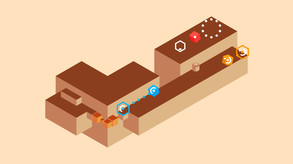
Induction is an abstract puzzle game about time travel and paradoxes. As you master its logic, Induction will rewire how you think about cause and effect.
Modeled estimate, not a reported figure. How we estimate →
About
Stats
All-time low is the lowest price we've recorded for this game since we started tracking it.
Languages: English, Simplified Chinese, Spanish - Spain, Japanese, Russian, Italian, German, Korean, French, Dutch, Portuguese - Portugal, Portuguese - Brazil +2 more
Engagement
Reviews
Themes across 40 recent reviews and how positive each mention is. A keyword signal, not full sentiment analysis.
Reviews
This game drove me crazy (in a good way) and kept me engaged for much longer than I expected for its price.
Mind blowing puzzles. Hard puzzles. You can understand what things do and still be stumped at what you are actually doing, even as you clearly complete levels. There is one mechanic that is particularly hard to grasp every repercussion of, but it's very satisfying when you put the pieces together.
It's a very good game, but it's quite difficult. I recommend for people who enjoy logic and have a big patience.
Media

Related
Related
Price dynamics, follower growth, revenue and sales trajectories with interactive tooltips
This and every other Pro feature is free until October 20, 2026. A free account is all it takes.
Hours played at review time, across 40 reviews with recorded playtime.
positive critical· bar length = how often the theme comes up
谜题很有难度,但是简约的设计很好
非常烧脑,质量很高,大家放心玩
It all depends on the barrel. You can stand on the barrel and the clone will push it. You and the clone are independent and can help each other, and the clone needs to go to where you were at the moment the clone appeared. すべては樽次第です。あなたは樽の上に立ち、クローンが樽を押します。あなたとクローンは独立しており、互いに助け合うことができます。クローンは、現れた瞬間にあなたがいた場所まで行く必要があります。
神作,无需多言
Induction, developed and published by Bryan Gale, is a cerebral puzzle game that builds its entire identity around the manipulation of time, transforming a simple concept into something surprisingly intricate. At a glance, it appears minimal—guiding a small cube across floating platforms toward a goal—but this simplicity quickly gives way to a system that challenges players to think across multiple timelines at once. It is less about movement and more about understanding how actions ripple through time, creating a puzzle structure that feels both elegant and demanding. The central mechanic allows players to rewind their actions and create “echoes” of previous movements. These echoes replay exactly what the player did in the past, effectively turning earlier decisions into tools that can interact with the present. This creates a layered form of problem-solving where players must coordinate multiple versions of themselves, ensuring that each iteration contributes to a larger solution. What begins as a straightforward concept evolves into increasingly complex scenarios, where timing, positioning, and foresight all intersect. As the game progresses, it expands on this idea without ever abandoning its core. New elements are introduced gradually, adding depth without overwhelming the player immediately. However, the difficulty ramps up significantly, requiring players to think several steps ahead and consider how each action will be repeated and combined. The puzzles often demand a precise understanding of cause and effect, and solutions can feel elusive until the underlying logic becomes clear. This progression creates a strong sense of intellectual challenge, rewarding persistence and careful reasoning. One of the defining aspects of Induction is its approach to teaching. The game provides minimal direct instruction, instead relying on players to learn through experimentation. While this design fosters a sense of discovery, it can also lead to moments of confusion, particularly when new mechanics are introduced without clear explanation. The lack of guidance is a deliberate choice, encouraging players to engage more deeply with the systems, but it may not appeal to those who prefer more structured learning. The visual presentation reflects the game’s focus on clarity and abstraction. Environments are composed of simple geometric shapes and soft colors, creating a clean and uncluttered space that keeps attention on the puzzles. This minimalism ensures that even complex scenarios remain readable, which is essential given the layered nature of the gameplay. The accompanying soundtrack is subtle and ambient, providing a calm backdrop that contrasts with the mental intensity of solving the puzzles. Despite its strengths, the game’s design also introduces some limitations. The difficulty can become quite steep, especially in later stages, where puzzles require a high level of precision and understanding. This can lead to frustration, particularly when progress stalls and the solution is not immediately apparent. Additionally, the abstract presentation and lack of narrative context may make it harder for some players to stay engaged over longer sessions. Replayability is also limited by the nature of the puzzles. Once a solution has been discovered, the challenge largely disappears, as the experience is rooted in first-time problem-solving rather than variation. While the game offers a substantial number of levels, its long-term appeal depends heavily on the player’s enjoyment of its core mechanic. Even with these challenges, Induction succeeds in delivering a unique and thoughtfully designed puzzle experience. It explores its central idea with depth and consistency, creating a series of challenges that feel both cohesive and rewarding. The interplay between past and present actions gives the game a distinctive identity, setting it apart from more conventional puzzle titles. In the end, Induction is a demanding but highly satisfying game that rewards patience and analytical thinking. It may not be accessible to everyone, but for those willing to engage with its systems, it offers a memorable and intellectually stimulating journey through time-based problem-solving. Rating: 8/10
在其它艺术形式如小说,电影中,创作一个时间穿越类题材,且是宿命论的作品是可行的。这是因为无论小说也好,电影也罢,它们都在讲故事,而故事中的主角是没有自由意志的,作者想让它们干嘛就干嘛。但把这任务放到在游戏中,就出问题了。这其实也体现出游戏这一艺术形式与其它艺术形式的本质区别——参与者(游戏里就是玩家,小说和电影里分别是读者与观众)具备自由意志,能够左右作品故事情节和内容的发展。 Induction中,玩家按空格键可以穿越回过去,而游戏通关条件便是玩家抵达终点并且过去的自己抵达穿越点。前面说了,做一个祖父悖论宿命论的游戏会出问题,而Induction的“问题”便是玩家在穿越前,无法看到未来穿越到现在的自己。这也间接导致一些原本能靠时间穿越能力解决的谜题无法实现。举个简单的例子,玩家被一个只能从后面打开的门挡住,而他拥有时间穿越的能力,本来他完全可以靠未来穿越回现在的自己在门后出现,打开门并让现在的他能够达到门后再原地穿越,从而实现闭环。但在Induction则不行,因为玩家无法“召唤”未来的自己。 Induction其实是一个祖父悖论,半宿命论,半平行宇宙论的游戏。玩家穿越到的其实是另一个平行宇宙,只是这个宇宙中的主角会干玩家之前做过的同样的事情。在此基础上作者还给游戏添加了一个“宿命论”的通关条件,那便是这个宇宙的主角最后的穿越点必须与上一个平行宇宙的玩家一致。 关于“线条圈”这一元素的机制,其实就是在解决玩家无法“召唤”未来的自己的问题。线条圈可以让来自上一个平行宇宙的主角消失,将控制权给予这个宇宙的主角并令其不必复刻上一个主角的行迹,唯一的改变便是保留了上一个主角对这个世界产生的影响——如将一个箱子推到一个位置上,并且开始控制这个世界的主角的时间并非这个世界的最初时间。所以玩家便可以默认未来穿越回过去的自己能够达成这个被保留的影响,从而打开“只能从后面打开的门”。 游戏的谜题设计,音乐和视觉效果体验下来都不错,推荐。
Quite a doozy. If you enjoy coordinating a team, this is for you. [hr][/hr] Induction is a puzzle game about going back in time to curate an ideal timeline, where the most recent iteration of yourself gets to the exit, and past iterations cleanly transition into the next, without any holes in the timeline. Structurally and visually, the levels are simple: grid-based area and movement, toggleable bridges, pushable cylinders, and triggers that require constant signal. [spoiler] Later on, two powerups get introduced: one allows access to a second timewarp, and the other allows reverting to the previous iteration of yourself, to redo its movements. Additionally, there are introduced cylinders that can be brought through a timewarp.[/spoiler] Since this game uses an isometric view, movement can be confusing without a joystick. However, you do get to choose which way the orthogonal movement is tilted. The game isn't particularly long. Please do know that you can fast-forward, if you have to wait.
Selling now
See how fast this game is selling right now — estimated copies and revenue per day from recent review growth.
Players by region
Where this game's players are, estimated from review languages.
Related
| Game | Estimated lifetime revenue | Reviews | Review score | Price |
|---|---|---|---|---|
| — | 0 | — | — | |
| — | 0 | — | — | |
| $5.4M | 13.7K | 95% | $19.99 | |
| $2.3M | 5.8K | 99% | $19.99 | |
| $457K | 7.7K | 95% | $4.99 | |
| $416.8K | 2.3K | 92% | $6.99 |
Related
| Game | Estimated lifetime revenue | Reviews | Review score | Price |
|---|---|---|---|---|
| $21.1K | 137 | 80% | $14.99 | |
| $21.1K | 99 | 86% | $8.99 | |
| $21.1K | 84 | 85% | $9.99 | |
| $21.1K | 65 | 71% | $15.99 | |
| $21.1K | 133 | 62% | $4.99 | |
| $21.1K | 75 | 96% | $11.99 |