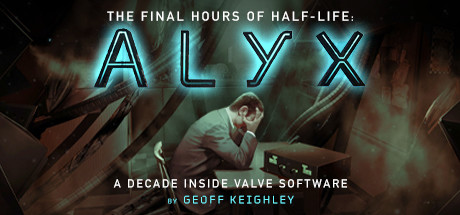
THE FINAL HOURS OF HALF-LIFE: ALYX is an interactive storybook, written by Geoff Keighley, that takes fans inside Valve Software to chronicle the company’s past decade of game development, including the return of Half-Life.
Modeled estimate, not a reported figure. How we estimate →
Media

About
Genres
Stats
All-time low is the lowest price we've recorded for this game since we started tracking it.
Languages: English**languages with full audio support
Engagement
Hours played at review time, across 40 reviews with recorded playtime.
Reviews
Themes across 40 recent reviews and how positive each mention is. A keyword signal, not full sentiment analysis.
positive critical· bar length = how often the theme comes up
Reviews
This book and its contents from Valve inspired my entire career.
I was expecting some sort of movie from the Steam Trailer shown. Paid for a boring interactive add book. Waste of money, sorry Gabe. P.S.: This should be free for anyone using your platform imho.
Very informative, hl3 releasing at tga.
Given that it's been over half a decade since Valve's last singleplayer game, it seems evident that they fell right back into the bad habits this documentary accused them of overcoming. IT WOULD BE FUNNY IF IT WEREN'T SO SAD
With Keighley's capital you would expect something more than this. Not that this e-book (?) is bad or anything but for almost 9 Euros you would expect everything to work flawlessly. What you are actually met with is numerous instances of your mouse scroll wheel having no effects on anything and you have to resort to using buttons to navigate. Interactive pieces using your keyboard INCLUDING w and s making the screen move when you clearly are using them for something else etc. Also, for someone that has been at Valve's offices numerous times, Geoff seemingly has no idea what exactly the Half-Life universe is even about. He makes such elemental mistakes (like saying that you meet Laszlo in HL2:ep2) that you would think he never even played the games. The book is still incredibly interesting but it has nothing to do with this clown, whose introspectives just makes it apparent that all the quality of this book lies solely in the hands of Alyx's devs. Feel free to buy but maybe wait for a sale of some kind.
Reading this 5 years after release instills some hope that Alyx 2 may still happen, no matter how long it will take. And also now I want to replay the game again
Half-Life: Alyx – Final Hours is a fascinating experiment in interactive storytelling that functions as both a documentary and a digital book, developed and published by Geoff Keighley. It is not a game in the traditional sense, but rather a meticulously constructed narrative experience that explores the hidden history of Valve’s development process over the last decade, culminating in the creation of Half-Life: Alyx. In many ways, it feels like a time capsule—a deep dive into the creative, technical, and emotional journey of one of the most influential game studios in history. Through a blend of narrative text, interactive elements, embedded media, and exclusive behind-the-scenes materials, Keighley captures a side of Valve that players rarely see, revealing both its creative chaos and its persistent ambition. The structure of Final Hours is that of an immersive multimedia chronicle. Each section unfolds as a mix of long-form journalism, photo essays, animated graphics, and interactive segments that invite the reader to engage rather than simply observe. Instead of passively watching a film, you scroll, click, and explore, unlocking concept art, design documents, and even small mini-games or visual sequences that punctuate the reading experience. The interactivity never overwhelms the narrative—it exists to enhance immersion, allowing readers to feel as if they are flipping through a living archive of Valve’s past. The presentation is clean and cinematic, with smooth transitions between chapters, soft ambient music, and subtle animation effects that give the impression of being inside a digital museum curated with extraordinary care. What makes Half-Life: Alyx – Final Hours stand out is the level of access and transparency it provides. For years, Valve has been notoriously secretive, often withdrawing from the public eye as rumors about Half-Life 3 swirled endlessly. Keighley’s project lifts that veil, offering concrete insights into the company’s internal workings and the numerous creative experiments that never saw release. Players learn about multiple canceled projects—early prototypes for Half-Life 3, various Source 2 experiments, an ill-fated open-world concept, and even a few ambitious VR projects that served as stepping stones toward Alyx. Each revelation adds texture to Valve’s legacy, illustrating that its periods of silence were not due to inactivity, but to the perfectionism and iterative experimentation that have long defined its design philosophy. These candid glimpses are more than mere trivia; they form a portrait of a studio wrestling with its own expectations and the weight of an iconic franchise. The heart of the experience lies in its storytelling. Keighley’s writing maintains the balance between journalistic objectivity and human curiosity, guiding the reader through the highs and lows of Valve’s development culture. He details the internal debates, the technical hurdles, and the creative anxieties that accompanied the studio’s decision to return to the Half-Life universe through virtual reality. The text is layered with quotes from developers, revealing their conflicting emotions about working on a project so steeped in legacy and expectation. There’s a recurring theme of rediscovery—the sense that Half-Life: Alyx not only revived a dormant series but also rekindled Valve’s identity as a creator of groundbreaking single-player experiences. The emotional core of the narrative comes through clearly, showing that behind the polished technology and meticulous design is a team of people who still love building worlds that challenge and inspire players. In terms of presentation, Final Hours strikes a remarkable balance between accessibility and depth. Each chapter feels thoughtfully paced, rich in detail without feeling bloated. The interface encourages exploration—sections flow seamlessly into one another, and interactive features such as rotating concept art, timeline scrolls, and embedded videos provide context without interrupting the reading rhythm. The sound design complements the atmosphere subtly, using ambient cues and quiet music to create a contemplative tone. Occasionally, there are playful touches, like a headcrab popping up during navigation or small audio samples that let readers feel like they’re wandering through the Half-Life universe itself. These inclusions remind the reader that, despite its documentary nature, this is still part of a creative world built by storytellers. While Final Hours is comprehensive and engaging, it is also highly specialized. Its appeal is strongest for those already invested in Valve, Half-Life, or the craft of game development. Readers unfamiliar with the studio’s history or the context of its technological evolution may find the material dense or overly detailed, as it assumes a baseline understanding of the industry and the importance of certain events. The interactivity, while innovative, remains light-touch—it enhances the experience without transforming it into a full-fledged game. For some, this hybrid format might feel unconventional or uneven, hovering between a book, an app, and a short documentary. Yet, that hybridity is also what makes it unique; it embodies the same experimental spirit that has defined Valve’s approach to its own work. Ultimately, Half-Life: Alyx – Final Hours succeeds not only as an exploration of Valve’s creative process but as a reflection on the nature of video game development itself. It captures the uncertainty, the ambition, and the endless iteration that shape how groundbreaking games are made. It gives life to the myth of Half-Life 3 while showing how its ghost eventually evolved into something new through virtual reality. Keighley’s project is more than a companion piece—it is an act of preservation, documenting a pivotal moment in gaming history with honesty and respect. For fans, it provides closure and insight; for industry observers, it serves as a case study in innovation and perseverance. As both a narrative and an artifact, it stands as one of the most thoughtful and comprehensive accounts ever created about a game studio’s inner workings, offering a rare look into how great ideas are born, falter, and sometimes, after years of silence, find their way back to life. Rating: 9/10
It's a LONG read but has great insight of how a company can work even when its employees aren't put under stress for release dates.
A decently short but interesting and informative view of how Valve develops their hardware, software and games. Not only is it informative but also has some neat little interactions along the way! If you are into IT, complex projects or just like how great minds think, definitely worth checking out.
Дуже класний інтерактивний артбук з унікальним контентом. Рекомендую!
Related
Related
Trends
Modeled estimate over time, reconstructed from Steam's monthly review histogram.
Momentum
Pace estimated from the game's recent review growth (our daily snapshots) at its own sales-per-review ratio — a momentum signal, not booked sales.
Audience
Estimated from the language of this game's reviews — a proxy for where players are, not official Steam demographics.
Related
| Ashes of the Union | $178.1K | 422 | 64% | $12.99 |
| Disney Classic Games: Aladdin and The Lion King | $178K | 460 | 69% | $19.99 |
| Strategic Mind: Spectre of Communism | $178.1K | 225 | 79% | $29.99 |
| Flee, My Elven Ninja! 3D | $178.1K | 308 | 88% | $14.99 |
| Psychonauts in the Rhombus of Ruin | $178.2K | 529 | 87% | $19.99 |
| Blastforge Breach | $177.9K | 117 | 84% | $39.99 |