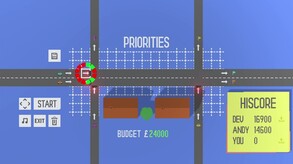
GRIDROAD is a traffic optimisation puzzle/simulation game. Build roads, place road markings and tweak traffic lights to build the most efficient traffic junction!
Modeled estimate, not a reported figure. How we estimate →
Media

About
GRIDROAD is a traffic optimisation puzzle/simulation game. Build roads, place roadsigns and tweak traffic lights to build the most efficient traffic junction!
Remember that time you were stuck in traffic for the umpteenth time at that idiotically designed junction? Remember how you swore you could have designed a better intersection in your sleep? Well look no further, GRIDROAD is the game for you!
Genres
Stats
All-time low is the lowest price we've recorded for this game since we started tracking it.
Engagement
Reviews
Themes across 40 recent reviews and how positive each mention is. A keyword signal, not full sentiment analysis.
Reviews
A decent traffic-themed puzzle game with one of the worst control schemes I have ever seen in a game. You get used to it after a while, but my god, it’s bad. Other than that, it’s quite enjoyable to figure out how to make the traffic flow in the most efficient way, even if I wish there were more options for how to manage it. The Linux version of the game works without any issues.
GRIDROAD is a tightly focused traffic-optimization puzzle game that takes a deliberately abstract approach to a familiar problem: how to keep vehicles moving smoothly through increasingly complex intersections. Developed and published by RAJACORP, the game strips traffic management down to its logical core, framing each scenario less as a realistic city simulation and more as a spatial logic challenge. From the first moments, it becomes clear that GRIDROAD is about understanding systems, identifying patterns, and refining solutions rather than recreating real-world traffic behavior in granular detail. The central appeal of GRIDROAD lies in how it transforms traffic flow into a puzzle language. Each level presents a fixed grid with incoming streams of vehicles that must be guided efficiently through intersections using roads, lane layouts, and traffic light timing. Cars behave in predictable ways, following the rules set by the player’s design, which turns every junction into a kind of equation waiting to be solved. Small adjustments can have outsized effects: shifting a signal’s timing by a second or reworking a single turn lane can mean the difference between total gridlock and a perfectly synchronized flow. This cause-and-effect clarity is what makes the game so satisfying, especially when a messy, jammed layout suddenly resolves into something elegant and efficient. Rather than overwhelming the player with simulation complexity, GRIDROAD embraces abstraction. Vehicles do not exhibit nuanced human behavior, and there is little concern for real-world driving etiquette or realism. Instead, the game operates on internal rules that must be learned and mastered. For players who enjoy optimization puzzles, this approach feels intentional and rewarding, as success depends on understanding the system rather than reacting to randomness. However, this also means that players expecting a true traffic simulator may need to adjust their expectations, as the experience is closer to a logic puzzle than an urban planning sandbox. Visually, the game adopts a minimalist 2D presentation that prioritizes readability over flair. Roads, cars, and traffic lights are clearly defined, and the grid layout ensures that information is easy to parse at a glance. This clean aesthetic supports the gameplay well, as clarity is crucial when analyzing traffic flow and identifying bottlenecks. While the visuals are unlikely to impress players looking for atmosphere or artistic spectacle, they serve their functional purpose effectively, keeping attention focused on the puzzle itself rather than on decorative elements. The difficulty curve is one of GRIDROAD’s more interesting aspects. Early levels introduce concepts gently, allowing players to grasp the fundamentals of road placement and signal control. As the game progresses, scenarios become more demanding, layering multiple traffic streams, tighter spaces, and stricter efficiency requirements. Many levels allow for multiple valid solutions, encouraging experimentation and creativity rather than enforcing a single “correct” answer. This openness adds replay value, as players can return to earlier challenges and attempt to optimize their designs further, chasing higher scores or smoother flows. Community reception reflects this niche appeal. Players who enjoy problem-solving, optimization, and systems-driven gameplay tend to praise GRIDROAD for its clever design and satisfying feedback loop. Watching a carefully planned intersection operate flawlessly can be deeply rewarding, especially after several failed attempts. On the other hand, some players express frustration with the game’s rigid ruleset and abstract logic, particularly when outcomes feel unintuitive compared to real-world traffic behavior. These reactions highlight the game’s clear identity: it rewards those willing to think in its language while potentially alienating those seeking realism. Overall, GRIDROAD succeeds as a focused and confident entry in the puzzle and strategy space. It does not attempt to be a sprawling simulation or a visually rich city builder, instead honing in on the pleasure of optimization and system mastery. Its strength lies in how clearly it communicates its goals and mechanics, offering a challenging but fair experience for players who enjoy refining solutions and learning from iteration. For fans of logic puzzles, traffic flow problems, and minimalist design, GRIDROAD offers a compact yet engaging experience that proves depth can emerge from simplicity when systems are thoughtfully designed. Rating: 8/10
Related
Related
Trends
Modeled estimate over time, reconstructed from Steam's monthly review histogram.
Languages: English, German, Dutch, Japanese, Russian, Simplified Chinese
Hours played at review time, across 40 reviews with recorded playtime.
positive critical· bar length = how often the theme comes up
One of my favorites. I love a minimalist game. Excited to see a sequel or more levels! A level editor would be nice too. Maybe leaderboards and sharable maps to see how others are completing levels.
A properly good simple game, with nice interface and easy mechanics to grasp. Addictive to the point where if you are a perfectionist, this is dangerous but a great game for spending a bit of time logically thinking about getting cars going as smoothly as possible. Hopefully there is a GRIDROAD 2 in the works, with other types of vehicles (busses and push bikes... and maybe even pedestrians!)
I was really bad at this game so I went and worked in traffic signals for four months still really bad at this game 8/10
the game trains your brain while haveing a lot of fun!!!!!
Great game, would recommend. Have gotten distracted playing this for hours lol
[h1][b] Reseña de GRIDROAD[/b][/h1] [h2]Resumen del Juego[/h2] GRIDROAD es ese tipo de indie que te dice “relájate, solo estás construyendo y moviendo cositas”… y a los 10 minutos ya estás mirando una cuadrícula como si fuera un examen final de lógica con castigo. La propuesta mezcla simulación y estrategia en un tablero 2D pixelado: planificas rutas, optimizas movimiento por casillas y resuelves rompecabezas de transporte con mentalidad de ingeniero y paciencia de santo. La primera impresión es clara: colorido, minimalista y directo al grano. No hay distracciones cinematográficas ni “mira mi lore”. Aquí el drama es que tu ruta es mala, tu planificación es peor y el tablero no te va a perdonar. Si te gusta ese placer culposo de optimizar hasta que duele, GRIDROAD te va a agarrar de la frente y te va a decir “piensa”. [h2]Semáforos en Verde y Choques en Cámara Lenta[/h2] Lo Bueno: Rompecabezas de lógica y movimiento en cuadrícula que premian la planificación real, no el azar. Enfoque de transporte + construcción con sabor a “mini constructor de ciudades”, pero sin inflarse. 35 logros de Steam para que tu obsesión tenga constancia legal. Steam Cloud: tus decisiones cuestionables viajan contigo. Tablas de clasificación: perfecto para competir por quién sufre más optimizando. Lo No Tan Bueno: Un jugador y ya: si querías culpar a un amigo por el desastre vial, toca hablarle al espejo. La “historia” brilla por su ausencia (o por su humildad extrema): esto va de sistemas, no de narrativa. Puede sentirse más como “puzzle de optimización” que como simulador con vida propia, según lo que busques. Si no te engancha mejorar rutas, el juego te va a parecer una hoja de cálculo con pixeles bonitos. [h2]Tabla de Evaluación[/h2] [table] [tr][th]Aspecto[/th][th]Puntuación (0-10)[/th][th]Comentario[/th][/tr] [tr][td]Jugabilidad[/td][td]7[/td][td]Sólida y adictiva si te gusta optimizar; fría si no.[/td][/tr] [tr][td]Dificultad / IA[/td][td]7[/td][td]Reta por diseño y lógica; el tablero es tu verdadero enemigo.[/td][/tr] [tr][td]Contenido[/td][td]6[/td][td]Cumple, pero se apoya fuerte en repetir y perfeccionar.[/td][/tr] [tr][td]Gráficos / Video[/td][td]6[/td][td]Pixel 2D colorido y funcional: bonito sin presumir.[/td][/tr] [tr][td]Historia[/td][td]2[/td][td]Historia en modo “te dejo trabajar”: prácticamente inexistente.[/td][/tr] [tr][td]Ambientación[/td][td]6[/td][td]Consistente y clara; todo está al servicio del sistema.[/td][/tr] [tr][td]Efectos (VFX)[/td][td]5[/td][td]Correctos y discretos; no esperes fuegos artificiales.[/td][/tr] [tr][td]Música[/td][td]5[/td][td]Acompaña sin estorbar; tampoco se queda contigo.[/td][/tr] [tr][td]Voces[/td][td]0[/td][td]No hay voces (y honestamente, mejor que no me grite el tráfico).[/td][/tr] [tr][td]Diversidad[/td][td]4[/td][td]Varía por mecánicas y retos, más que por “mundo” o narrativa.[/td][/tr] [tr][td]Rendimiento[/td][td]7[/td][td]2D y directo: debería ir fluido en general.[/td][/tr] [tr][td]Rejugabilidad[/td][td]7[/td][td]Los rankings y la optimización te pican el orgullo.[/td][/tr] [tr][td][b]Total Puntuaciones (Bueno)[/b][/td][td][b]5.5[/b][/td][td]Buen núcleo de lógica/estrategia, pero sin maquillaje narrativo.[/td][/tr] [/table] [h2]Conclusión (Bueno)[/h2] GRIDROAD es un buen juego para gente que disfruta el sufrimiento elegante: mover, conectar, optimizar y volver a optimizar hasta que el “perfecto” aparezca… o hasta que aceptes que tu cerebro hoy no coopera. Como indie de simulación/estrategia, su identidad está clara: sistemas primero, espectáculo después (si es que llega). Eso sí, no esperes una experiencia social ni una epopeya con personajes memorables: es un un jugador puro y duro. Con 356 recomendaciones totales, se nota que encontró su nicho: el de quienes ven una cuadrícula y sienten paz… o guerra interna. Si eres de esos, te va a rendir; si no, te va a parecer un castigo con paleta bonita. [h3]Recomendación de Compra (Solo si te gusta optimizar)[/h3] Puntuación Total: 5.5/10 Número de jugadores activos al momento de hacer esta review: 1 Descuento máximo registrado: -33% Veredicto: [i]Recomendado con reservas[/i] Si lo tuyo es la estrategia de tablero, la lógica y el transporte en 2D con mentalidad de “una ruta más y me voy”, adelante. Si buscas historia, carisma o caos compartido, mejor maneja tus expectativas… porque aquí el único choque garantizado es contra tu propia planificación.
Gridroad is an awesome game that may seem simple, but it can be really challenging. The developer has clever solutions to solutions sharing and offers great support.
Ich habe nachts von Straßen geträumt
Momentum
Pace estimated from the game's recent review growth (our daily snapshots) at its own sales-per-review ratio — a momentum signal, not booked sales.
Audience
Estimated from the language of this game's reviews — a proxy for where players are, not official Steam demographics.
Related
| LEGO® Brawls | $138.3K | 710 | 79% | $9.99 |
| Isekai Janken Hero | $138.2K | 572 | 85% | $9.99 |
| Orbi Universo | $138.2K | 262 | 71% | $19.99 |
| vROVpilot: TITANIC | $138.2K | 161 | 88% | $24.99 |
| One Dog Story | $138.2K | 513 | 79% | $11.99 |
| Haruka Ao no Hanayome ni | $138.3K | 284 | 97% | $29.99 |