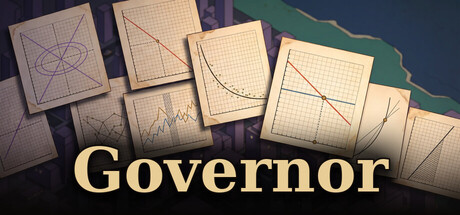
Governor
An economic strategy game where you run the central bank. Built on the IS–PC–MR macroeconomic model. The policy rate, unemployment, inflation, the trade balance. Can you keep the economy clear of overheating and slumps?
Estimated lifetime revenueLow confidence
$20.4Kgross
$6.1Klow → high range$61.1K
Net to developer$13.5K
Modeled estimate, not a reported figure. How we estimate →
Est. copies sold
1.3K
mid estimate
About
About the game
A real model, not a game-shaped imitation
Governor runs your economy on the Carlin–Soskice three-equation model — the one macroeconomics is taught from in upper-year university courses.
IS — Demand. The dearer money is, the less a country spends and invests — but with a lag. Add to that the exchange rate, the government's budget, and how freely banks are allowed to lend.
PC — Inflation and unemployment. An overheated economy pushes prices up faster than a slump pulls them back down. And down is the hard direction: wages are almost never cut.
MR — The monetary policy rule. The game derives the best rate not from a curve, but from what costs you more — missing the inflation target, or unemployment you didn't have to have.
You set the nominal rate. The real price of money is what's left once expected inflation is taken out — and what people and markets expect depends on how far they trust you. Hit the target and credibility accumulates; miss it several quarters running and it crumbles, and the very same rate starts working noticeably weaker. The rate has a floor. If the central bank answers to the government, inflation drifts upward on its own: markets price in the abuse before it happens. Unemployment is tied to output, and banks add their own markup on top of your rate — borrowers pay more than you announced.
Out of your decisions a long-run picture assembles itself: economic growth (Solow), equilibrium unemployment, inequality (Gini), public debt, the exchange rate and the trade balance — and financial bubbles that inflate and burst if nobody is watching them.
The United States, 1925 to 2025
1931, the golden fetters — hold the gold standard, or let the currency go so the economy can breathe.
1971, Camp David — close the gold window, or defend Bretton Woods with reserves.
1979, Volcker — crush inflation with the rate, or take the road of price controls.
2008, the Lehman weekend — put a shoulder under the banking system, or let it fall.
2021, "is inflation transitory?" — wait the price spike out, or hit it early.
The 1929 crash, three waves of bank panics, a war in which the Fed holds rates wherever the Treasury needs them, Bretton Woods, the OPEC embargo, the Volcker disinflation, Black Monday, the Asian crisis, the dot-com bust, 2008, the pandemic and the inflation of 2021–2022 — all of it arrives on schedule. Only one question stays open: what will you do about it?
A full tutorial and a short one, to get the basic economic concepts and the links between them.
An economy you can look at
The state of the economy is drawn as a city on the world map. Buildings rise and multiply as the country grows richer; traffic in the streets shows how hard the economy is running; the city's colours warm up in an overheat and go cold in a slump; cranes work when money is cheap and the future looks good. You will see a crisis in the skyline before you open a chart.
Around it — a world map with historical borders by era and up to 24 rival countries, each with a central bank of its own. They trade with you the more willingly the closer and richer you are; tariffs and trade wars tear those ties apart. A separate mode, off by default, switches on spheres of influence: blocs, satellites, and debt dependency between countries.
If you would rather have numbers than pictures, there is the terminal: tables, charts, and a breakdown of every move in inflation — by cause, with figures. Plus the influence map: 106 variables of the model and 276 links between them, all on one screen.
The Association
Gather famous economists into an association of your own.
Once a year the Economic Association meets and takes your policy apart. You appoint the Chair — and with them a school of thought: it grants your economy one permanent bonus and one permanent penalty.
Multiplayer
From two players — over Steam or a local network. Each has their own country and a full copy of the model; after every turn the worlds are reconciled, so your surplus is somebody else's deficit. Credit to a neighbour is a lever too, and debtors know it.
What isn't here
No toy models, no random numbers standing in for an economy, no "correct" playthrough, and no story that will pull you out of a stagflation you arranged yourself. There is a model, a hundred years of history, and the price of a mistake you set for yourself.
