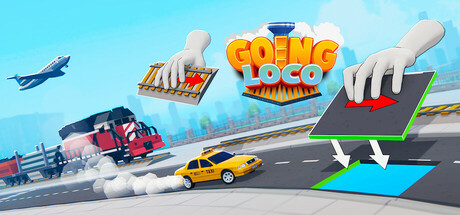
A fun, accessible, traffic-based VR puzzle game with a low-poly aesthetic.
Modeled estimate, not a reported figure. How we estimate →
Media

About
Armed with spare bits of road, railway, and anything else to hand, take on the role of a city planner as you repair the routes for vehicles on your charming, low-poly city map.
Your targets will travel at different speeds, and they may travel on custom routes, so you will need to get creative and build around their various requirements. You may need to block access one way in order to free up another, or send cars in a loop to let a bullet train pass through.
This charming puzzle game should be easy to learn, but hard to master in order to attain all the 3-star scores. Can you perfect every level?
Genres
Stats
All-time low is the lowest price we've recorded for this game since we started tracking it.
Languages: English*, French, Italian, German, Spanish - Spain, Japanese, Traditional Chinese, Ukrainian*languages with full audio support
Reviews
It's okay for what it is. My biggest complaint is that you should be able to move around the playing area (instead of just the few nodal teleportation spots) and also re-size the level. A lot of devs, with this type of game-style, have it where you press grab to move around and then press grab on both controllers to re-size and alternate to turn around. That would let you leave the joystick controls for moving the pieces and turning them or for the quick selection of them. I do like that it has a creator mode, that's pretty cool. Unfortunately, not a lot of people have shared their creations. Honestly, I bought this game because it had zero reviews, but it's not really the type of game I'd normally go for. [b]Rate ?/10. It's okay for the asking price I think.[/b]
道路や線路などのタイル(パネル)を正しく設置して、車・電車・飛行機をゴールに導くゲームです。 参加者は少ないながらも全ステージランキング1位、全実績解除と一通りやり込んだのでレビューします。 全50ステージで難易度はかなり低めですが、操作性の悪さがストレスとなり途中で投げ出す人が多い様子です。ランキング参加者は最終ステージで私含めて僅か二人です。(笑 定価では流石にオススメできませんが、セールで8割引きなら買っても損は無いので、一応はオススメ評価です。 雰囲気は良いですが、残念な部分が際立つ作品です。以下、残念な点ですので、許容できそうな人は買っても良いと思います。 ■悪い点 個人的には、掴みたいタイルを掴めない事が当ゲームの最も致命的な点です。下のタイルを掴もうとして上のタイルを掴んでしまう事が私の環境では頻繁に生じます。左手の掌を上にするとタイルが表示されて、右手でタイルを掴むのですが、VRコントローラーのサイズが大きいとコントローラー同士が干渉して下のタイルが掴みづらいです。棒状の細いVRコントローラーなら恐らく大きな問題にはならないと思われます。そもそも、このゲームで掌を上に向けてタイルを出す必要性があるとは思えません。ナンセンスです。 タイルを狙った場所に置くのに神経を使うのもストレスです。タイルを置きたい場所まで手を伸ばして、1マス単位でしっかり狙って置く必要があります。手放す位置も高すぎると置き損ねます。ポインターで場所をざっくりと指定して置けた方が快適性もテンポも向上するのに、リアリティを重視したのかそれらが犠牲になっています。 上記の問題点が常に付き纏い、ガチプレイでタイムアタックをしているとストレスでちょいちょい発狂します。タイルを選ぶのも置くのも全部ポインター操作で済む話なのに、何故、こんなストレスフルな操作にしたのか謎です。 それぞれの車は次の交差点をどう曲がるか表示されていますが、序盤ならまだしも終盤で車がどっちに行くか考えて解く人は殆どいないでしょう。タイルの置き場所が容易に想像でき、正しくタイルを置けば車は勝手にゴールに向かうからです。もっとシンプルに赤の車は右しか曲がらない、青は左だけ、白は真っ直ぐといったように、視覚的に分かりやすい仕様の方がパズル的に良かったように思います。 ゲーム終盤においてもタイルの置き場所は初見でも何となく察しが付くレベルの難易度です。あまり知的なゲームとはいえません。もう少し知的でやりごたえのあるゲームが個人的には好みですが、良くいえば気楽にプレイできるゲームともいえます。パズル主体というより、どちらかというとミス無く機敏に動く事が求められるゲームです。 タイムアタック制なのに、時間を速くするのがトリガーやグリップでは無く、ボタン2つを長押しなのもナンセンスです。これだと時間を速めながらのジョイスティック操作ができません。ガチプレイでタイムアタックをするなら、少し面倒ですが早送りボタンはSteamVR側の設定で変更必須です。オススメはグリップを「早送り」、トリガーを「掴む」に変更です。 ■総評 悪い点を寛容的に受け入れる事ができるなら、セール中に買って損は無いと思います。 良くも悪くもパズル自体の難易度は低く、熟考せずとも行き詰まる事は無いはずです。 終盤は盤面が広がって手を伸ばしてタイルを置くようなシーンも出てくるので、必須ではありませんが半径1.5mくらいの余裕はあった方がいいです。 プレイスキルで前後しますが、全ステージクリアまで2時間、全実績解除なら4時間ほど遊べます。 個人的にはセール価格以上に楽しめました。早送りボタンを変更してコツを掴めばそれなりに楽しめるゲームです。 箱庭ゲームが好きで、多少の操作性の悪さは目を瞑れる人にはオススメです。
Related
Related
Trends
Modeled estimate over time, reconstructed from Steam's monthly review histogram.
Going Loco is a virtual reality puzzle and transportation management game developed and published by David Addis that transforms the challenge of organizing traffic networks into an entertaining and surprisingly strategic experience. Instead of focusing on large-scale city construction or economic simulation, the game narrows its attention to solving transportation problems through careful planning and route design. This focused approach allows it to deliver a series of satisfying puzzles that gradually increase in complexity while remaining accessible to newcomers. The premise is simple but effective. Players are placed in charge of repairing and reorganizing transportation systems that have become inefficient or incomplete. Roads, railway lines, and other routes must be connected and adjusted to ensure vehicles reach their destinations safely and efficiently. What initially appears to be a straightforward task quickly evolves into a deeper strategic challenge as traffic patterns become more complicated and new transportation systems are introduced. One of the game's greatest strengths is its emphasis on route manipulation. Players are not merely observing traffic flow; they actively reshape the network by placing and modifying transportation paths. Every decision influences how vehicles travel through the map, and even minor changes can dramatically alter the outcome. A well-placed connection can eliminate congestion and create a smooth flow of traffic, while a poorly planned route can generate bottlenecks and confusion. This constant cause-and-effect relationship gives every puzzle a satisfying sense of depth. The puzzle design consistently encourages creative thinking. Rather than presenting a single obvious solution, many scenarios allow multiple approaches. Players must analyze vehicle movement, predict potential conflicts, and determine the most efficient way to organize transportation routes. This flexibility makes problem-solving feel rewarding because success comes from understanding the systems rather than simply following instructions. As a result, each completed level feels like the product of genuine planning and experimentation. Vehicle variety adds another layer of complexity. Different forms of transportation behave differently and often introduce unique logistical concerns. Managing rail traffic alongside road vehicles requires a broader understanding of the entire network, forcing players to think beyond individual routes. Solutions that work perfectly for one type of transportation may create unexpected issues for another, making every level a balancing act between competing priorities. The progression system is structured effectively, introducing new mechanics at a steady pace. Early levels focus on teaching the fundamentals of traffic management and route construction, allowing players to become comfortable with the basic tools. As the game progresses, challenges become increasingly intricate, requiring greater attention to detail and more sophisticated planning. This gradual increase in difficulty keeps the experience engaging without becoming overwhelming. A particularly enjoyable aspect of Going Loco is its emphasis on optimization. Completing a level is often only the first step. Players are encouraged to revisit challenges and refine their solutions in pursuit of higher ratings and more efficient transportation systems. This focus on improvement adds considerable replay value, as there is often a better route, cleaner design, or more elegant solution waiting to be discovered. The virtual reality implementation enhances the experience significantly. Being able to physically observe transportation networks from different angles provides a strong sense of immersion and makes it easier to understand how traffic is moving throughout the environment. Manipulating routes directly within a three-dimensional space feels intuitive and helps reinforce the sensation of being an active planner rather than a distant observer. The VR design is not merely a novelty but an integral part of how the game communicates information and engages the player. Visually, Going Loco adopts a colorful low-poly art style that prioritizes clarity and readability. Vehicles, roads, and environmental elements are easy to identify, ensuring that players can quickly assess situations without visual clutter. The bright presentation creates a welcoming atmosphere that contrasts nicely with the increasingly complex puzzles. While the graphics are intentionally simple, they serve the gameplay extremely well and help maintain focus on strategy. The sound design supports the experience with subtle but effective audio cues. Vehicle sounds, interface feedback, and ambient effects help bring the transportation systems to life without becoming distracting. The overall audio presentation contributes to the game's relaxed tone, creating an environment where players can concentrate on solving problems at their own pace. Accessibility is another area where the game performs well. The core objective is easy to understand, and the controls are intuitive enough for players with little experience in strategy or simulation games. At the same time, the deeper mechanics provide enough complexity to satisfy players who enjoy optimization and logistical problem-solving. This balance allows Going Loco to appeal to a wide audience despite its specialized premise. The game's focused design may be a limitation for some players. Those expecting expansive city-building features, detailed economic management, or narrative-driven progression may find the experience narrower in scope than traditional simulation games. However, this specialization is also one of its greatest strengths. By concentrating entirely on transportation puzzles, the game avoids unnecessary distractions and delivers a more refined and cohesive experience. Ultimately, Going Loco succeeds because it takes a familiar concept and presents it through a highly interactive and engaging format. The combination of route planning, traffic management, virtual reality immersion, and clever puzzle design creates an experience that remains consistently rewarding. Every level offers a new logistical challenge, and every successful solution delivers a strong sense of accomplishment. For players who enjoy strategy games, optimization puzzles, and creative problem-solving, Going Loco provides a satisfying journey through the art of transportation management. Rating: 7/10
Momentum
Pace estimated from the game's recent review growth (our daily snapshots) at its own sales-per-review ratio — a momentum signal, not booked sales.
Related
| Factorio | $206.6M | 189.7K | 98% | $35.00 |
| Cities: Skylines | $203.5M | 290.6K | 93% | $29.99 |
| Cities: Skylines II | $127.4M | 62.8K | 57% | $49.99 |
| Planet Coaster | $109.4M | 72K | 91% | $44.99 |
| Planet Zoo | $107.4M | 96.7K | 91% | $44.99 |
| House Flipper | $65.8M | 110.8K | 94% | $24.99 |
Related
| Poopy Philosophy | $1.1K | 77 | 75% | $0.49 |
| Beyond Magic | $1.1K | 76 | 71% | $0.79 |
| Horror Girl Puzzle | $1.1K | 76 | 83% | $0.59 |
| The Doorbreaker | $1.1K | 57 | 30% | $0.49 |
| Mountain Trap: The Manor of Memories | $1.1K | 88 | 56% | $0.76 |
| Music Racer 2000 | $1.1K | 62 | 42% | $0.99 |