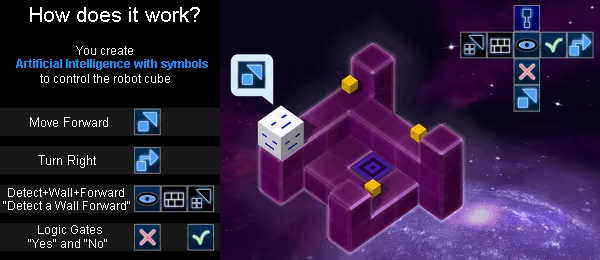
An easy to start programming puzzle game where you design Artificial Intelligence with symbols, to control robot cubes and build space pyramids. Inspired by SpaceChem, Lightbot, Human Resource Machine and the Redstone from Minecraft. A game 99% made by one guy.
Modeled estimate, not a reported figure. How we estimate →
Media

About

Genres
Stats
All-time low is the lowest price we've recorded for this game since we started tracking it.
Languages: English, French
Engagement
Hours played at review time, across 21 reviews with recorded playtime.
Reviews
My main complaint with this over other puzzle games is that you're far more restricted in the code you can write. You're not just limited by the commands that seem to change every single level, but also by the shape of the code. The code blocks you're seeing in the screenshots are forced to be in those pre-defined shapes, so you're not just writing something that works, you're trying to figure out what the author wanted your script to look like. If you want to use a conditional, you have to be at a 4 way intersection so you can get to it, then have the condition you're checking for, then have true and false paths out. I've played enough Zachtronics games with friends to know that every developer writes things a little bit differently and this was just too restrictive for me to enjoy. The game suggested I skip to level 30 since I'm a programmer and I think I stopped at 50 and got a refund. I don't normally leave reviews, but I thought maybe this feedback would help the dev, either with this or with future projects.
This is an amazing programming puzzle game in the vein of the Zachtronics games. While the mechanics are not quite as complicated as those of these so-called "Zachlikes", this is by no means an easy game. The levels ramp up in difficulty and get hard quite fast. In addition, all the levels have a secret way of finishing them that requires you to think outside the box and abuse the system. While the graphics could use some polish and the music can get a little repetitive (it's great music though!), this does not change the fact that this is an excellent puzzle game with interesting mechanics that I can only recommend.
This is my impression after playing the first 8 sets, admittedly, not the whole game. This game plays like a course on programming cubes complete with boring, repetative homework. New concepts are introduced, and for each one there are a set of problems that are variations on work already done with the new element thrown in. The structure templates and rune availability do not allow for much creativity - though trying for dark block solutions given these limitations does offer some challenge. For the most part, the learning curge is so shallow as to be more like being lead down a path. The weird quasi-religious interludes seem like someone tried to tack on "story" but they seem out of place and lacking context. I felt at times the learning curve pacing might be intended for kids, but the story elements don't back that up.
Much like it says on the tin, God is a Cube is a game about programming robot cubes. If you're a fan of what Zachtronics does, you'll be right at home here. Also like it says on the tin, it's made almost entirely by one guy. That ultimately means that the game lacks polish. However, that's not really a huge deal. The core game is well-built and fun to play, and that's what matters most.
The game description claims to be open-ended. That is a lie. Playing through 2 'constellations' it seems that the commands you program are locked to a very specific format and it does not become more open over time. You have a single branching if/else structure that loops, and space and availability of 'runes' is constrained so heavily that it's just a fill-in-the-blanks exercise. The only thing vaguely challenging is the secret solutions, which are only made difficult by attempting to fit a different solution in the space designed for the one being spoonfed to you. The game is basically just a worse LightBot if you remember that game. Also, the story is just a couple cutscenes of pseudo-profound bs, with the tutorial being delivered by a poorly drawn waifu (and the dev literally called it cube-chan and identified it as a waifu, I'm not just insulting it). Refunding.
Looked interesting and seems like a reasonably solid idea on the surface. Lacks enough polish and ease of use to make me not want to spend any more time with it. The progression of difficulty is also quite stale and you will be asked to do the same thing you did the last half dozen times just with one additional little bit added on to it over and over. Not deep enough to keep me interested.
The screenshots give a pretty good idea of the gameplay- you'll know right away whether you like this kind of game or not! Its a straightforeward puzzle game where you "program" with simple runes to create larger behaviours and navigate the level. I played an early access copy, and its pretty straight to the point. Dozens of puzzles set up for you to solve. The graphics vary a lot, the runes are pretty ugly, but the levels themselves look nice and are sometimes sculptural. After completing a mission you get the graph of how well you did compared to other players, and it immediately adds to replayability. Story/setting: weirdly, the game succeeds in making me believe I'm getting a glimpse into another world or reality, rather than moving around digital videogame blocks. Overall, there is room to improve with presentation of the game, especially in regards to sound (it has music but no effects), but this a puzzle game, and the core of "here are puzzles for you to solve" is solid.
excellent straight forward engaging, as huge potential in education
This is a pretty diverting puzzle game, and I'm happy to have got through it -- although it did not live up to some of my expectations. Calling it open-ended and comparing it to SpaceChem (among others) is not very accurate. Each puzzle has a tightly constrained grid and a small set of symbols to put in them, so it's more like finding the expected solution rather than making your own (although you can try some optimisation). There is a sandbox mode, but not much to do with it at the moment. Most of the puzzles also have an alternate goal, which is a good idea that didn't add enough variation to be really worth it. The game's style is simple but effective, and I didn't see too many bugs (although some programming instructions are more constrained than I hoped). In the end it feels more like an over-extended tutorial to something really cool that may or may not be coming.
Refunded. Dev went so hard into quantity of levels that quality is heavily lacking, including MSPaint-style drawings. Left a message on discussion board as it has no movement on it, but still got no response from the dev so discussion board is clearly not read by the developer. Avoid at all cost.
Related
Related
Trends
Concurrent players on Steam, sampled daily since tracking started.
Momentum
Pace estimated from the game's recent review growth (our daily snapshots) at its own sales-per-review ratio — a momentum signal, not booked sales.
Audience
Estimated from the language of this game's reviews — a proxy for where players are, not official Steam demographics.
Related
| Mount & Blade II: Bannerlord | $309.8M | 294.1K | 88% | $49.99 |
| The Forest | $254.8M | 678.7K | 96% | $19.99 |
| Project Zomboid | $239.1M | 461.1K | 94% | $19.99 |
| Satisfactory | $164.4M | 276K | 97% | $27.99 |
| Schedule I | $144.4M | 308.7K | 98% | $19.99 |
| Raft | $144M | 375.9K | 93% | $19.99 |
Related
| Volleyborne: Unbound Horizons | $10.6K | 64 | 84% | $7.99 |
| Dice Dice Baby | $10.6K | 85 | 89% | $4.99 |
| Super Inefficient Golf | $10.6K | 220 | 78% | $2.49 |
| Cat at Home | $10.6K | 59 | 100% | $6.99 |
| V.L.A.D.i.K | $10.6K | 578 | 54% | $0.99 |
| Escape Quest | $10.6K | 281 | 71% | $2.99 |