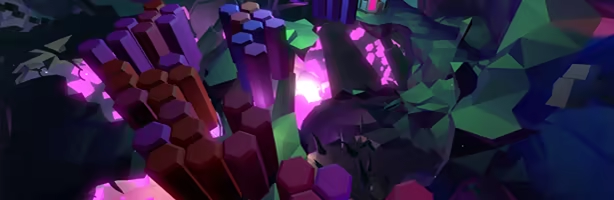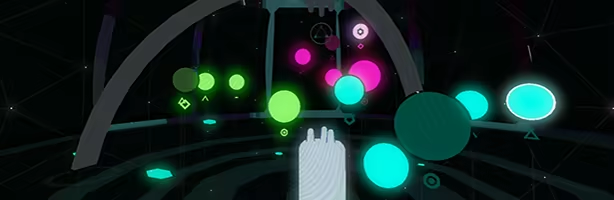
FRACT is a musical exploration game. You arrive in a forgotten place and explore the vast and unfamiliar landscape to discover the secrets of a world built on sound. You rebuild its machinery by solving puzzles and bring the world back to life by shaping sound and creating music in the game.
Modeled estimate, not a reported figure. How we estimate →
Media

About


Stats
All-time low is the lowest price we've recorded for this game since we started tracking it.
Languages: English
Engagement
Hours played at review time, across 51 reviews with recorded playtime.
Reviews
Themes across 51 recent reviews and how positive each mention is. A keyword signal, not full sentiment analysis.
positive critical· bar length = how often the theme comes up
Reviews
The game looks beautiful with its minimalist, TRON inspired style, and the graphical animations and reactions are outstanding, a good variety of puzzles with unique styles to solving them, plus they made everything simple but complicated in the puzzles you solve, and having an actual music editor in a studio like area where you can make your own song for you to save, export them and share to anyone. I would say the game is a mash up of Antichamber’s simplicity, some of the feel of NaissanceE’s atmosphere, TRON’s visuals, and 80s-90s ski-fi hacker sound SFX, and we have FRACT as a lovely result. -FreakOrama More info at: http://www.ksalue.com/main/2014/04/fract-osc-review/
I have been a Beta tester from the second round for Fract OSC and as is such I have seen the game develop within the Beta community and I have to say it is amazing…… If you are interested in music or puzzle games it is a must have day one game. The gameplay is solid with no bugs and so different from any other game out there to date. If I had to compare it to something I would say it is similar to the later Mysts but with music and synths and neon like Tron. The sound is very well incorporated into the game world and is a (if not the) key feature in the game. It is a great game and a good introduction on using synths to someone who is not that musically inclined but would like to produce some music for personal pleasure, this is due to the game teaching you how to use the synths in the in game open world which is very pretty and gives a solid feeling of being inside a synth machine or computer but it is also abstract enough that I spent a number of hours just wondering around the world looking at it. The tools that the Devs give you in game in the studio are simplistic but can provide a massive array of sounds and beats. There is also the option once you have completed the game to change the studio area to a more complex almost akin to a number of programs out there. The Devs have done an outstanding job with it all the puzzles are of good difficulty and any that have been troublesome to many of the beta testers they have improved (without making them straightforward) to the feedback given to them by the community and I have an honest feeling they will continue to do this once the game is released. A massive 11/10.
The marvel of Fract OSC struck me to the point of immobility. Standing within its world of organic sound and breathing architecture, I often found myself unconsciously freezing in place as a dormant level stirred at my approach, erupting into an awe-inspiring display or neon lights and blaring synths that sent goosebumps down my neck. I’d drift into obscure corners and onto meaningless ledges just to see what was there, being astonished at even the smallest piece of a world that seemed impossibly connected and alive. Playing Fract made me feel alive in a way I haven’t experienced in a very long time. There’s so much energy in the air, twisting its way through structures and along the ground to create a world that feels as if it’s constantly in motion, adjusting and changing as so many wondrous sound bellow through the caverns. Fract isn’t just a giant synthesizer, it’s raw emotion flowing through bass lines and echoing synths that shakes the very floor you’re walking on. Every structure is its own sound, adding notes to the beautifully coordinated melody that grew with every step I took and machine I set in motion. Fract provides almost zero assistance in helping you solve its humongous musical contraptions, but the way in which each puzzle builds off the last creates a persistent logic that grows with you as you begin to understand it more. Each object is introduced slowly enough to allow you to learn how to interact with it, but Fract never wastes time repeating itself. Instead it seamlessly folds areas and elements into each other so I was always learning something new even when I didn’t realize it, each puzzle pushing me just enough to feel stimulating but never overwhelming. You can almost feel Fract diligently holding itself back, clearly capable of so much more but always hyper aware of what constitutes “enough” as it cleanly bypasses the excess of many puzzle games with its extraordinarily tight pacing. Being at the center of all this noise, attempting to conduct instruments I had barely begun to understand, I was struck by how small and powerless I was when compared to the monstrous amplifiers all around me. Even as I was helping to revive a world which had gone to sleep, I couldn’t shake how immensely alone I felt. All around me were unbelievable sights moving to a soundtrack that was itself alive within these walls, but there was no one to share it with; not a single soul anywhere to be found in this isolating cavern. The feelings Fract created in me were powerful and complicated. The wonders of its design contrasted with the crushing emptiness I found growing within me the more I played. It filled me with amazement and yet all I wanted to do was cry. What was the point of any of this if it meant spending an eternity in solitude? Fract OSC is everything I expected it to be: clever, gorgeous, innovative, inspired. But I wasn’t prepared for how it would affect me on a deeper level. Without even meaning to I was suddenly examining parts of me I couldn’t make sense of; things I didn’t want to acknowledge or feel comfortable sharing here. It’s an incredible game for so many reasons I’ve sold short here, yet somehow it’s the things I couldn’t see or hear that meant the most. [b]You can read more of my writing on [url=http://kritiqal.com/2015/06/02/fract-osc-review/]Kritiqal[/url].[/b]
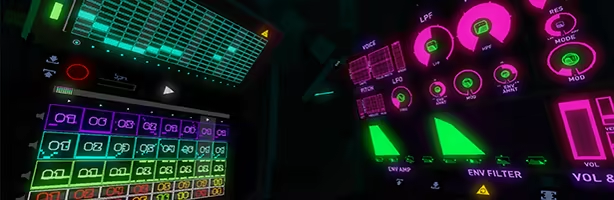
Static washes out your vision, slowly fading away to reveal large and impossible geometric objects reaching up and out as far as you can see. Dead machinery jutting out from pastel colored ground and rock. You don’t know how exactly you got here nor how any of these strange constructs were built. Your legs carry you across the land, poking your head into enclosed buildings that might as well be giant tombs. At last, you come across an object that emits a strange hum. You touch it and the hum changes pitch slightly in reaction. You move it around and it changes tempo and pitch respective to where it was before. You don’t know what is going on but you sure as hell are nodding your head. FRACT OSC is like a Fantasia for the dance-minded music fans. IDisneylandM, if we were to give it a genre tag in our music player. Much like the Aggro-crag, every area on the map is color coded according to the theme of the sounds you’ll expect to hear. Pink acts as your bubbling leads, blue as your bass and green as the airy pads. Each instrument has its own dedicated area in the mountain area FRACT takes place in. The leads come from such towering heights, the pads sit in the middle and the bass rumbles on from down below. There are other, smaller details which show themselves to musician and non-musician alike which key you in to each place’s role in the overall scheme of what is going on. Exploration is only one part of what makes FRACT tick. The tock of the metronome comes from the game’s puzzles. Each instrument has a specific puzzle type which increases in difficulty as you progress through them. The block movement and pad rotation puzzles were fine, but the last laser puzzle in the bass area had me tearing at my hair a while. Overall though I didn’t find any of them prohibitively difficult (though the ease of a majority of them may disappoint hardcore puzzle game fans) and FRACT always allowed me the freedom to leave any given puzzle to explore at my leisure. I would have to come back to it eventually if I wished to see the end, but the lack of pressure really goes a long way towards making even the hardest puzzles easier to forgive. I’m glad to see games like FRACT and Ether One taking this stance. The way the sound design is so keenly and closely tied together with the puzzles was enough to make me smile as every solution came together. Starting off in an area, the puzzles were very basic and the sounds those areas produced once fully activated reflected that. By the time you’ve hit the end of the series of puzzles for a given color/instrument, the puzzles have added new mechanics over time and the resulting sounds that blast forth have additional layers of complexity. It really builds up a feeling of progression. Instead of a simple pat on the back for completion and shoving the player towards the next goal, you’re allowed to enjoy the fruits of your labor. As you complete puzzles which slowly teach you vital elements of constructing tunes you unlock various tools to use in the in-game Studio room. The further into the game you get, the more you’re allowed to add and tweak into the track as you work. It starts off small with only a single loop sequencer and bare minimum controls over the tone of the digital instrument. By the time you’ve completed the entire game, you’re handed an impressively beefy DAW that looks as awesome as the sounds you’re able to make with it. While it is still limited and won’t replace your Reason, ACID or even your old copy of Fruityloops burned to a CD from a decade ago, it serves as an excellent introduction into the world of digital audio production. FRACT OSC is really a musical instruction tool masquerading as a videogame. To make things even better, the game has a built in export function and the dev is totally cool with users making commercial tracks so long as the loop work done with FRACT’s samples were all done in-game. A tutorial to mod in your own beats has been promised as well. By the time I reached the end of my musical journey my ears were ringing and I felt similar to those nights after a gig. I’d emerged from the 8 hour rave session that I conducted for myself and myself alone, nary another ear to hear what reverberated through the cavernous area but my own. With every box aligned, switch flipped and cogs rotated I had brought life to these dead hills. As though Holy Mountain had been redone as a living Demoscene file, I had seen the secrets of this strange land from the very tip of its highest cliff to the very bottom of its deepest trench. I overlooked all that I had conquered and felt that it wasn’t quite enough. I retreated back to my lair, dark and still, slaving away for hours on what was to be my next song. I’d earned the right to control this giant machine and make it bend to my will. If only because I demonstrated that I understood what it wanted. It wanted to make you move.
In FRACT OSC, you explore a desolate alien landscape littered with derelict machinery, beautifully realized by simple untextured polygons shot through with neon and displayed using a graphical filter reminiscent of CRT interlacing. Rods of light, pulsating liquid columns, and crystal lattices respond to your proximity with bursts of sound, the stuff of music flowing forth from the ground beneath your feet, waiting to be harnessed and organized. As you wander, you make inferences about the structure of the world and the function of its technology. You notice visual cues that prompt you to engage your interact mode in specific places, and you discover various pieces of information or interface superimposed upon objects around you. Before long, you begin figuring out how to get things working again, and this abandoned place pumps and glows with activity and color. In the course of solving the world's puzzles and restoring its infrastructure, you construct bits of music through devices that teach you the basics of music programming while incorporating your solutions into the soundtrack that results from the reactivation of key facilities. Sound is all generated on the fly using a unique music engine that is constantly working in the background, and, as if the game itself wasn't enough, FRACT OSC doubles as a robust synth sequencer with exporting and automated YouTube sharing functionality. Playing FRACT OSC has been one of the most enjoyable gaming experiences of my life. I have felt so much wonder and joy while discovering its intricately crafted and interconnected world. Please buy this wonderful game.
It took a few failed attempts before I finally really got into this game, but I'm so glad I stuck with it. FRACT does not go out of its way to tell you what you're meant to be doing or how you're meant to do it, and indeed my first hour was spent utterly lost and wandering around the (admittedly very pretty) landscape, accomplishing absolutely nothing. That frustration led me to put it aside for a few months. But if you stick with it, you'll eventually begin to figure out this game's secrets. By the end of my playtime with FRACT I could start it up knowing exactly what I wanted to do, where I wanted to go, and how I was going to do it. In FRACT, you're plunged into the trippy, Tron-like world of a gigantic yet dormant synthesizer. As you progress further and further, you'll gradually begin to bring the beast online, unlocking more and more of its features that can ultimately be put to use in an actual sequencer (your studio, as the game calls it) which you can visit at any time. This is a game where completing all the puzzles presents you with an actual reward - a fully functional digital audio workstation that is simple to play with, yet deceptively powerful under the hood. If you liked Portal's method of first-person-puzzling, and in particular if you enjoyed the dynamic nature of Portal 2's music which adapted to your progression through the puzzles, you'll likely enjoy this game. It does require a bit of initial time and patience, but it pays off in spades.
Just don't buy if you're on a Mac. Two months after launch, the developers have yet to fix game-breaking sound issues affecting a large number of Macs that are well above the minimum specs (take a look at the forums). There's no word on when or if they'll ever fix this problem, so unfortunately steer clear for now.
A first person puzzler i've been waiting to play since i've seen the first presentation video while the game was still under development. The puzzles aren't very numerous but they are all musically rewarding. As you go on, the dark monolithic world of silence you explore progressively turns into a landscape of sound and primary colors. You control your surrounding as you would an audio creation sofwate; only with a few keys and a mouse. No tricky controls or ninja reflexes requiered. The musical enviromenent makes you feel like living in a "boards of canada" album. I've spent most of my time playing with the sequencer in studio mode and even managed to record a track :) I recomend this game to anyone into electronic music or adventurers not affraid to explore a world made of sound.
an audiovisual journey through unknown landscapes and machinery. On the way you solve pretty simple music based puzzles with sequencers and other stuff. Sounds and looks AMAZING Edit: I wish it had a drum sequencer tho, that would have been kickass
This game has issues. First of all, getting into the menu where you can modify controls requires an internet search to reveal an obscure key combo to hold while launching the game. Second, the game offers minimal guidance as what to do, with visual cues for basic the mouse or gamepad controls in the starter area, but little else. These icons seem simple enough, but I still had trouble getting inside the developers head and realizing they don't want me to hold down a button while moving the mouse, they want me to move the mouse and then click the button. It seems like this was all done to create an immersive experience, which is all well and good, but nail down your UIX first. It doesn't hurt to write actual words explaining what you want the player to do. Getting around is a chore, because the input isn't normalized so you walk diagonally faster than walking forward. If you use a gamepad, this means you will constantly be walking faster and then slower as you change the angle you are headed. This is annoying in a game that has a great deal of walking. The levels are visually appealing, but not much fun to get around in. There are a lot of stylized elevators with long animation sequences and obscure controls. You might think you have found a control panel of some sort, but no it's just another elevator and your experimentation leads to a long animation where you are taken someplace you didn't intend to go. This feels like someone's first stab at putting together something interactive in Unity. It has great artistic direction, but the actual game is at the early alpha stage.
Related
Related
Trends
Modeled estimate over time, reconstructed from Steam's monthly review histogram.
Momentum
Pace estimated from the game's recent review growth (our daily snapshots) at its own sales-per-review ratio — a momentum signal, not booked sales.
Audience
Estimated from the language of this game's reviews — a proxy for where players are, not official Steam demographics.
Related
| Pro Pinball Ultra | $173.6K | 325 | 82% | $14.99 |
| Gatewalkers | $173.6K | 335 | 68% | $24.99 |
| Island Notes | $173.5K | 862 | 82% | $9.09 |
| The Ship: Remasted | $173.4K | 687 | 58% | $9.99 |
| MotoGP™23 | $173.4K | 991 | 76% | $29.99 |
| Circle Empires Rivals | $173.8K | 2K | 90% | $4.79 |