“Master, Master! I did it!!” "I can hear you, no need to shout! Oh, my! This is a rather firm Kidney." My Organic Garden is an avant-garde organ-clicking game. Whether it’s to get Master’s praise, or to please the customer, click away and ship those organs!
Modeled estimate, not a reported figure. How we estimate →
Media

About


Genres
Stats
All-time low is the lowest price we've recorded for this game since we started tracking it.
Languages: English, Japanese
Engagement
Hours played at review time, across 40 reviews with recorded playtime.
Reviews
Themes across 40 recent reviews and how positive each mention is. A keyword signal, not full sentiment analysis.
positive critical· bar length = how often the theme comes up
Reviews
A game whose style far weighs its substance, and I mean that as a positive. The design team did not need to go to such efforts to create such a beautiful, almost stained glass vibrancy and aesthetic in every corner of this games art and world, but it only helps make what would be a simple idle game into something far more. The stories in this game took me by surprise, being storybook-like and genuine in the little tales they wished to tell in this strange world. I think for anyone that has been around the idle block more than once and is craving something fresh in appearance and style, please pick this up.
Best clicker game.
新エンドまで見ようとすると若干作業感がでるのを除けばシナリオの長さにあったコンテンツ量だと思う 値段もボリュームにあってるし 強いて言えば水やりを収穫の画面でやりたかった ジョウロ選択して切り替えの手順が面倒くさいかも
.
Love it, good game
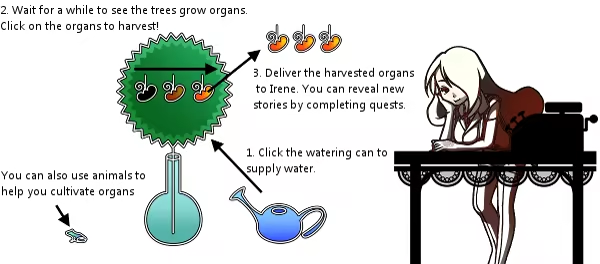
Forget Me Not: My Organic Garden is one of the most unusual indie simulation games ever created, blending farming mechanics, clicker-style progression, visual novel storytelling, and surreal body horror into an experience that feels strangely comforting and deeply unsettling at the same time. What initially appears to be a quirky management game about growing organs inside a greenhouse slowly transforms into something far more atmospheric and emotionally layered. Beneath the repetitive farming mechanics and soft visual style lies a surprisingly haunting story about identity, routine, and the disturbing normalization of impossible things. The premise alone immediately makes the game stand out. Players take control of Organa, a young apprentice working for a woman named Irene in a peaceful village shop that specializes in cultivating human organs like crops. Hearts, lungs, kidneys, and other body parts are planted, watered, harvested, and sold to customers as though they were ordinary vegetables. The world treats this bizarre process as completely normal, and that calm acceptance of something grotesque creates the game’s uniquely surreal atmosphere. Instead of relying on graphic horror, the game becomes unsettling through its quiet normality and dreamlike presentation. The gameplay revolves primarily around growing and harvesting organs while fulfilling requests from customers visiting the shop. Players repeatedly water organ plants, monitor their growth, collect them at the proper quality level, and complete delivery orders in exchange for money and progression. At first the mechanics feel extremely simple, almost resembling a basic idle or clicker game, but the loop gradually becomes surprisingly addictive as more organ types, upgrades, and management systems unlock. The constant cycle of planting, harvesting, and fulfilling requests creates a strangely hypnotic rhythm that becomes central to the game’s atmosphere. One of the most interesting aspects of the experience is how repetition itself becomes part of the storytelling. The routine of growing organs eventually starts to feel natural despite the disturbing premise, mirroring how Organa adapts to life inside Irene’s greenhouse. The game intentionally blurs the line between comfort and discomfort, encouraging players to settle into an unsettling daily routine while quietly hinting that something deeply wrong exists beneath the surface of the village. That emotional contradiction gives the game much of its identity. Progression systems help maintain engagement throughout the experience. Completing customer requests unlocks additional organ types, greenhouse expansions, better tools, and efficiency upgrades that gradually transform the simple farming loop into a more involved management system. The satisfaction of optimizing organ production and building a more efficient greenhouse creates a rewarding sense of advancement even though the core gameplay remains relatively straightforward. The narrative unfolds slowly through conversations with customers and interactions between Organa and Irene. At first, the story feels almost slice-of-life in tone, focusing on everyday tasks and the strange routines of the village. However, darker themes gradually emerge involving obsession, sacrifice, memory, and the disturbing nature of the world itself. The game avoids directly explaining everything immediately, instead allowing atmosphere, implication, and subtle storytelling to create tension and mystery over time. This slower approach makes later revelations significantly more impactful. The characters contribute heavily to the game’s charm and emotional weight. Customers arriving at the shop range from eccentric and humorous to quietly disturbing, each bringing their own strange requests and stories into the narrative. Irene is especially memorable because of how calm and affectionate she appears despite the grotesque work surrounding her. Her relationship with Organa develops gradually and becomes one of the emotional foundations of the story, adding warmth to a world that constantly feels slightly wrong. Visually, the game uses a soft cartoon-inspired art style that contrasts sharply against the disturbing premise. The organs themselves are colorful and oddly cute rather than graphic or horrifying, allowing the game to maintain a strange dreamlike quality throughout the experience. Character portraits are expressive, environments are warm and inviting, and the overall presentation feels intentionally cozy despite the body-horror themes hidden beneath the surface. This contrast between comforting visuals and unsettling concepts is one of the game’s greatest strengths. The soundtrack also deserves considerable praise. Gentle melodies, music-box themes, and melancholic ambient tracks constantly shift between peaceful and eerie, perfectly supporting the emotional tone of the story. The music rarely becomes loud or dramatic, instead quietly reinforcing the unsettling atmosphere and emotional melancholy surrounding the greenhouse and its inhabitants. Combined with the repetitive farming mechanics, the soundtrack helps create an experience that feels strangely meditative. However, the game is not without flaws. The repetitive nature of the gameplay can eventually become exhausting, especially during later stages where progression requires large quantities of specific organs and extensive grinding. Players who dislike clicker-style mechanics may struggle with how heavily the experience depends on repetitive harvesting loops and resource management. The interface also becomes somewhat cluttered as more organ types and systems unlock. Managing the greenhouse efficiently during later stages can feel tedious, and certain mechanics are not explained clearly enough for new players. Some progression requirements become confusing without experimentation or outside guidance, which may frustrate players looking for a smoother management experience. Pacing can also become uneven. While the slower progression contributes heavily to the game’s atmosphere, certain sections drag due to repetitive grinding and limited gameplay variety. The strongest elements of the experience are clearly its atmosphere and storytelling rather than the complexity of its mechanics. Despite these weaknesses, Forget Me Not: My Organic Garden succeeds because of how confidently it embraces its bizarre concept. Very few games attempt to combine cozy farming gameplay with surreal body horror and emotional storytelling so naturally. The game constantly feels strange and uncomfortable, yet also oddly relaxing and emotionally sincere at the same time. What ultimately makes the experience memorable is the emotional contradiction at its core. The game somehow turns the repetitive act of harvesting human organs into something peaceful while gradually revealing darker truths hiding beneath its comforting surface. That balance between warmth and unease gives the game a personality unlike almost anything else in the indie simulation genre. Forget Me Not: My Organic Garden is not a game designed for everyone. Its repetitive structure, slower pacing, and unsettling themes will likely alienate some players. However, those willing to embrace its strange atmosphere and surreal storytelling will discover one of the most original and emotionally distinctive indie management games available. Its combination of farming mechanics, atmospheric storytelling, memorable music, and bizarre world-building creates an experience that lingers long after the final harvest. Rating: 8/10
Дизлайк чисто за механику лейки, полив путем "выделение конкретного дерева + зажатие ЛКМ" очень душит. Еще и откат по времени.. зачем?.. По итогу и не полноценный идл, и не адекватный кликер. Графон самобытный, сюжет в целом интересный, но гринд очень кривой и из-за лейки пипец скучный
So as clickers go, this one is interesting, varied, and actually has a plot. The world it is set in is calm yet quite strange (seriously, you're selling organs, which can bring things to life) which keeps things interesting. The different trees work differently which invites strategy. All in all, quite good. The frogs suck, though. I hate them with the passion of a thousand suns. You need them to help you get water, see? Them and the homonculi are the only necessary 'animals'. However they flee from their one job CONSTANTLY. No matter their level. Once you buy a few, there is a literally constant stream of stupid frogs leaping away from the only reason they exist. You'll be clicking desperately on the bottom of your screen at all times. You'll be so busy you forget to water your trees. I can't count how many interesting story missions I've missed because they popped up while I was desperately trying to keep my retarded frogs from running away and I clicked through them before I could stop myself. I HATE those things. I don't quite hate them enough to downvote the game, but it was a close thing. Aside from the frogs it's a very good game for its type. The frogs can burn in hell.
Cute, surprisingly wholesome and relaxing.
Finally 100% the game nine years after I firt played it. An unforgettable game with tons of charm, the music is a special highlight for me too.
Related
Related
Trends
Modeled estimate over time, reconstructed from Steam's monthly review histogram.
Momentum
Pace estimated from the game's recent review growth (our daily snapshots) at its own sales-per-review ratio — a momentum signal, not booked sales.
Audience
Estimated from the language of this game's reviews — a proxy for where players are, not official Steam demographics.
Related
| Artifact Seeker: Resurrection | $166.7K | 710 | 80% | $8.99 |
| Nancy Drew®: Shadow at the Water's Edge | $166.6K | 421 | 82% | $19.99 |
| Hive Jump | $166.6K | 371 | 68% | $19.99 |
| Gray Haven : Witch's Garden | $166.7K | 350 | 76% | $21.99 |
| Overture | $166.7K | 1.3K | 75% | $4.99 |
| Aeon's End | $166.5K | 492 | 82% | $14.99 |
Related
| 7 Days to Die | $425.3M | 403.6K | 87% | $44.99 |
| Euro Truck Simulator 2 | $421.6M | 932.3K | 97% | $19.99 |
| Mount & Blade II: Bannerlord | $309.8M | 294K | 88% | $49.99 |
| Stardew Valley | $258.9M | 881.6K | 99% | $14.99 |
| The Forest | $254.8M | 678.6K | 96% | $19.99 |
| Project Zomboid | $239.1M | 461K | 94% | $19.99 |