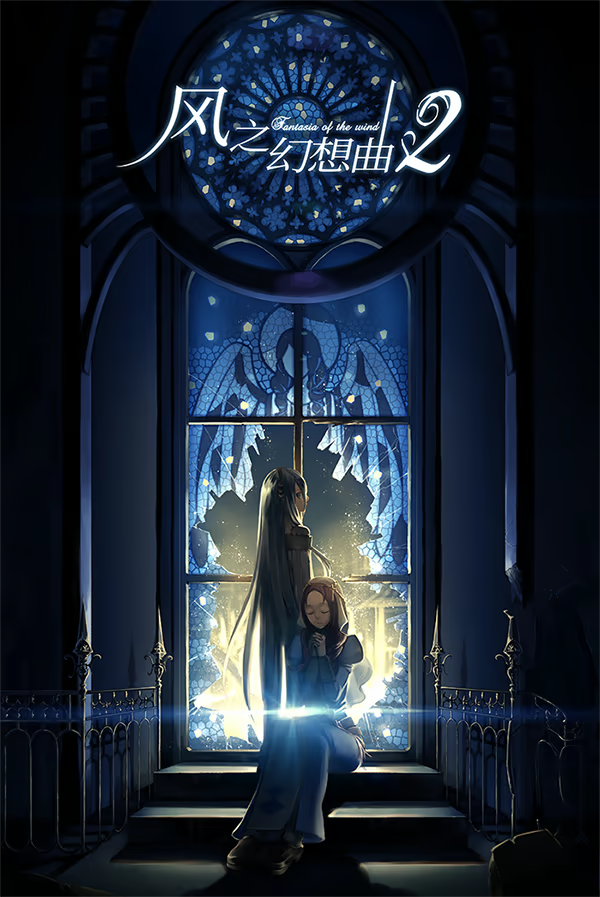
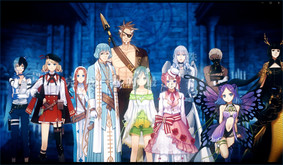
Fantasia of the Wind 2 风之幻想曲 第二部 is a narrative-heavy indie RPG developed and published by Fantasia Studio that doubles down on introspection, consequence, and player choice rather than spectacle or mechanical excess. As a direct continuation of the first game, it assumes familiarity with its world and themes, yet it quickly establishes its own identity by shifting focus toward reflection and the emotional cost of past decisions. The tone is quieter and more contemplative than many fantasy RPGs, framing its adventure not as a race to stop an abstract evil, but as a journey through regret, responsibility, and the lingering echoes of choices once believed to be necessary.
The story centers on Sandora, who previously altered fate itself by forming a pact with the Time Goddess to save her homeland. Victory, however, has left her isolated. Companions have gone their separate ways, bonds have frayed, and the certainty she once had has been replaced by doubt. This premise gives Fantasia of the Wind 2 a distinctly reflective backbone, where the central question is not simply what must be done next, but whether the past could—or should—have unfolded differently. The narrative frequently revisits key moments, allowing players to explore alternate outcomes and perspectives, turning the act of replaying into a thematic extension of the story rather than a purely mechanical incentive.
Exploration across the Marcus Continent unfolds in a semi-open structure that prioritizes narrative discovery. Towns, wilderness areas, ruins, and dungeons are designed less as combat gauntlets and more as storytelling spaces, filled with NPCs whose lives have been shaped by the world’s shifting history. Dialogue carries significant weight, often revealing subtle changes in relationships or worldview depending on the choices made earlier. Side quests are not filler distractions but meaningful vignettes that expand the setting’s emotional and thematic scope, offering insight into how ordinary people cope with the consequences of grand, god-touched decisions.
Combat and progression serve the story rather than dominating it. Encounters are integrated naturally into exploration and plot advancement, and character abilities feel tied to identity and narrative role instead of existing purely as optimization tools. Party members bring distinct skills that matter not only in battle, but also in puzzles, exploration, and story events, reinforcing the sense that these characters are people first and combatants second. Progression is steady and deliberate, avoiding power inflation in favor of maintaining tension and relevance across the game’s branching paths.
One of the game’s defining strengths is its cast. Companions are written with care, each carrying their own motivations, regrets, and unresolved conflicts. Their interactions with Sandora evolve based on player decisions, and these relationships can subtly or dramatically alter the direction of the narrative. Even minor characters are given moments of humanity, making the world feel lived in and emotionally coherent. Rather than presenting clear moral binaries, Fantasia of the Wind 2 consistently frames choices as trade-offs, encouraging players to reflect on intent versus outcome.
Structurally, the game embraces non-linearity with confidence. Key decision points open divergent story routes, each containing unique scenes, character developments, and revelations. These branches are not superficial variations but meaningful rewrites of events, making repeat playthroughs feel like legitimate alternate timelines rather than minor tweaks. This design significantly enhances replay value, especially for players interested in uncovering the full emotional and narrative scope of the game.
Visually, Fantasia of the Wind 2 adopts a classic RPGMaker-inspired 2D presentation that emphasizes clarity and expressiveness over technical spectacle. Sprite work, portraits, and environments are functional yet evocative, supporting the story without distracting from it. The aesthetic leans into nostalgia while maintaining a consistent atmosphere, and the soundtrack reinforces emotional beats with restraint rather than bombast, allowing quieter moments to resonate.
A notable limitation is accessibility. The game is presented entirely in Chinese, with no official English localization, which creates a significant barrier for international audiences. For players able or willing to engage through translation tools, the narrative depth is evident, but the language barrier undeniably limits its reach. This is unfortunate, as the game’s strengths lie almost entirely in its writing and character development—areas that depend heavily on clear understanding.
Ultimately, Fantasia of the Wind 2 风之幻想曲 第二部 stands as a thoughtful, emotionally driven RPG that prioritizes meaning over momentum. It is less concerned with delivering constant action or spectacle and more interested in asking players to sit with their decisions and explore the ramifications of altering fate. For fans of story-rich RPGs, branching narratives, and introspective fantasy worlds—and especially for players comfortable with Chinese-language titles—it offers a deeply rewarding experience that lingers not because of what you defeated, but because of what you chose to change, and what that change cost.
Rating: 8/10