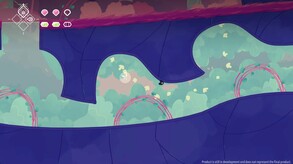
Embark on an enchanting adventure in this breathtaking 2D Metroidvania game inspired by the rich folklore of Indonesia. Control Kimo and Wispy as they seek to recover the Shards of Light. Manipulate terrain to solve puzzles, befriend the natives of Lumina, and take abilities from powerful titans.✨
Modeled estimate, not a reported figure. How we estimate →
Media
About


Stats
All-time low is the lowest price we've recorded for this game since we started tracking it.
Languages: English, French, German, Japanese, Simplified Chinese, Indonesian
Engagement
Hours played at review time, across 40 reviews with recorded playtime.
Reviews
Themes across 40 recent reviews and how positive each mention is. A keyword signal, not full sentiment analysis.
positive critical· bar length = how often the theme comes up
Reviews
Pros - art style and music - cuuuuteness - cool names - NPC design (big fluffy cats!) Cons (here we go) If you enjoy backtracking, I suggest looking elsewhere, because here there is basically none. Sure, there are some platforming sections that might look like you need a new ability, but you can actually find a way around it in 10 seconds. That being said, new abilities do NOT suggest backtracking. Almost all collectibles are lore chests or letter, no trinkets or stuff. Why do I need such a big inventory then? I wished to see more characteristics of the genre. Map is terrible. It shows huge chunks as explored but there might be a chest or a scroll that you can't reach yet, but the game has no symbol for it. It also doesn't have any names on the map, so you need to memorize exists to different areas. There is also no world map, which is a pity, since the game has such nice visuals; it would be nice to see everything put together. Fast traveling is kinda lame. You only have one spot in each area, which you can travel from. Moving through the level starts feeling boring, but you need to buy (for some small amount) trinket that will let you travel between checkpoints. Combat is ... okay, I guess? You have a basic attack and 3 combat abilities later. Abilities cost the same amount of mana and do mostly the same amount of damage (except the second one). What is the difference damage wise between basic attack and ability 1? None, except range and animation. I also absolutely hate that they added GLIDE as a 4th ability, so you constantly need to switch them on keyboard, which is really dumb. You can't imporve them, nor you asic attack. You can buy health and mana (or spirit, or whatever) upgrades. Controls are clanky and more often than not I want to smash my keyboard, because the inputs are late or incorrect. I loathed every water section because of that. Mind, I played with keyboard, so maybe it feels better with joystick. But then, why would you not make proper controls for keyboard? Timings are often off. Hitboxes are not constistent. RIP my pinky. It's a pity that you can't play with a mouse, it would be so much easier. Glide is not properly implemented. Why you start using Glide to go up, you jerk upwards, and there are some platforming sections where it really messes it up. If you want to be inspired by Ori, at least, do it properly. I do appreciate how fast dash is and how little cooldown time it has. Platforming is either a miss or hit. Some parts are okay. I enjoyed platforming in the palace with plant-like snakes and lasers, that was such a great idea. Respawning is questionable at times. You have little enemies on the level, but there were a couple of times where the room was littered with them. It felt out of place considering the level design. Some enemies merge with the background or even their weapons. For example, the yellow shurikens blend a lot with the walls, platforms or ground. Boss design is mid. Most bosses do not require any abilities and you can cheese them. Hitboxes are off most often than not. Final boss should have been more developed a bit more. The colors chosen for it and for the attacks are a bit unfortunate. As of now, I can't finish it, because unfortunately my eyes simply cannot keep up with the color scheme. I wish the devs had thought more about this. Maybe, they did it on purpose to raise the difficulty, but it is a very artificial way to do this. The story is also mid, you can kinda predict it, so it's not fun or intriguing. I am not familiar with Indonisian folklore, but I think it has much more to offer to the story. I had some minor bugs, where Kimo kinda gets stuck in a dash animation. It can move and jumb and even attack in this state, just without any visuals. The bug disappears in about 7 seconds. I can't return to talk to Quinn after defeating her. The whole battle sequence starts again while she is talking and I can't move on with the dialog since it's in a battle mode. All that being said, I think it is a cute game with great potential, but, given all the cons, I wouldn't pay the full price for it. I got it with a hefty discount, and I don't think it's worth more; unless some serious polishing is made.
It looks vibrant and colorful on the store page, but upon closer inspection, this game's mechanics, level design, and graphic design all come off as lazy, rushed, or unfinished. Specific examples include: -An enemy that fires a laser at you, but the laser is an orange rectangle that just appears like you inserted a shape into your PowerPoint. It's just a rectangle that extends in your direction, and that's its only attack. -Some floors that are too slanted can be stood on, but you can't jump off them. The devs forgot to include the ability to slide off slopes. -There are a few locations that while moving along the ground I just stopped moving because the ground that's supposed to be smooth isn't. It looked like I was running into nothing. -One boss requires attacking on the surface of a pool of water, but the little blob guy will constantly go in and out of surface-mode and water-mode. This screws with your ability to dodge and attack. -None of the bosses are exciting. Master Lou is so easy it's kinda sad. The final boss is weird and disappointing. To be honest, it wasn't a bad experience. I enjoyed quite a few of the platforming challenges, and I don't feel like I wasted my time, but I just can't recommend an unfinished game.
I wanted to like this game. There are many issues with missed inputs. Especially when moving sideways. The character acts as if there was a wall and stops moving. You need to release the joystick in order for the movement to start working again. This makes traversing the game difficult. But what is extremely frustrating is when you die to a boss because of these missed inputs and have to start over again.
I feel bad giving this game a negative review, because it did so much right, but ultimately I found myself disliking more segments than liking them, so I'll split my review into segments to show off why I like Faerie Afterlight, and why I dislike it. I loved the art style and music of this game. What allured me to this game was that initially. I also saw that Skurry played it, and after watching them play it for 10 minutes, I decided I wanted to see it for myself. Every area of the game is so vibrant and different to each other that its refreshing to explore each area to take in the beauty of it all. Taking in each environment with the beautiful ost was awesome, if only before the puzzles got unfair. The boss music wasn't exactly memorable to me, but it wasn't like it was bad. I thought they were solid and made sense for a boss. The puzzles did help me understand how each gimmick worked very well! They didn't feel too impossible and made sense to me without having to look much up. However, that's where my praises end, as many negatives began to pile up. First, I encountered several visual glitches while playing. Most weren't too hard to manage, as it didn't change gameplay, but the final 3 bosses would make Kimo's sprite break and mean that I couldn't attack, making me have to restart the fights in order to fix the fight. EXTREMELY frustrating, especially in a good run. The game also scales the difficulty extremely strangely. The bosses were pretty easy, but the platforming was obscenely precise. Some of the early water sections felt way too unfair, but the final boss felt as easy as the first boss. I was expecting an easier difficulty scaling in the platforming, and harder difficulty scaling with the bosses, but didn't really get that. The characters felt really basic, and didn't really keep me interested in the plot. The twist was super easy to call out, which really didn't add to the plot, either. It's always cool to be able to call out something, but when you call it out after the first boss...not nearly as cool. Really killed my motivation to get the secret ending, and I don't know that I'll do anything else with this game. Maybe? But I'm not sure. My final critique is that the final areas being able to be accessed at the same time was a bit misleading. You need to beat the fourth boss to get through Ashen Sanctuary, and they don't say anything at all regarding this, making me go through all this platforming and having to find ways around it without that upgrade because I had figured that's how the game was meant to be. Very frustrating, the backtracking was annoying. Wish there was something indicating this before, but there was nothing. After everything, I feel like Faerie Afterlight definitely tried and did a lot of things right, but felt more like a slog to the end, rather than an exciting story and good gameplay. I wish the developers well in their next developing journey, and hope they find this criticism well. I may go back and 100% this game, but as it stands, I'm satisfied with what I played.
Faerie Afterlight is an amazing metroidvania with a nice story and art designs, don't let the mixed reviews deceive you because this is a spectacular indie game with great playability. I have seen reviews which says the game doesn't have any biome / world fast travelling or even backtracking. Well guess what? I can say that is incorrect. There is fast travelling in the game between the biomes as well as backtracking whenever you want in order to collect missing items which you might need later in the game. The soundtracks and art design in the game is top notch which makes the game even more memorable. The boss fights design were fun as well. I really enjoyed reading all dialogues as well as the story. This is a truly underrated metroidvania game that was overlooked. The devs has addressed many bugs over the past few months and I can say the game is polished now and even more enjoyable. Overall Rating 10/10. Thank you Clay Team for this Amazing Game!!
This game is really good at what it is trying to do, which is frustrating the player. Character controls like a oiled up shopping cart, combat is stale and platforming sections are designed to make you start all over.
回想起来,最早吉莫还有没有嘴...... 从游戏的pr阿尔法测试版到贝塔测试版,整整追随了五年,如今正式版上线,我认为可以称得上一款优秀的作品。特别是艺术风格和音乐,都很独特。而且作为我人生中第一部银河城类游戏,改变了我曾经云玩认为银河城游戏地图都很屎的特点(虽然这游戏在阿尔法测试阶段也没地图),当然,也不是所有银河城游戏都不带地图..... 跟测试版相比,我认为作者他是会玩自己的作品的,游戏中的泰坦巨神血量(游戏中boss)明显变脆(相比阿尔法和贝塔测试版,boss命那是比基岩还硬,血比大气层还厚)。战斗方面我推荐使用手柄,游戏本身是具备一定难度的,如果用键盘的话可能会出现操作鸡肋的情况。(我看了下大部分差评都是说操作恶心,所以要玩的话请无比准备手柄)。整体体验下来,操作弊端就是技能钩爪没做好。测试版出身自带的蹬墙跳和冲刺改到打完boss后才有的技能,这真的让我很生气 剧情方面我认为没什么可挑剔,含反转桥段。游戏结局分为好结局和真结局,个人认为从这一层面上给整个剧情添上了最好的一笔。 总体下来如果你有手柄的话真的很推荐尝试,无论是体验战斗还是美术,都能获得不错的体验。至于最终boss,啊,那可能要吃点操作,我相信如果你经常或者偶尔玩些高难或者吃操作的游戏,你花不了太长时间,一样可以像我把他摁在地上摩擦(¬_¬ )👍 啊我求你了,赶紧出2吧
Faerie Afterlight is a hand-crafted 2D Metroidvania developed by Clay Game Studio and published by Mastiff that leans heavily into atmosphere, folklore, and visual storytelling rather than pure mechanical intensity. Set in the fractured world of Lumina, the game presents an adventure shaped by light and shadow, where exploration and mood take precedence over fast-paced combat. From the very beginning, it establishes itself as a gentle, dreamlike experience that invites players to slow down and absorb its world rather than rush through it. The story centers on two intertwined protagonists: Kimo, a solitary creature bound to the darker depths of Lumina, and Wispy, a small fairy whose mission is to restore the shattered source of light known as Lucentia. Their journey is framed as both a physical and symbolic restoration, with each recovered fragment helping heal the world’s corrupted regions. Narrative delivery is understated, relying more on environmental cues, visual symbolism, and lore fragments than on lengthy dialogue. This subtle approach works well for players who enjoy piecing together meaning through exploration, though it may feel restrained for those expecting a more character-driven or emotionally explicit storyline. Visually, Faerie Afterlight is its strongest and most immediately striking element. The hand-drawn art style draws inspiration from Indonesian folklore and philosophy, giving the game a distinctive identity that sets it apart from more Western-inspired Metroidvanias. Environments are lush, colorful, and often painterly, shifting from tranquil forests and glowing caverns to eerie ruins and corrupted zones overtaken by darkness. Animation is fluid and expressive, particularly in environmental effects and background details, which helps the world feel alive even during quieter moments. Complementing the visuals is a soft, atmospheric soundtrack that reinforces the game’s calm, almost meditative tone. Gameplay revolves around classic Metroidvania exploration, with interconnected areas gradually opening up as new abilities are unlocked. Control is split conceptually between Kimo and Wispy, though they move as a single unit. Kimo handles most physical actions such as movement and combat, while Wispy interacts with the environment by manipulating light-based elements, activating mechanisms, or altering terrain. This dual-character design adds a light puzzle-solving layer to traversal, encouraging players to think creatively about how to progress rather than relying solely on reflexes. Platforming forms the backbone of the experience and varies in difficulty across the game. Early sections are forgiving and exploratory, easing players into movement mechanics and environmental interactions. Later areas introduce more demanding sequences, including precise jumps, environmental hazards, and sections that require careful timing. These difficulty spikes can feel abrupt at times, especially given the game’s otherwise gentle pacing, and may frustrate players who were drawn in primarily by the relaxed atmosphere. Combat in Faerie Afterlight is intentionally simple and often takes a secondary role to exploration and puzzles. Regular enemies function more as obstacles than as tactical encounters, with limited patterns and straightforward interactions. Boss fights tend to emphasize environmental mechanics and movement challenges over traditional combat depth, sometimes restricting abilities players have previously unlocked. While this design reinforces the game’s puzzle-oriented identity, it can also create a sense of inconsistency, particularly for players who expect their growing skillset to be fully utilized in major encounters. Progression is steady and satisfying from an exploration standpoint. New abilities meaningfully expand traversal options, encouraging backtracking to uncover secrets, collectibles, and hidden paths. The world design supports this loop well, with visual hints subtly guiding players toward unexplored areas. However, the lack of a fully featured map system can make navigation confusing, especially in more complex regions, and may slow down the sense of momentum during extended play sessions. Overall, Faerie Afterlight is a Metroidvania that prioritizes mood, art direction, and thematic cohesion over mechanical complexity. Its strengths lie in its enchanting presentation, culturally inspired worldbuilding, and thoughtful environmental design. While its combat and pacing may not satisfy players seeking tightly tuned action or deep systems, it offers a memorable journey for those who value atmosphere, visual storytelling, and exploratory platforming. As an indie title, it stands out not for reinventing the genre, but for infusing it with a distinct artistic voice and a calm, reflective sensibility that lingers long after the adventure ends. Rating: 6/10
謎の生き物キーモと精霊のウィスピーが幻想的なルーミナの世界を旅する、2Dアクション作品。 一番の推しどころは、なんといっても独特で美しいビジュアル。 どこを取ってもスクショしたら映える世界感で、目が退屈するようなことはありません 音楽も聴き心地がよく、世界感の統一ができており、それだけでも十分楽しめる作品です。 アクション面はすこしゆっくりめで、自分的にはかなり遊びやすく思いました。 面白そうなギミックやスキルはあったものの、個人的にうまく活用されていないと感じてしまい、少し残念にも感じました。 ただ、そこにものを求めるゲームでもないのかもしれません。自分はたのしく遊べました。 [spoiler]ラスボス戦の飛躍的難易度には腰を抜かしましたが、たのしく撃破まで持っていけました。[/spoiler] アクションの若干の物足りなさを世界感で補う、良い作品だと感じました。 少しゆったりめな2Dアクションを楽しみたいかたは、ぜひ手に取ってみてください。
I just got the game and immediately got hooked for the next 4 hours, best metroidvania I've ever played alongside Hollow Knight. Very Impressive design and feel, and the visuals are gorgeous
Related
Related
Trends
Concurrent players on Steam, sampled daily since tracking started.
Momentum
Pace estimated from the game's recent review growth (our daily snapshots) at its own sales-per-review ratio — a momentum signal, not booked sales.
Audience
Estimated from the language of this game's reviews — a proxy for where players are, not official Steam demographics.
Related
| PBA Pro Bowling 2021 | $43.5K | 109 | 83% | $14.99 |
| Ghost Files 2: Memory of a Crime | $43.5K | 200 | 84% | $14.99 |
| The Cooking Game VR | $43.5K | 63 | 70% | $19.99 |
| 30 Birds | $43.5K | 149 | 97% | $17.99 |
| 100ft Robot Golf | $43.5K | 194 | 69% | $9.99 |
| Tiny Auto Knights | $43.5K | 209 | 84% | $7.49 |
Related
| 7 Days to Die | $425.3M | 403.5K | 87% | $44.99 |
| Mount & Blade II: Bannerlord | $309.8M | 293.9K | 88% | $49.99 |
| Palworld | $279.6M | 445.8K | 94% | $20.99 |
| The Forest | $254.8M | 678.5K | 96% | $19.99 |
| Clair Obscur: Expedition 33 | $243.3M | 273.2K | 95% | $47.99 |
| Ready or Not | $238.1M | 338.9K | 78% | $49.99 |