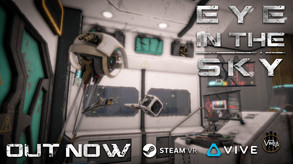
Eye in the Sky is an asymmetrical local co-op escape room where a VR player and a Computer player solve puzzles from different perspectives. The goal is to share information from each perspective and overcome the obstacles on a journey to the center of a post-apocalyptic robot planet.
Modeled estimate, not a reported figure. How we estimate →
Media

About
Stats
All-time low is the lowest price we've recorded for this game since we started tracking it.
Languages: English
Engagement
Hours played at review time, across 40 reviews with recorded playtime.
Reviews
Themes across 40 recent reviews and how positive each mention is. A keyword signal, not full sentiment analysis.
positive critical· bar length = how often the theme comes up
Reviews
This has been great so far. My daughter and I play this at the end of the day to unwind. It nice that there is no fighting, just a puzzle that has to be figured out and each person has a role to play to continue to the next level/puzzle. It is like an escape room without the timer.
По ремоут плею более чем классный опыт игры)
Good idea - very bad execution. Game is not fun. Graphic dull. Sound works sometimes. Some puzzles are ok, but in general not interesting.
Eye in the Sky is a distinctive cooperative puzzle experience that revolves entirely around perspective, communication, and trust between two players. Developed and published by VinLia Games, it is designed as a local asymmetrical co-op title where one player uses a VR headset while the other plays on a standard screen. Rather than relying on reflexes, combat, or fast-paced mechanics, the game’s core identity is built on shared problem solving, asking players to interpret the same space in radically different ways and combine their partial understandings into complete solutions. The asymmetrical structure is the game’s defining feature and its greatest strength. The VR player takes on the role of the “Eye,” a floating observer with a godlike, top-down view of the environment. From this vantage point, the Eye can see the entire puzzle layout at once, manipulate large objects, activate distant mechanisms, and guide the other player through hazards. The non-VR player controls the “Light,” a small robot navigating the environment from ground level. This role involves exploring narrow paths, interacting with switches, collecting items, and responding to dangers that the Eye may not be able to perceive clearly from above. Neither player can solve puzzles alone; success only comes from constant verbal communication and coordinated action. Puzzle design is carefully built around this division of roles. Early challenges introduce the concept gently, encouraging players to learn how to describe what they see and translate that information into action. As the game progresses, puzzles become more layered, requiring precise timing, spatial reasoning, and careful sequencing of actions. Lasers, moving platforms, hidden triggers, and environmental obstacles force both players to stay engaged and actively problem-solve together. The Eye might understand the overall structure of a puzzle but lack the fine detail needed to execute it, while the Light might see a crucial switch without understanding how it fits into the larger mechanism. This deliberate imbalance creates moments of tension and satisfaction when communication finally clicks. Visually, Eye in the Sky adopts a stylized science-fiction aesthetic set in a quiet, abandoned robotic world. The environments are clean and readable, with strong visual cues that help players identify interactive elements from both perspectives. Lighting is used strategically to draw attention to hazards and objectives, ensuring that puzzles remain fair even as they grow more complex. While the graphical style is not overly detailed or realistic, it serves the gameplay well by emphasizing clarity over spectacle, which is especially important in a VR setting where visual overload can be distracting or uncomfortable. Sound design and music play a subtle but effective supporting role. Ambient audio reinforces the sense of isolation within the puzzle spaces, while sound effects provide feedback for successful interactions and environmental changes. Audio cues often help bridge the gap between perspectives, alerting one player to actions taken by the other even when they are not directly visible. This reinforces the cooperative nature of the experience, making players feel connected despite occupying very different viewpoints. One of the game’s most notable limitations is its strict reliance on local co-op. There is no online multiplayer option, meaning both players must be physically present in the same space. While this design choice strengthens face-to-face communication and shared discovery, it also limits accessibility for players without access to both a VR setup and a willing partner. Additionally, the game offers little in the way of solo content, making it firmly a shared experience rather than something that can be enjoyed alone. Overall, Eye in the Sky stands out as a thoughtful and inventive take on cooperative puzzle design, especially within the VR space. Its emphasis on communication, asymmetry, and shared understanding creates a unique dynamic that few other games attempt. While its scope is intentionally narrow and its audience limited by hardware and local co-op requirements, it succeeds in delivering a memorable experience that feels genuinely collaborative. For players looking for a VR game that prioritizes teamwork and intellectual engagement over action or spectacle, Eye in the Sky offers a rewarding and refreshing cooperative challenge that highlights the power of perspective-driven design. Rating: 6/10
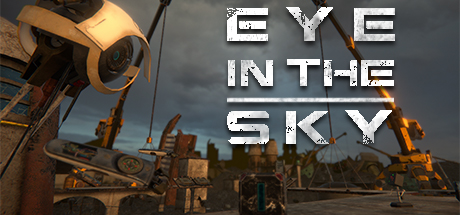
An adorable escape-room-lite experience for two players. If you wanted to go out puzzling but are stuck inside, it's a great way to kill an evening. The puzzles include a little bit of everything; they're mostly communication challenges that require the players to communicate information only one of them can see, with a few physics and timing puzzles mixed in. The puzzles that synthesize limited information with clever thinking are the standout of the bunch - one my partner described as "tic-tac-toe" was particularly memorable in feeling great to solve together. The physics puzzles are the worst - I spent 15 minutes in VR trying to throw barrels at small holes to get the required materials for that same puzzle. I suspect most players will take between 2 and 4 hours to finish the game, and then there are some bonus levels afterwards if you crave more. Once you're done with that, though, that's it - a short-and-sweet way to spend an evening puzzling with a good friend, but not something you'll be coming back to when you're done.
the game lacks a way for the Vr player to move other than mopve there body. its not nice when a cabinet or something like that stops you from playing the game just because you dont own a 1000m^2 home with space for this game.
I like the idea of what this game was going for, but between not explaining even what the win condition is, and physics interactions being very unpolished (it's easy to glitch objects through the wall - the camera regularly clips through them too), this game seems more like a tech demo than a coherent series of puzzles. If you're up for some jank, this may be for you, but be prepared to struggle a little.
👍
DEV READ THIS PLEASE: This is a really nice game and I love the whole asymetric VR thing but you need to enable the VR guy move! You can make him move with the analog stick or add a button to recenter the VR player because there were many times I needed to reach somewhere but there is a wall or a couch or a table in my room that made this whole thing very difficult. I need to get a box from the ground - there is a couch there and the box is under the couch. I had to move things in the room to be able to reach there! I need to rotate a valve but half of the valve is in the wall (in real world) so I can grab a portion of the valve and it becomes such a stupid hard thing to rotate a valve. This really hindered the fun. Please add some sort of movement / recenter ability to the VR guy. Besides the semi-game breaking issue I mentioned above, this is a great game to be played with your friend/SO/kid. I've been playing with my 10 year old son, and we had so much fun. The price is fairly cheap. The puzzles are nice. Graphics are not bad. I didnt experience any major bugs. The only problem is in its current state you need alot of room to be able to play it properly, which can be easily solved if the DEVS add some sort of movement for the VR player.
geht ab
Related
Related
Trends
Modeled estimate over time, reconstructed from Steam's monthly review histogram.
Momentum
Pace estimated from the game's recent review growth (our daily snapshots) at its own sales-per-review ratio — a momentum signal, not booked sales.
Audience
Estimated from the language of this game's reviews — a proxy for where players are, not official Steam demographics.
Related
| The Blue Flamingo | $28.3K | 112 | 61% | $9.99 |
| Switch Galaxy Ultra | $28.3K | 112 | 46% | $9.99 |
| HOPELESS JUNCTION: cuppy dog barf girl and co. | $28.3K | 132 | 99% | $11.99 |
| Serafina and the Key to the Egg | $28.3K | 123 | 78% | $11.89 |
| Untitled Crossing Record | $28.3K | 91 | 66% | $9.99 |
| Corporate Slave Succubus | $28.3K | 62 | 85% | $17.99 |