Don't buy this. This is an old protoype and i'm waiting for steam to remove it. Please look for "Amatsuko" on steam for the final game.
Modeled estimate, not a reported figure. How we estimate →
Media

About
Don't buy this! This is an old protoype and i'm waiting for steam to remove it. Please look for "Amatsuko" on steam for the final game.
A short puzzle and exploration game with progression based on discovering systems that were hidden from the start. Discover what happened to Holmes and Watson's friend, confront a strange cult, and reveal the hidden truth of our reality.
DISCORD SERVER: "discord.gg"+"/HbKhBX4rRa"
Stats
All-time low is the lowest price we've recorded for this game since we started tracking it.
Languages: English, Catalan**languages with full audio support
Engagement
Reviews
It's pretty short, and maybe a little jank by modern standards (i.e. only runs windowed, and uses tank controls), but the puzzle is really good. The English translation seems pretty good and shouldn't cause you any problems. It took me about 80 minutes to get through it, but you might be able to get it faster depending on how quickly you figure some things out. Hopefully we see some more from this developer. The way this is structured seems to indicate that there is more to come later?
Very good little game, following the footsteps of Outer Wilds, as others have mentioned. I find this much better than a surprisingly similar game called "Stars Die". Whereas Stars Die focused more on the cyclical aspect of time, El cas d'Arthur Gordon Pym (henceforth affectionately calling it Pym) focuses on learning mechanics, available from the beginning, that let you access more and more places. It is quite short and, unfortunately, linear. There is a single "next" place to reach at any time, and it alone holds the clue to the next one (mostly). But it is well designed, if a bit... "naked". By which I mean that the clues are often given by drawings on the wall, drawings which have no reason to be there, nor any explanation. It is a bit gamey, hurting immersion, but I can live with it. I never felt really stuck, but neither was it immediately obvious how to proceed, which is a good balance. I've even felt a bit clever when I solved the last puzzle. :) The biggest problem with the game is the janky camera and controls. The camera changes perspective in places, which also changes controls (from WS to move forward and AD to turn as if in first person, to then having a fixed camera with WASD moving the character as if in topdown). The biggest problem with this comes with the fact that one of the mechanics has a timer associated, and requires you to walk through cumbersome paths. This frustrated me a bit, especially when I was still "experimenting", looking for the solution to a puzzle. A second, less impactful problem, is the writing. The english can be a bit awkward (which made an impact near the end of the game), but above all it also misuses terms like "heretic" and "pagan" in connection to some lovecraftian cult. I understand the intent, to make it religious and occult, but the wrong terms works against the game. The characters are also rather simplistic, lacking a fitting voice. Regardless, the core of the game is quite good. The puzzles are well designed, and it is surprising how it manages to produce "eureka" moments in such a small scale. Due to its length, it remains little more than a proof of concept. But it definitely has my attention, and I eagerly look forward to future chapters. A very promising start!
Related
Related
Trends
Modeled estimate over time.
Hours played at review time, across 28 reviews with recorded playtime.
Very cool niche game for fans of Outer Wilds. I loved the atmosphere, it has just the nice touch of creepy and mystery without being cringe or cryptic. The controls and camera are a bit tedious sometimes. I'm looking forward to what's next!
下架欺诈? 2026/1/2更新: - 游戏终于修复了没有下架的BUG
Great bite-sized retro aesthetic puzzle game! While a bit rough around the edges, this game has real soul. This is one of those games where it is best to go in not knowing anything. So what are you waiting for?
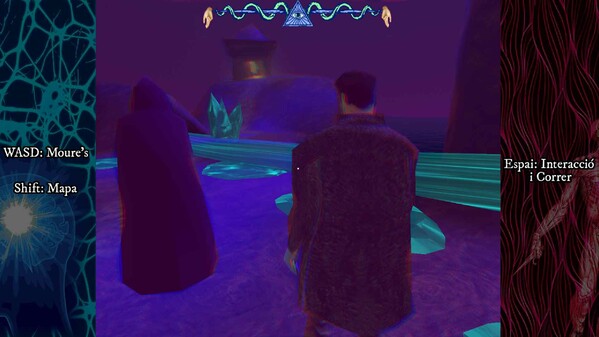
El cas d'Arthur Gordon Pym, developed by oldcompanyia Catalana d’Orient and oldarnau and published by oldCompanyia Catalana d’Orient, is a short but evocative experimental adventure that leans heavily into atmosphere, curiosity, and player-driven discovery. Conceived as a prototype rather than a fully polished commercial release, the game feels intentionally small in scope, yet ambitious in its ideas. It presents itself less as a traditional narrative-driven adventure and more as an interactive mystery, where understanding the rules of the world is as important as uncovering any explicit story. The experience is loosely inspired by the literary legacy of Edgar Allan Poe’s The Narrative of Arthur Gordon Pym of Nantucket, though it avoids direct adaptation in favor of thematic resonance. Rather than retelling Poe’s tale, the game evokes similar feelings of isolation, unease, and intellectual intrigue. Players explore a compact island environment while inhabiting a role reminiscent of a detective figure, tasked not with following clear objectives but with observing, experimenting, and slowly piecing together how the world functions. The narrative unfolds indirectly through environment, implication, and player inference, rewarding attentiveness rather than exposition. Gameplay centers on exploration and environmental puzzles that are deliberately understated and, at times, opaque. There is no combat, no explicit quest log, and little hand-holding. Progress depends on interacting with objects, noticing subtle changes in the environment, and experimenting with mechanics that may not initially announce their purpose. This design encourages a mindset closer to investigative play than traditional puzzle solving, where understanding emerges gradually through trial, error, and reflection. Moments of realization can feel genuinely satisfying, as solutions are rarely given outright and instead emerge from accumulated observation. Visually, El cas d'Arthur Gordon Pym adopts a deliberately rough, retro-leaning aesthetic that recalls early 3D exploration games. Models and environments are simple, but expressive enough to establish mood and spatial clarity. This visual restraint gives the world a slightly uncanny quality, reinforcing the game’s mysterious tone. Rather than distracting with visual fidelity, the presentation focuses on spatial composition and atmosphere, making the island feel like a place shaped by intent rather than realism. Sound design plays a meaningful role as well, with audio cues occasionally functioning as puzzle elements, asking players to listen carefully rather than rely solely on visual feedback. As a prototype, the game inevitably shows technical limitations. Menu options are minimal, presentation options are sparse, and certain sequences can feel unintuitive or frustrating due to limited feedback. One of the later puzzle sections, in particular, demands precise interpretation of audiovisual cues and can feel punishing if the player misreads its logic. These rough edges underscore the experimental nature of the project, sometimes pulling players out of immersion but also reinforcing the sense that the game is testing ideas rather than delivering a refined product. Despite these shortcomings, community reception during its availability leaned positive among players receptive to experimental design. Many appreciated the sense of discovery and the confidence with which the game trusted players to think for themselves. Rather than offering constant validation, El cas d'Arthur Gordon Pym allows uncertainty to linger, making each breakthrough feel personal. At the same time, players expecting a more structured adventure or a fully realized narrative arc often found the experience incomplete, which is a fair reflection of its prototype status. Ultimately, El cas d'Arthur Gordon Pym works best when approached as a conceptual exploration rather than a conventional game. It is a brief, thought-provoking experience that prioritizes mood, curiosity, and player interpretation over clarity or polish. While its technical roughness and limited scope prevent it from standing as a definitive work, it succeeds as an intriguing experiment and a creative stepping stone toward more fully realized projects. For players drawn to atmospheric puzzle exploration and unconventional design philosophies, it remains a memorable and distinctive experience despite its unfinished edges. Rating: 6/10

This is one of those games that you want to know nothing about. So far there is only 1 chapter and im looking forward to play the others. It is a short experience (took me 2 hours) but the puzzles and mechanics are clever and I really enjoyed solving them. If you like puzzles then go for it. It is fairly cheap and there certainly is more to come.
Really inventive and well designed puzzle mystery horror game with a pretty dense atmosphere for its at present extremely short length.
Momentum
Pace estimated from the game's recent review growth (our daily snapshots) at its own sales-per-review ratio — a momentum signal, not booked sales.
Audience
Estimated from the language of this game's reviews — a proxy for where players are, not official Steam demographics.