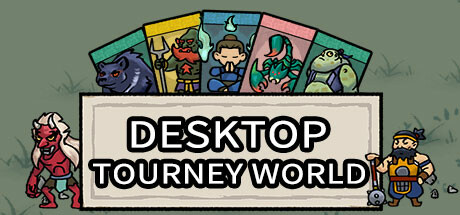
Desktop Tourney World is an indie strategy and survival title developed and published by One leaf Games that blends card-based mechanics, light simulation, and elements inspired by immortal cultivation fiction into a compact but conceptually ambitious experience. At a glance, the game presents itself as a minimalist desktop-style survival simulator, but beneath that surface lies a layered system built around managing limited resources, navigating random events, and gradually transforming a fragile mortal existence into something far more enduring. Rather than focusing on spectacle or narrative-driven storytelling, the game emphasizes systemic interaction and long-term planning, appealing to players who enjoy incremental progression and emergent gameplay.
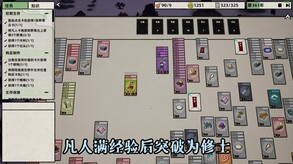
The core of Desktop Tourney World revolves around a card-driven interface where nearly every aspect of play is represented through cards. Resources, buildings, encounters, equipment, and even progression systems are introduced and manipulated through an ever-growing deck. Players open card packs, combine elements, and respond to randomly drawn situations, balancing immediate survival needs against longer-term goals. Food management, material gathering, and base construction form the backbone of the experience, and poor planning can quickly lead to stagnation or failure. This reliance on card randomness creates a constant tension between control and chance, forcing players to adapt rather than follow rigid strategies.
What sets the game apart thematically is its integration of cultivation concepts. Unlike many survival simulators where progression is measured purely in expansion or efficiency, Desktop Tourney World introduces mortality as a meaningful constraint. Characters have limited lifespans, and advancement often revolves around extending life, improving physical and spiritual capabilities, and eventually transcending mortal limits. This cultivation arc gives the game a meta-progression layer that encourages repeated playthroughs, as players experiment with different paths toward longevity and power. Equipment, buildings, and special events all tie into this theme, reinforcing the idea that survival alone is not the end goal, but rather a stepping stone toward ascension.
Exploration adds another dimension to the otherwise static desktop presentation. At certain points, players can venture into external areas represented through exploration cards, triggering encounters, discovering new resources, or facing combat scenarios. These excursions break up the rhythm of base management and inject uncertainty into the flow of play. Combat itself is abstracted through card interactions and equipment checks rather than direct control, keeping the focus on preparation and decision-making rather than reflex-based action. Monsters and hostile events serve as periodic tests of a player’s readiness, punishing neglect while rewarding thoughtful investment in gear and infrastructure.
The game openly wears its inspirations on its sleeve, particularly its similarities to other card-based survival titles. Rather than attempting to disguise this, the developers acknowledge these influences and attempt to build upon them with new systems such as lifespan mechanics, career progression, and cultivation-themed goals. This honesty gives the project a sense of earnest experimentation, even if some mechanics feel familiar or underdeveloped. At times, systems can feel loosely connected, with certain cards or features lacking the depth needed to fully justify their inclusion, but the overall structure remains engaging enough to encourage continued experimentation.
Presentation is deliberately restrained. The visual style is clean and functional, prioritizing clarity over aesthetic flourish. Cards are easy to read, interfaces are straightforward, and the desktop format makes it easy to track ongoing processes at a glance. Audio design follows a similar philosophy, providing light background music and subtle sound effects that support the pacing without drawing attention away from strategic thinking. While the audiovisual elements are unlikely to impress players seeking immersion or spectacle, they suit the game’s slow-burn, systems-focused design.
Community reception reflects both appreciation and criticism of the game’s approach. Many players enjoy the addictive loop of opening packs, optimizing card combinations, and pushing their character closer to immortality, finding satisfaction in the gradual accumulation of power and stability. Others point out that the game can feel derivative, with limited depth in certain systems and pacing issues that become more apparent during longer sessions. These mixed reactions highlight a title that succeeds in concept and moment-to-moment engagement, but occasionally struggles to fully realize its broader ambitions.
Overall, Desktop Tourney World is a thoughtful and niche entry in the card-based survival genre that rewards patience, planning, and curiosity. Its cultivation theme adds a distinctive flavor to familiar mechanics, offering players a reason to think beyond immediate survival and consider the arc of an entire lifetime. While it may lack polish and depth in some areas, its willingness to experiment and its accessible, replayable structure make it a compelling option for fans of strategy games who enjoy managing complex systems through simple interfaces. For players drawn to slow progression, randomized challenges, and the idea of guiding a character from fragile beginnings toward transcendence, it offers a quietly engaging and memorable experience.
Rating: 6/10