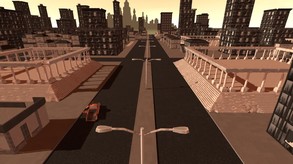
Dear Future is a multiplayer wandering game where you photograph a procedural city using an inherited camera. After your session ends, the next player will receive the camera and continue. What will you pass on to those that come after you?
Revenue comes from in-game items and microtransactions, which our price-based model doesn't estimate. Copies below reflect the player base, not paid sales.
Media

About
Stats
Languages: English**languages with full audio support
Engagement
Reviews
Themes across 40 recent reviews and how positive each mention is. A keyword signal, not full sentiment analysis.
Reviews
[h1]Photos of future ruins[/h1] [i]Dear Future (Dear Future Production Committee, 2021) is an asynchronous massively-multiplayer photography game about exploring an abandoned city. I have been trying to write about it for several weeks and have found myself incapable of doing with any organization or distance. What follow, instead, are orchestrated recollections and half-formed conclusions of my time with the game. A half-step towards the understanding I'm searching for. A version with photos is available [url=https://kritiqal.com/articles/dear-future]here[/url].[/i] - - - The sun is setting for the first time. I aim my camera towards the horizon, watch the light fade, and wait to be thrown out. It is more intense than I expect. The accelerated rhythms of this infected city, its empty streets, the strings swelling around me. Has there always been music playing? Despite knowing this would happen I am disoriented. I tilt my head and attempt an abstract photo of the spire in the distance. I miss my shot and the screen fades. I am told to pick one photo to save and then the infection forces me out, out of this city, out of the game. I am alone again. I open my folders. Users, app data, roaming…but my photos are gone. Like they said they would be. There is a heaviness inside me I can't place. - - - The sun is setting for the third time. I aim my camera towards the horizon, watch the light fade, and wait to be thrown out, again. It is familiar. Already I have adjusted to the accelerated rhythms of this infected city, taught my body how to navigate its empty streets, contorted around columns and under cars for snapshots I will inevitably leave behind. I don’t know why I keep coming back. I take more pictures, build more bridges, collect more notes on how everything fell apart. But it won’t – it can’t change anything. The sun sets when it always sets. I cannot stop nature anymore than I can stop the infection forcing me out, out of this city, out of the game. I am alone again. I unlock my phone, open Twitter, scroll aimlessly for a few minutes before remembering what I am looking for. [i]Transmissions from The Foundation[/i] ; photos lifted off these broken islands, out of the game, suspended in cropped frames. The best we can do. - - - I have lost track of how many times the sun has set. I aim my camera towards the horizon, watch the light fade, wait to be thrown out, again. It is ordinary. I organize my time and am ready to go. My photos are deliberate and I’ve made peace with the ones I can’t save. I don’t like to think why I keep coming back. I take more pictures, build more bridges, collect more notes on how everything fell apart. I still don’t know what’s important so I chronicle everything. Papers, road signs, graffiti, buildings. Things I recognize. I open the journal and wonder where the rest of the story lives. If it lives anywhere. The sun sets when it always sets. I can’t stop the infection forcing me out, out of this city, out of the game. I am alone again. I unlock my phone, open Twitter, scroll aimlessly for a few minutes to settle myself. Deep breaths, focus. [i]Transmissions from The Foundation[/i] . I see one of my photos, a black and white rooftop overlooking a soft focus skyline. Three likes. At least someone is watching. - - - The sun is setting. I am lying in bed, trying to remember the last time I held a camera. Everything before last year is fuzzy and I am struggling to organize my thoughts. I unlock my phone, open Twitter, continue scrolling. [i]Transmissions from The Foundation[/i] . I put my phone away. I cannot stop thinking about [i]Dear Future[/i] . I consider playing it again but that weight is getting heavier. The desolation and isolation it portrays is so much an inevitability, to parallel it with reality feels obscene – pointing at a game and shouting, “look, this is what will happen to us.” We are past the point of warnings, now entering some form of literature “deep adaptation.” I was always told learning about something painful before it happens makes it easier, but perhaps some things are too painful to anticipate. But here I am, reading about climate change, mass displacement, the exponential rise in natural disasters in one tab and looking at screenshots of [i]Dear Future[/i] in another. This is the surreal state we all exist in now: tragedy and fiction splintering into one another as we sit in our homes, stare at our screens, unable to look away or do anything to stop what’s happening. All we can do is watch. Chronicle everything. Papers, road signs, graffiti, buildings. We are all watching. - - - The sun has set. I am thinking about the confidence I feel holding a camera. The way it urges me to think differently about space, about time, about who may appear in frame and who will look at it afterwards. I am not always conscious of these things but I understand them intuitively. I feel safe with a camera. Suddenly I am allowed to simply “capture” the moment instead of having to live it. There is a distance with photos. But perhaps it’s wrong to say I am allowed. Nobody has given me permission and as much as I may wish to I cannot step out of time. Taking up this camera gives me perspective, an idea of control, but I am not apart from the things I photograph. Events outside of frame are no less real. This is the part of [i]Dear Future[/i] that lingers with me. Not the particulars of its mechanics, its design, the allegories it invokes and implies. I just remember what it feels like to hold the camera. To momentarily feel safe, a tourist. Chronicling everything. I keep coming back to reclaim this feeling a little longer, throwing a new body into the infected city for a few minutes where the desolation and isolation is just fiction, just snapshots, just a game. But the sun sets when it always sets, forcing me out. Out of this city, out of this game where we are alone, together. [b]This essay originally appeared on [url=https://kritiqal.com/articles/dear-future]Kritiqal[/url].[/b]
Related
Related
Trends
Concurrent players on Steam, sampled daily since tracking started.
Hours played at review time, across 40 reviews with recorded playtime.
positive critical· bar length = how often the theme comes up
⠀
Un escenario postapocalíptico, una cámara heredada y 12 horas (que son 12 minutos por sesión) para descubrir algunas pistas de que llevó a la destrucción de la ciudad. Un juego cautivador e inmersivo, musicalizado a la perfección, donde la única mecánica es tomar fotografias (con un pequeño editor incorporado en la cámara). El clima es de cierta tensión, melancolía y nostalgia. https://steamcommunity.com/sharedfiles/filedetails/?id=3023777869 Al finalizar tu tiempo podrás seleccionar la foto más representativa y guardarla en la memoria (este es el aspecto multijugador, ya que compartimos recuerdos del anterior jugador), todo lo demás se pierde. https://steamcommunity.com/sharedfiles/filedetails/?id=3023691057 Excelente experiencia, es corto y gratis ♥
Очень приятная и расслабляющая игра :)
Excellent exploratory game! You will want to play multiple times to see if you can understand the world a bit more. There is a narrative you can uncover, but if that's uninteresting to you this is a very striking tone piece. For the price of free, it's absolutely worth what little time it asks for a taste. Plus be sure to take a look at the twitter account @DearFutureGame to see what folks have uploaded to the cloud for future travelers.
The real tragedy of this game is that it wasn't ambitious enough. This seems like a really great concept. A timed photo shoot in an abandoned, decayed, weird sci-fi city? Sign me up. The problem is that it completely stumbles over its own feet in the execution of that idea. The biggest struggle is that there's just not a lot to see. This is a very large world, and was somehow surprisingly empty. Because the game uses the same assets over and over, any time you find something really interesting in the world, if you walk a few feet, you're guaranteed to see the same thing repeated twenty times over. I remember coming upon a strange, Greek temple on a shoreline, and thought, "wow, what an interesting design," only to see the same temple copy-pasted 3 more times past the next building. It's because of this reuse of assets, and very minimal amounts of unique variety, that makes this a bother. Very rarely does the world offer interesting vistas, and even then, it's a chore to find them. There's also the fact of the mechanics. Again, a timed photo adventure seems really appealing. Get in, get out, and only take what you find important. The problem is that the mechanics are a deliberate wrench in your fun. First, why is there a sprint button? I'm already limited by the time of day, so why should I be further limited by my ability to navigate the world? Perhaps the idea was to force people to choose paths, and come up with unique experiences. But when everything looks the same, and there's only a smattering of narrative bubbles, that you're not guaranteed to see, this mechanic isn't serving its intended purpose. The time also doesn't stop when you're taking pictures. The game seems to relish in you playing with your lenses, exposure, and grain. But you're not really given the time to explore the artistic process, because you're on the clock like a wage-slave. Then there's the narrative. It's steeped in mystery, which is kind of cool. But again, because a player can wander any direction their heart desires, the odds of them finding a collection of good narrative bubbles is low, and this is exacerbated by the size of the world, which is large. The note feature helps, allowing you to place Dark Souls style notes on the ground for other players to find. But again, it's hard to find something creative to say with a note when the world is just the same buildings ad infinitum. And, if you choose to write a note, that's precious in-game minutes spent forming the perfect sentence and not taking photos. It's best to compare this game to other photo games. Umurangi succeeds by giving you infinite time, a clear objective, but allowing for artistic freedom. Pokémon Snap gives you limited time, a clear objective, and reduces artistic freedom for the sake of gameplay. Dear Future, by contrast, gives you limited time, no objectives, and restricts artistic freedom through its mechanics. And that's just a shame, because there are the bones of a really interesting game here. But the bones are scattered on the ground like the assets in this world. Maybe you can find beauty in those bones. But I did not.
[i] Beautiful Water [/i] [i] Reminds me of You [/i] [i] Sea Forever [/i] [i] A tribute to You [/i]
A good time
This game is short and extremely sweet. I loved every moment of it. From the second you leave the tutorial area, you are dropped into a mysterious world of which you slowly get more and more engrossed in. The soundtrack is so soothing and relaxing, seeing the messages left by others was such a cool thing, and looking at the pictures taken by others and then finding where they took them in the game was very fun. My only problem with the game was the sound when you jump and land, as the landing sounds plays whenever you fall off the smallest thing or go up and down steps, but it's pretty easy to see around that. This game makes you like photography for a good 10 or 20 minutes whether you like photography in real life or not. Yes it is short, but hey, it's free, relaxing, and somehow makes you emotional at the end. Watching that time tick down waiting for 8PM to hit, and then having to pick which picture to save knowing the rest are lost in time. In the end, I would recommend this to anyone to really anyone who needs some relaxation.
Audience
Estimated from the language of this game's reviews — a proxy for where players are, not official Steam demographics.
Related
| 7 Days to Die | $425.3M | 403.5K | 87% | $44.99 |
| Palworld | $279.6M | 445.8K | 94% | $20.99 |
| The Forest | $254.8M | 678.5K | 96% | $19.99 |
| Ready or Not | $238.1M | 338.9K | 78% | $49.99 |
| Sons Of The Forest | $201.1M | 314.9K | 88% | $29.99 |