Deadnaut: Signal Lost is a sci-fi horror turn-based roguelike where loyalty isn't earned - it's installed. Scavenge derelict ships and abandoned moons filled with hellish creatures, brutal AI and insanity storms. Gather gear and upgrades to fight or evade the hi-tech supersoldiers hunting you down.
Modeled estimate, not a reported figure. How we estimate →
Media

About


Stats
All-time low is the lowest price we've recorded for this game since we started tracking it.
Languages: English
Engagement
Hours played at review time, across 40 reviews with recorded playtime.
Reviews
Themes across 40 recent reviews and how positive each mention is. A keyword signal, not full sentiment analysis.
positive critical· bar length = how often the theme comes up
Reviews
This game has no risk/reward systems. Just the risk. Damage is very punishing, and exploring offers little to discover. This incentivises you to inch forward slowly, repeatedly doing the things you found to work reliably, and put you at the least risk. This is very easy, and not interesting. You could switch things up, and try riskier tactics that promise more fun, but you'll likely be severely murdered and lose your run. Too difficult is frustrating, and too easy is boring. A game's difficulty should stay in the area between the two. In Deadnaut, it's not really an area, just a thin border. So, which do you prefer? "safe and boring" or "risky and frustrating"? The choice is between boredom, and boredom you get to die a lot as well. The Watcher mechanic is good example of this; with a Hacking Tool you can effortlessly avoid them, making them a non-factor (boring). You will need to activate it over and over to negate the threat (repetitive). It also takes up one of two of the slots you need for carrying tools, the items that let you do cool ♥♥♥♥, thus limiting your options for fun (boring). OR You can forgo the Hacking Tool, and bring a cool thing with you! However, Watchers are now invisible and unpredictable, and the damage they deal is unavoidable (frustrating). You'll know when they're near, but not whether they are approaching to zap a room, or leaving after having done so. So do you enter the room? You can wait around to be sure (tedious) or roll the dice (risk without reward). Let's not forget that, sometimes, rooms are so big that Watchers can be too far away to be detected, but can still zap you for unavoidable, unpredictable damage (you get the idea). I don't want to write more, so I'll wrap this up. Too easy or too difficult with no fun in between, nothing much to find while exploring, missions are repetitive... It's got good bits too, the atmosphere is amazing and the system of swapping upgrades for other ones is good, but they don't get to shine in this game.
This isn't a bad game per-se, but it's one I would struggle to recommend, for a few reasons. Gameplay wise, there are an interesting number of paths and upgrades you can take your Deadnaut to handle challenges, and while I haven't tried all of them I can see how all the different approaches could work in their own ways. You can become a gun expert and shoot your problems, become a stealth and information expert and avoid them before they even know you're there, become a tech wizard and rely on deployables, etc. That said, there's an issue that looms over this build variety. Part of deadnaught's pitch is that if you stick with it and amass rewards, you can become powerful. I think it delivers, but it feels like it doesn't really know what to do once that happens. I only did a couple runs, but the last half of the game seems pretty consistently to boil down to walking through pretty same-y level after level handling stuff without any real curve balls. Once you collect a cloak and enough turrets to drop anywhere you need, all that's left is for the most part walking. Quite a few levels of walking, often through some pretty large settlements with poison gas that make getting anywhere pretty slow and inconvenient. This game has been compared in feel to Duskers, which sort of takes the opposite track of leaving you perpetually one bad coincidence or call from a wipe. I'm not going to say one way is better than the other, but I will say that while both games have a sense of mystery and information as a draw, Duskers feels like it did it way better. Duskers has lore as a central goal for the game: you want to figure out the answers to big mysterious disasters that plagued humanity, and you retain that progress towards the truth between runs. In Deadnaut your goal is to scan the Warp Core at the end, which ends the game, and the lore snippets you pick up provide good flavor for the major enemy factions but don't otherwise interact with anything. Ultimately, while it's clear a lot of love went into crafting Deadnaut to produce a gritty future vibe set on the edge of humanity's reach (and for some people that is enough to sell a game on its own), I found the experience a little short and lacking in substance once properly solved.
Fun concept, interesting worldbuilding, but that's sadly it. It's called "Deadnaut" because the character you control is essentially a (half-)dead man walking, saved by a tech parasite in exchange for you being able to control them. A nightmarish scenario, but I think it maps well onto how roguelike players tend to think of their characters. "Yes, it's me, but in the end, this is just a disposable body; I can always pick another." Fitting. Theoretically, it plays like a classic roguelike: the missions (dungeons) are split into decks (floors), which in turn consist of rectangular rooms connected by tile-wide corridors. Time only moves when you do, everything is on a grid, you attack in melee by walking into the enemy; same ol good ol. There are even some interesting attempts to spice things up. Your console - what your [i]actual[/i] character uses to control the Deadnaut - can take damage, for example; and you can't control the Deadnaut without it. And the ships have a patrolling Watcher - an invisible entity which fires a room-wide EMP once it reaches the center of the room; You have ways of detecting it, and making sure you're not there when the EMP fires is interesting...but becomes an annoyance relatively quickly. Another change is that you can hear what the Deadnaut hears, but you can't see what they see. This adds a lovely layer of horror to the experience, and is quite helpful when it comes to detecting enemies... and [i]identifying[/i] them. See, whenever you see a hostile blip, you won't know what it is until your Deadnaut's suit finishes scanning. To scan, you have to be in the visual range - and the enemy must stay alive. Some enemies will engage in ranged combat if they see you - so what, are you going to just stand there and scan while they turn your suit into Swiss cheese? I don't know about this mechanic. Cool in theory, but in practice, eh. This applies to the whole game. Ships have some story pieces that might explain why these particular mobs are here - and that's very cool; but there's only 3 per ship as far as I could tell. So there's not much room to tell interesting stories, and sure enough, they tend to cut off mid-way. It might make sense, considering they're messages of the doomed... but it doesn't make for very exciting storytelling. The combat and upgrade mechanics are also strange. You buy upgrades by dragging them on your hotbar or into your inventory, and from there you can use them on a mission (they're all active abilities). But you never really know how strong they are, even though all other sources of damage have neatly written numbers. You don't see damage popups, so it's a bit of a guessing game. Feels weird. But all these things aren't why I'm not recommending it. I'm not recommending it because it's becoming stale and samey very, very quickly. I got bored of it on my second run, as it became apparent that it's just going to be more of the same; I understand there are some new elements as you go, but the base is too dry to be meaningfully hydrated by novelty. Roughly 4% of players saw the ending, I think that's enough said. [url=https://store.steampowered.com/curator/42922988/]Curator page[/url]
I am enjoying the aesthetic, but nothing about the gameplay is endearing to me. I play a run, I kid myself that I'm doing alright and then something insta-kills me and I have to start from scratch. I am not entertained.
To the devs: I played the original deadnaughts and loved it’s spooky atmosphere, I was excited when I saw that a second one had been made. I like your new game, but it’s equally frustrating as it is fun. This is intended to be constructive critique and I’m not bashing you in any way, I like the game but it could be better. Bugs, Here are a few I’ve found: - During character creation a point will sometimes be subtracted instead of added when clicking the "+" button. The point is NOT returned to the pool despite the subtraction. - Sometimes your cooldown bonus (from ability points) will be ADDED to your cooldown timer instead of subtracted. This is persistent across levels but seems to be fixable by restarting the game, which probably recalculates the modifiers. - One of the subclasses (fragments) has a scanning drone that can explode randomly and damage/kill you, but the drone AI makes it tailgate you 80% of the time. It follows you closely before exploding and dealing damage to you (bad AI behaviour). - Sometimes enemies will spawn very close to you, around a corner you just peeked around or even within visual range. - If you end your run with low HP you lose trust even if you have an unused cloning pod, purposefully killing your deadnaught and respawning at the cloning pod negates this. Seems a bit silly. Maybe an in-between option? - Grammar issues sprinkled a bit everywhere around the UI - If enemies move faster than the player they may move two or more squares in one turn. This essentially teleports them two tiles and they can walk right through hazards or over traps without triggering them. There's not much point in setting traps if the zoombies can just phase past them. - Sometimes going into parts of a corridor in an outpost counts as being outside for some reason. You will be exposed to the toxic atmosphere and potentially take damage. _ Feedback on game balancing: - It can be very easy to get overwhelmed in corridors even with a chain gun, enemies can spawn from any direction quickly, including that dead end you just came from, pinning you at corridor junctions. Could be fixed by not having new entities spawn from recently entered rooms/tiles. - In later levels you can pretty much expect a death during any given level. If you haven't found the cloning pod there is no second chance. Since you don't know where it is, it can often be bad luck finding the pod which ends your run. This is especially a problem with outposts, as the buildings can be quite far apart and require a lot of walking outside, where you will take chip damage from the atmosphere (Seriously, why are you not wearing a helmet!?) (and run into roaming bots too!). Chip damage + spread out rooms/buildings (bad procedural rng) + many enemy encounters over a large map + bad luck finding the cloning station = death. I've died on outposts more than ships due to this. - Outposts are walking simulators with searchlight-stealth elements, and are tedious AF. - Holograms are fun but on outposts they will wander the edge of the map forever and prevent you from creating a new one. Clicking the button while one exists should replace the existing hologram/s instead of preventing their use. - Cybernetic threats and the inability to see the ADAD systems pretty much forces you to always take a hacking tool with you. It's a two part problem. A) You are pretty much forced to take a hacking tool to keep an eye out for invisible watchers that will zap you or waste time by keeping you guessing. Also other defences like rovers. B) every time you swap weapon loadouts it deactivates your active item (cloak/scanner/shield/field/etc) and puts it on cooldown. Doing so also passes turns. - As mentioned above, a lot of gear combinations don't work well due to mechanics. Say for example you want a knife as a secondary item in order to be able to make accurate attacks against enemies who get within melee range. You want to use a Field or Shield with this. The enemy gets close, you have to switch to your knife, this uses a turn and deactivates your other item, the enemy gets a turn. You stab the enemy to death, there are two more coming down the corridor spitting acid at you, you switch back to your alt loadout to reactivate your shield, the enemies get to attack you again as you do this. Oh, and it's on cooldown since you deactivated it a few turns back. Once again this forces you to use a non-combat alternate secondary, probably the hack tool, since it can be switched to/from in safer conditions. It adds further tedium every time you switch to the hack tool to turn on a light (most of the rooms are unlit) and have to wait for a cooldown to renable your other secondary. Maybe some combinations should be illegal like two fields or a field + shield, but they shouldn't keep getting flicked off like that. - Certain enemy abilities feel kind of cheese. For example enemy A staggers you, your now stumbling in random directions for about 8 turns and have a vision radius of 1 tile. You can’t use your ranged weapon, you can only see one tile. You can’t move to melee, your stumbling around. You can’t run, your stumbling around. You’re pretty much incapacitated. Meanwhile enemy B is free to get off 8 shots against you, now you have a real deadnaught. - Corridors are always dark, limiting your vision range even when looking into a lit room. Quite annoying. - Some abilities, like darkvision, really feel like they should be passives. It's really weird that you have to manually activate dark vision for X turns before it expires and goes on cooldown, it should just be active as long as it's in your bar. It also turns off the light in the room when activated, so that could instead be a split passive/active, with darkvision always enabled when slotted and the active use hitting the lights? Or balance the passive by removing the lights-off part? There are some other "passives" like this such as hacking range and other utility skills, using a slot is enough of an opportunity cost without adding the need to manually activate them and use a turn. There's a group of skills that give you passive buffs for standing in a cloud, including not having a vision penalty from standing in said cloud; Not only do you have to use a move to create a cloud, but then also waste one or more moves to separately activate each passive for duration-X moves followed by cooldowns, it's pretty silly. There is one ability that boosts your elemental effect chance (from 5% base) by a whopping 10%! And of course it needs to be manually activated, lasts a few turns, and then goes on cooldown. - Elemental ‘injections’ sound and are good, but there are four issues holding them back. A) the proc chance is too low to be reliable, even boosted. B) The combat encounters are usually decided in just a few turns, meaning either the enemy dies or you die quickly, once a proc does happen it doesn’t have a chance to stick around long enough to make a difference. C) combat encounters are usually against many enemies in a row, the procs just don’t have time to make a big difference since they affect only the combatant being fired on (and soon to die). D) The spreading fire proc specifically is especially dangerous to the player and will often spread to your deadnaught and ruin your run. Perhaps these could be balanced by a combination of the following? Raise base proc chances a bit. Make injector abilities passive, with a guaranteed proc on active skill use. Convert some of the more dangerous effects to extra damage (since enemies are dead before the DOT can be fully utilized). _ Due to combinations of the aforementioned concerns, some subclasses and skill trees feel very capable while others struggle to counter the sudden-death worst offenders. Some skill trees/combos just feel too cumbersome to use, I always end up dropping them for something else.
сильно отличается от первых Дедонавтов - как минимум, смена real-time на походовый режим, более свойственный рогаликам, и один дедонавт вместо пяти, - но все еще атмосферно, залипательно и с кучей фишечек, в которые интересно въезжать жаль, что игра тонет в безвестности :( upd после первого прохождения: стало только интереснее суммарно времени улетело около 30 часов, но более умелые игроки смогут и быстрее очень хорошая игра
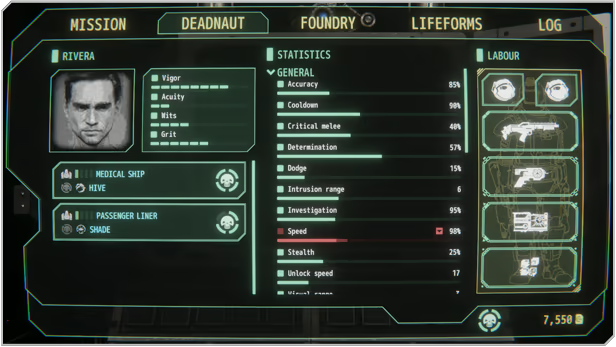
EDIT: Many years later and I still come back to this game on occasion. Slay the Spire is my main roguelike obsession (and has been for years) but I still love this game. I was about to play this again when I couldn't recall if I'd written a review, so... consider this a second endorsement after years of thought. Deadnaut: Signal Lost is a strategic, turn-based, sci-fi roguelike dungeon crawler. It's a true roguelike - every run is independent, no boons carried between them except the experience you've gained. First you pick a filter - this will determine much of your starting equipment and the skill trees you have for the run. There are three basic skill trees available to all deadnauts, three special trees for each class of dreadnaut, and the game also gives you one random skill tree for each run. Next you're randomly generated a 'Missing in Action Report' - functionally a randomly generated person to get inside the deadnaut while you 'pilot' them both. MIA's have randomly assigned stats, a photo, and some flavor such as criminal and occupational past. You can re-roll continuously until you find one you like and launch the run. You start each run in 'cooperative mode': you and the filter working together to control the deadnaut. If you perform poorly over several missions, however, your pilot may lose trust in you, and to continue you might have to engage... 'puppet mode'. I will say: I've never had to engage puppet mode, maybe because I always pick filters with high 'Grit', who can take a beating and not lose trust because I don't want to HAVE to use it. Conceptually horrifying. Once you've picked your filter, you go on a series of missions in which you avoid electonic security measures, handle monsters with some mix of stealth and violence, complete the objective (usually finding an object or computer terminal) which causes an evacuation countdown to start, and making it out of the dungeon before said counter expires. That timer is usually pretty generous in my experience - I don't think I've ever come close to losing due to evac timer. Each mission has the following, randomly generated and more/less intense based on how far you are in the game: Map: Either an indoor space-ship maze usually having multiple floors, or an outdoor map where you have to brave the elements (and boy can those elements be rough). Enemy Category: Each category has a handful of monsters, usually 3-5. The monsters are designed to work well together and have a common theme: Ghouls, for example, are slower and weaker than other enemies, but won't stay dead for long - the tier 1 always comes back after a few turns, the tier 2 has a chance to come back but is much nastier and ranged, and IIRC the tier 3 can spawn tier 1 and 2 ghouls - so you can get easily overwhelmed if you keep killing the ones that come back and don't deal with the big one. Map Hazard: Except your first couple of missions each run, every map has a random hazard. For outdoor maps it's usually weather: If you stay outside too long you'll take damage, or start to hallucinate, or any number of things. For indoor maps there's more variety, maybe the thermal regulator is down so in unpowered rooms you're slower and skills take longer to recharge (but you can fix this by finding the thermal cpu). Benefactor Chance: Benefactors are the people pursuing you, and they have a chance to be added as an additional enemy type around your third mission. Benefactors are tough and perceptive, but they also fight the other monsters around. Objective: Usually the objective, especially in early levels, amounts to 'find an object on the map, interact with it which will start a countdown, make it off the ship / planet before the countdown expires.' Sometimes it may be 'kill x enemies' or 'kill the big enemy', but there's not TOO much variety that I've found in objectives. That said, there's variety in basically everything else so it's never bugged me. XD Next-Mission Reward: In addition to the knowledge you'll find while exploring, each mission gives you a bonus to the next mission (not stacking). These are flavorfully linked to the mission's goal. If you help a ship of people being attacked by monsters, maybe next mission friendly NPC's will spawn. If you hack a Benefactor Database, maybe you'll start the next mission with your map filled out and a marker showing the location of some juicy loot. I want to gush about this game - I already typed a page and a half about the multiple layers of strategy involved in missions (there are more than enemies to worry about, but if you're clever you can turn obstacles and enemies on each other!) but this is too long already. Instead if you're still reading this you're clearly interested, so I'm going to list five things that may turn players away, and if none of these are deal-breakers for you, do yourself a favor and buy this game: 1) Graphically, the game is minimalistic. You'll be spending most of your time looking at a blue sphere on a mildly stylized grid. The UI is more like a board game than a video game, mostly. 2) This is a roguelike, not a roguelite - each run is independent and all you keep is the knowledge you've gained. A typical run can be over in minutes or can last a few hours (your progress on longer runs is saved, you don't have to finish in one sitting). 3) There are plenty of enemy and deadnaut types, but not as many as you might expect based on other roguelikes: This is NOT to say that the game gets old fast, instead the variety comes from seemingly mundane areas of play, mainly from the physical layout of the map and electronic security measures within it: Seriously, variations as small as DOOR PLACEMENT have strategic importance... So every level is different enough to require you to think about and account for its variations, but I can understand why some might say 'despite this variation requiring a different strategy, it doesn't feel novel without a completely new enemy type,' and maybe that's fair. That said, I still haven't seen all the enemy types so... There ARE plenty, just not the endless amount you find in other roguelikes. 4) This is not a game with a lot of 'vertical progression', where you get significantly bigger 'stats' or do tons more damage as the run progresses. I've never had a run where I felt too powerful for any late-game mission - almost always the opposite is true. Instead you get 'horizontal progression', spending your money on unlocking new abilities that aren't just higher-damage versions of old abilities, or different equipment to tackle different kinds of monsters or hazards. There are a few abilities that 'just deal damage', but most of them (and the best ones) require you use your noggin just a bit: Trap a door to instantly kill the next enemy walking through it, deal massive damage with a knife as long as you shut out the lights first and wear a cloak module, cause all mechanical enemies to overheat and drop a smokescreen, etc. 5) Finally, there's no wiki that I can find. If you get an ability that 'slams a door shut, deals heavy damage to any enemy in the doorway' and you want to know how much damage exactly, your only option is to buy the skill and use it. All weapons and many skills do have all the relevant numbers, but sometimes I wish there were a place for me to look up the finer details of how a mechanic works or exactly how much damage an ability does - sadly for some reason there's not a huge community for this game that I can find. So there you go - come on, you just spent how long reading this? You're clearly interested so grab it! I know $15 is a lot for a minimalist game, but I've had more fun with this little gem than most AAA games this year, so... Good luck, captain!
Great game Very well made the reason I was able to play this gem was thanks to Splattercatgaming and his video about and this game is fair without giving you any handholding Cheers mates
İndirime girince alınması gereken Duskers sevenlere gideri olan sanat eseri bir oyun
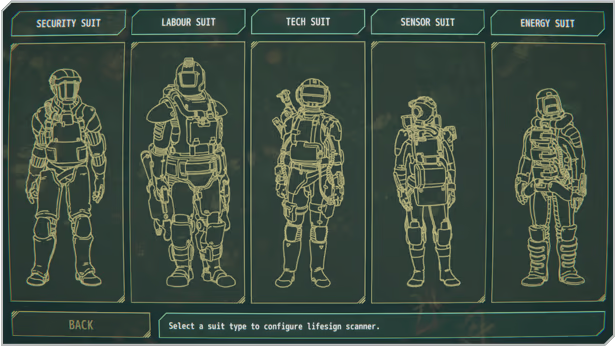
This is one of those games you will only ever see coming from an indie studio, graphics deceptively minimalistic, but really they are not, they are extremely detailed and useful for relaying all the information that matters. You are an operator who hired a mercenary to hunt for information in one of the most dystopian and outrageous settings I ever played in, and you dont even get a real story establishing that setting, it is all done by letting your own mind and fantasy run completely rampant. The guy who made the music is a wordsmith, the environmental information he is giving you, and the way he describes the different enemies, just from enemy chatter, electronic buzzing, clanks, shouts and suspenseful music notes is outstanding, what a brilliant guy, last time I heard work this fantastic was in the first subnautica game. The other half of the "story" you get from reading notes and log entries during missions, but those 2 limited but highly focused ways of telling a story just make all kinds of images pop up in your head, in many ways its like reading a book where all the images are made by yourself in your head from what the author describes with words. Dont get me wrong, this is not a ASCII level graphical presentation, the graphics are fantastic for what they do, but the room left in them for your own interpretation is brilliant. At first you see very minimal information when you board a ship or base, but with upgrades and technology the graphical information changes drastically, from seeing heat trails to radar blips to seeing the actual path and location of the artificial defenderbot patrolling, you can plant turrets who also function as early warning signs because they will fire at things you cannot see often, you can ping corpses you have found via their suit transponders .... and you WILL need to pull all the tricks because the enemies are not getting easier :) I would strongly suggest that for your first run you pick a tech suit so you can see the watcher mechanic in full motion, and I also strongly suggest you start on easy, easy is NOT easy, normal is very hard, and I havent even tried hardest cause normal is so brutal.
Related
Related
Trends
Concurrent players on Steam, sampled daily since tracking started.
Audience
Estimated from the language of this game's reviews — a proxy for where players are, not official Steam demographics.
Related
| Dosa Divas | $34.4K | 63 | 97% | $19.99 |
| Black Legend | $34.4K | 210 | 65% | $7.99 |
| Evergate | $34.5K | 196 | 93% | $9.99 |
| Hidden Through Time 2: Discovery | $34.5K | 193 | 88% | $10.99 |
| Repetendium | $34.4K | 295 | 90% | $5.99 |
| A House of Thieves | $34.5K | 140 | 84% | $11.99 |