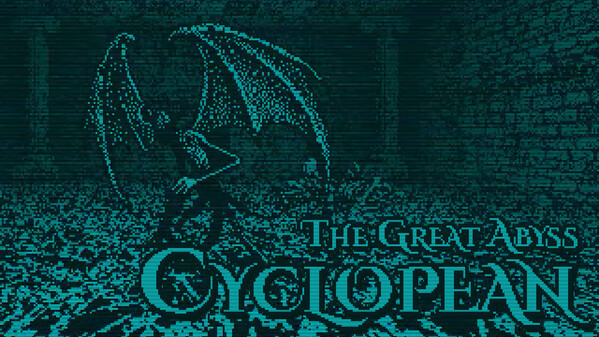
Cyclopean: The Great Abyss is a small scale, mechanics driven CRPG/Roguelike in a retro, monochromatic style, that takes place in the underworld of H.P. Lovecraft's Dreamlands.
Modeled estimate, not a reported figure. How we estimate →
Media
About
You are an old dreamer who, through unforeseen circumstances, has found himself trapped in the Great Abyss, the vast underworld beneath the Dreamlands. Use the resources at your disposal, weapons, armor, supplies, and any alliances you have with the locals, to explore and learn the secrets of the underworld, in order to make your way back to the upper Dreamlands, or back to the Waking World.
Cyclopean: The Great Abyss seems simple at first, but the gameplay becomes more complex as players learn the intricacies of its various systems. Read the in-game dialogue and text carefully, and you may actually learn some useful things.
A Variety of Strategies
Although combat plays a big role in the game, it is not the only means of achieving one's goals. Players may find it much more useful to use a combination of combat, stealth and/or dialogue to deal with the inhabitants of the nether realms. In fact, the game will punish you severely if you try to fight everything as a low level character, so try to manage your gold, health, alliances and sanity carefully as you traverse the Great Abyss.
Old School CRPG
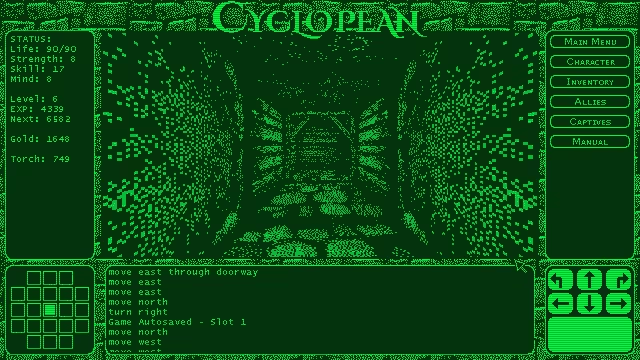
Cyclopean follows the tradition of early CRPGs like Ultima, Questron, and Legacy of the Ancients (among others) in that it presents two differing views of the game world. Outside of dungeons, you see your character from the top down in a 2D display of the map. Whereas, in dungeons, the view changes to a 3D, first person perspective.
Choose Your Dreamer Carefully
When you start the game you will be presented with a random dreamer, with basic abilities and equipment, and any alliances they have. You can choose to play as that person, or "reroll" to see if you can find a better option. Cyclopean gives you the freedom to choose from a wide variety of stodgy sounding English upper class gentlemen to play as. 
Turn Based Gameplay
The gameplay and combat is all turn based, allowing you to make strategic decisions. Enemies are dangerous, but polite, and will wait their turn.
Alliances
Some characters will start the game with an alliance in place. This can be very helpful in the early stages, especially for new players. Alliances allow you to have some of the various denizens of the Great Abyss join your party, and help to fight other enemies. New alliances can be formed during the game by finding and reading the right books.
Roguelike Mode
As of Version 0.9.936, you can now opt to play Cyclopean: The Great Abyss as a roguelike game with perma-death. The game will now prompt you when you first start it, whether you want the traditional CRPG experience or Roguelike Mode. You can always switch back by using the Options menu to restore the default settings. Games played in Roguelike Mode are not accessible via normal mode, and vice versa.
Game Manual
There are many other game mechanics and other things that are described in the game manual. The manual has been fully integrated with the game, so you can bring it up at any time, to learn about the various game mechanics available.
Use the options menu to change game settings including the color...

Stats
All-time low is the lowest price we've recorded for this game since we started tracking it.
Languages: English
Engagement
Hours played at review time, across 41 reviews with recorded playtime.
Reviews
Themes across 40 recent reviews and how positive each mention is. A keyword signal, not full sentiment analysis.
positive critical· bar length = how often the theme comes up
Reviews
I want so badly to like this game. The atmosphere is incredible, the graphics and HUD are so cool and intentional, and it feels like something I really want to dig into and explore. However, it also feels close to impossible to make any progress. Money is hard to come by and things are expensive. You can't refill your health without either buying a bunch of low-powered consumables, leveling up, or somehow getting a tent, which is both impossibly expensive and subject to RNG via trader availability. Add to that the fact that combat often comes down to praying that you hit enough and your opponent hits too infrequently to allow you a victory, and you're set up for failure. I appreciate the fact that a cosmic horror game should leave you feeling a little bit helpless, but I feel like there could have been more of a balance between this design philosophy and making something playable. Again, I really want to like this game. I tried it originally on itch.io and was hopeful that it would be more playable once it hit Steam, but alas; the choice to make the game impenetrably unforgiving means I really can't recommend it, even to friends who love old school dungeon crawlers. Maybe Cyclopean 2 will be a better fit for me.
Do you know what keeps this game from being positive? Fake walls. There's a dungeon with over 50 fake walls and one of them is the correct way to PROGRESS THE GAME. And no, there's no way to tell, so you will look like an idiot pressing yourself against every single wall. Other than that great game.
After realizing this game is based on "The dream quest of unknown Kadath", my favorite Lovecraft story, I quit the game and immediately ordered the book to reread it again. Will continue when I finish it.
[h3]RANKING:[/h3] [table] [tr] [td] [h3][strike]AVOID | FLAWED[/strike] | [b]MAYBE[/b] | [strike]WORTHWHILE | COMPELLING | UNMISSABLE [/strike] [/h3] [/td] [/tr] [/table] [h3]SYNOPSIS:[/h3] [table] [tr] [th][b]ASSESSMENT:[/b][/th] [/tr] [tr] [td] Cyclopean: The Great Abyss delivers a commendable old school RPG experience with retro audio-visuals that generate a spooky atmosphere to match the Lovecraftian setting. The monotone hue can be hard on the eyes, but the detailed pixel representations of Eldritch monsters are frighteningly good. Despite its small scale the wonderfully crafted 2D gameworld is rich in thematic activities that invite exploration. Combat tends to be a click fest due to a lack of true tactical abilities replaced by a menu of options to use; allies to fight, ambush, pickpocket, flee or capture opponents instead. Unbalanced encounters tend to be pyrrhic in outcome, if attempted before having grinded out XP to the prerequisite level. RPGing can feel directionless due to a lack of quests & aloof story. Character development is basic. 3D dungeon crawling formulaic. Loot drops are meagre, but treasure hunting is a real joy. Limited in parts. Engrossing in others, but [b]MAYBE[/b] has enough to be picked up. [/td] [/tr] [/table] [table] [tr] [td][b]STATUS:[/b][/td] [td]Looks complete. Is well polished & has received significant support since being released [/td] [/tr] [tr] [td][b]APPEAL:[/b][/td] [td]Fans of retro RPGs from the era of Ultima I etc. Must have the vision to put up with the monotone colour scheme [/td] [/tr] [tr] [td][b]VALUE:[/b][/td] [td]A fair price for a game that is more compact than may otherwise appear [/td] [/tr] [/table] [quote=]Key supplied by developer through curator [url=https://steamcommunity.com/groups/tbtactics/][b]TURN-BASED TACTICS[/b] [/url] | Click to follow & get updates[/quote] [i]More info below....[/i] https://steamcommunity.com/sharedfiles/filedetails/?id=3699696066 [h3]HIGHLIGHTS:[/h3] 🟡 PLAYS like Ultima I providing an experience that mixes traversing a 2D overland gameworld & 3D dungeon crawling. A shallow game loop allows for fluid gameplay with a focus on exploration & levelling through combat, rather than questing. While the Lovecraftian setting is refreshing for a CRPG. 🟡 Exploring OVERLAND is an involving exercise. There are dungeon entrances & exits to discover. NPCs to interact with & mobs to fight against. There are ladders & ships to isolated regions. Most rewarding of all, hunting treasure with maps. Dedicated trader to sell unwanted loot or grab required gear. 🟡 AUDIOVISUALS are reminiscent of 1st generation retro RPGs. The aesthetic captures the strange creepy vibe of the Lovecraft setting, accentuated by the monochrome hue. Event if it strains the eyes. Difficult to make out some tiles of importance, like traders. Built upon by the eerie soundtrack. Basic audio effects cements the retro sound. Dungeon creatures are crafted with impressive artisanship. 🟡 RPG MECHANICS are numerous & interesting for a small scale game. With the right inventory equipped, enemies can be captured & sold. Faction NPCs can be allied with to fight in battles. Can setup semi-permanent camps using tents. Maps lead to buried treasure. Ships allows access to remote areas. Sanity affects when characters flee. 🟡 PRODUCTION is excellent. Impressive since it was expanded from a core of code written for a 3-day contest. Of the few bugs experienced, all were minor. Many were reported & quashed prior to this version, the worst being broken save games. There were no issues with optimisation or stability. https://steamcommunity.com/sharedfiles/filedetails/?id=3699694457 [h3]OFF TARGET:[/h3] ⚪ CONTENT is limited to a solitary scripted adventure played as a regular RPG. With dynamic elements such as changing loot & encounters providing some replay value. Limited longevity comes from replaying as a roguelike, essentially an ironman mode, no alternate difficulties & only a few mysterious Steam achievements. ⚪ CHARACTER DEVELOPMENT is rudimentary, devoid of classes with only a handful of core stats impressing on game mechanics & few points to invest in them on levelling up. Gaining them by grinding XP through combat encounters as there are no quests. Starting characters can reroll stats until happy to start, though starting gear cannot be chosen. ⚪ ENEMIES are non-standard fantasy fare. A visually impressive roster of Eldritch creatures that look the part, plus unusual NPC factions that can be alienated & attack the player. Many of the tougher foes pack a punch, are well protected but not overly spongy. Perhaps some could induce a greater effect on sanity to make the fear they cause more convincing. ⚪ DUNGEON CRAWLING is limited & formulaic due to being built from uniform tilesets. Dungeons are labyrinthine in nature. Some are complex with multiple levels. Automapping allows the player to focus on playing. Loot drops & chest contents are meagre in comparison to hunting for buried treasure. Manually searching for traps every tile is laborious & always succeeds. They have no variety. Secret areas often do not lead to much of anything. Fresh enemies tend to respawn on the same tiles where foes where despatched. ⚪ COMBAT is straightforward. A click fest to out damage the opponent. Stats & worn equipment are king. Allies can be used to fight in the character's stead. Alongside inventory to heal. Stealth offers an attempt to ambush. Capturing foes is OP as they instantly take out tough foes without spilling blood. Being routed or fleeing teleports the character to a random part of the gameworld. Most encounters are fought against lone opponents. ⚪ INVENTORY is lean, a concise selection of functional items. Consumables heal & cure maladies. Different keys open different doors. Special items are used for treasure hunting, taking prisoners & recruiting allies. A tent can be used to set-up camp on overland tiles. Item availability for traders or NPCs is affected by RNG. Possibly stalling progression when out of stock. Mitigated with resets on returning from a dungeon. ⚪ UI has limited inventory space. Segmented & well-organised, lacks filters, but can be organised. Stacking lacks control so items can be inefficiently grouped. Its just a shame that the game isn't played at native resolutions to take advantage of those extra pixels. https://steamcommunity.com/sharedfiles/filedetails/?id=3699566549 [h3]SHORTCOMINGS:[/h3] 🟤 Without QUESTS storytelling can feel disjointed & even limp. Its easy to become disoriented on where to go & what to do. Its more a question of exploring to discover key books & open up dialogue options when talking to faction NPCs. 🟤 Some ENCOUNTERS are unbalanced, especially at low level. Tend to be pyrrhic in outcome & quickly over. 🟤 Lack of ACCESSIBILITY causes some struggle to understand how to play, despite the very well written & extensive manual incorporated into the game. What is really needed is a short tutorial on advanced elements such as how to capture prisoners, acquire & use allies in combat & other important game aspects. 🟤 ANNOYANCES are the need to press a lot keystrokes to move. Can't travel with map on, to help navigation. Auto-pick up of junk fills up the inventory & must constantly be removed manually. No fast travel points means a lot of backtracking. Losing a % of gold while fighting makes little sense. Constantly losing wits by searching tiles is taxing. [table][tr] [td]Click for:[/td] [td][h1][url=https://steamcommunity.com/groups/TheIrregularGamer/discussions/0/805722145474888967/]Full Review[/url][/h1][/td] [/tr][/table] [table] [tr] [td][b]REVIEWED WITH:[/b][/td] [td]Build v 1.1.2i to r @ 1200x800 windowed, EVO850 SSD [/td] [/tr] [/table] [quote=]Thank you for reading | Click to follow my curator[url=https://store.steampowered.com/curator/40556040-The-Irregular-Gamer/] THE IRREGULAR GAMER[/url][/quote]
I must confess I was browsing offers on steam and then this green image of a retro pixelated scan line interfaced micro game jumped at my eyes and I got curious. Downloaded the Demo and welp, I had to buy it after just 20 mins trying the demo. Been playing a few hours and loving it. It is a classic dungeon crawling game, though simple I love the vibe, the music, the feel and it also runs flawlessly under linux as well so its for me a win win Char creation is straightforward, roll randomly until you find something you like. Most initial characters will have about 12 points of attributes distributed between strength, skill and mind,, and I personally recommend maximizing during char creation skill and str so you have an easier time in combat at low levels, after you get allies, you can start pumping mind, also to read books and scrolls. If you roll enough you can get about 14 or 15 points total distribution, that one is super rare, you might get a bigger total, but 12 is the baseline, dont fret it, unless you wanna go full hardcore ironman and die and be unable to reload you can take it easy with just 12 points. Everything you need to know is in the ingame manual as well Thread on without fear Adventurer, this game is worth its money and your time!
As someone who grew up reading weird fiction, fantasy, and old myths, Cyclopean: The Great Abyss felt like discovering a lost game from a timeline where Lord Dunsany, H.P. Lovecraft, Clark Ashton Smith, and the old pulp dreamers had been allowed to make a video game. Too many games today are afraid of mystery. They explain everything, mark every objective, and leave little room for wonder. Cyclopean does the opposite. It trusts the player to explore, observe, speculate, and become lost in its world. The Great Abyss feels ancient. Not merely old, but ancient in the mythic sense. Ruins, forgotten histories, strange beings, and hints of civilizations long vanished all contribute to the feeling that you are exploring a place that existed long before your arrival and will continue long after you are gone. What I appreciate most is that the game understands something many modern fantasy settings have forgotten: the unknown is powerful. Not every mystery needs an answer. Not every corner of the world needs to be illuminated. Sometimes wonder comes from standing at the edge of something vast and realizing you cannot fully comprehend it. The atmosphere is extraordinary. The world evokes the Dreamlands, lost ages, forgotten kingdoms, and the strange sense of awe found in classic weird fiction. Exploration is rewarding because discovery itself is rewarding. Even the inclusion of an integrated manual speaks to the developers' love of classic gaming. It feels like the sort of game that would have come in a large box with a thick booklet full of lore, maps, and stories to pore over before ever launching the game. This is not a game for people who want constant action, hand-holding, or every question answered immediately. This is a game for dreamers, wanderers, readers of old tales, and anyone who has ever looked at a ruin in a fantasy story and wondered who built it, why it was abandoned, and what forgotten things still sleep beneath it. Cyclopean: The Great Abyss is not merely inspired by weird fiction, it understands why weird fiction matters.
Cyclopean is an indie role-playing game developed and published by Schmidt Workshops that draws heavy inspiration from early computer RPGs and cosmic horror literature. The game places players in a mysterious realm known as the Great Abyss, a strange and unsettling dimension filled with ancient ruins, bizarre creatures, and fragments of forgotten civilizations. Rather than following modern RPG conventions that emphasize cinematic storytelling and guided progression, Cyclopean deliberately adopts a design philosophy reminiscent of the earliest CRPGs, where exploration, experimentation, and player curiosity drive the experience forward. The result is a game that feels both nostalgic and unconventional, offering a deep but sometimes unforgiving adventure for players willing to engage with its systems. The setting is strongly influenced by cosmic horror and the dreamlike worlds associated with Lovecraftian fiction. The Great Abyss is portrayed as an enormous, surreal realm where reality seems unstable and populated by strange beings that do not necessarily conform to traditional fantasy tropes. Players assume the role of a “Dreamer,” a character drawn into this strange dimension for reasons that gradually unfold during the journey. Each Dreamer begins the game with different attributes, alliances, and starting conditions, creating a sense that every playthrough begins with slightly different circumstances. The narrative itself is subtle and often fragmented, encouraging players to piece together the lore through conversations, books, and environmental details rather than relying on straightforward exposition. One of the most distinctive features of Cyclopean is its blend of gameplay perspectives. Exploration across the overworld occurs through a classic top-down view reminiscent of early role-playing games, where players move their character across a stylized map filled with towns, NPCs, and entrances to dangerous locations. When entering dungeons or certain interior areas, however, the perspective shifts to a first-person view, creating a more immersive dungeon-crawling experience. This dual-perspective system mirrors the structure of older RPG titles that used similar transitions to differentiate exploration and combat spaces. Combat within Cyclopean is turn-based, allowing players to consider their actions carefully rather than relying on fast reflexes. Enemies take their turns sequentially, giving the player time to plan attacks, defensive maneuvers, or alternative strategies. While combat is an important component of the game, it is not always the most efficient solution to every encounter. The design encourages players to approach situations creatively, sometimes relying on stealth, dialogue, or diplomacy to avoid unnecessary battles. Attempting to fight every enemy can quickly become dangerous, especially during the early stages of the game when resources and equipment are limited. Character development is handled in a somewhat unusual way compared to modern RPGs. Instead of selecting from predefined classes, players begin with a randomly generated Dreamer whose attributes and background determine their initial capabilities. Players can accept the character they are given or reroll until they find one with traits that better suit their preferred playstyle. This randomization introduces a roguelike element to the game, as each starting character may have different alliances, equipment, or relationships with various factions inhabiting the Abyss. Alliances play a surprisingly significant role in the gameplay. Throughout the world, players encounter strange creatures and inhabitants who may become allies under the right conditions. Forming alliances allows these characters to join the player’s party and assist during battles or exploration. However, these relationships can be complex. Befriending one faction may anger another, forcing players to consider the long-term consequences of their decisions. This system adds an additional layer of strategic planning, as building a reliable party requires careful management of relationships across the game’s many factions. Exploration is another major component of the experience. The Great Abyss is filled with hidden locations, strange artifacts, and cryptic encounters that reward curiosity. Many areas contain secrets that are not immediately obvious, and players are often encouraged to revisit earlier locations after gaining new abilities or items. Because the game offers relatively little direct guidance, progress often depends on the player’s willingness to experiment and interpret subtle clues scattered throughout the environment. The game also includes an optional roguelike mode that introduces permanent death and greater unpredictability to the experience. In this mode, players must approach every decision cautiously, as a single mistake can end the entire run. This option significantly increases the tension of exploration and combat, appealing to players who enjoy high-stakes gameplay where survival itself becomes the ultimate objective. Visually, Cyclopean adopts a deliberately retro aesthetic that reinforces its connection to early computer RPGs. The overworld map is presented in a simple two-dimensional style with limited animation, while dungeon environments rely on basic textures and atmospheric lighting. Although the graphics are modest by modern standards, they serve the game’s overall tone by emphasizing atmosphere and imagination rather than visual spectacle. The environments often feel eerie and mysterious, with strange architecture and unsettling creatures that reinforce the cosmic horror theme. The audio design complements this atmosphere with subtle ambient sound effects and haunting background music. Rather than using dramatic orchestral scores, the soundtrack focuses on creating a sense of unease and isolation as players explore the Abyss. Footsteps echo through dark corridors, distant noises hint at unseen threats, and the quiet soundtrack reinforces the feeling that the player is wandering through a vast and unknowable realm. However, Cyclopean is not a game designed for broad accessibility. Its reliance on old-school mechanics means that it can feel difficult and opaque to players accustomed to modern RPG conveniences. The lack of detailed tutorials and minimal guidance may lead to confusion during the early hours of play. Players are expected to learn the game’s systems through experimentation, which can be both rewarding and frustrating depending on individual preferences. The interface can also feel somewhat rough around the edges, reflecting the game’s indie development origins. Navigation between menus, combat options, and inventory systems may require patience while players become familiar with the layout. These quirks are common among smaller independent RPG projects but may take time for newcomers to adjust to. Despite these challenges, Cyclopean offers a uniquely atmospheric and deeply engaging experience for players who appreciate classic role-playing design. Its combination of exploration, turn-based combat, faction alliances, and cosmic horror storytelling creates a world that feels mysterious and unpredictable. Rather than guiding players through a tightly scripted narrative, the game encourages them to forge their own path through the strange and dangerous landscapes of the Great Abyss. Ultimately, Cyclopean succeeds as a tribute to the earliest generation of computer RPGs while adding its own surreal twist through Lovecraftian themes and open-ended exploration. It may not appeal to players seeking modern conveniences or highly polished visuals, but those who enjoy challenging, old-school RPGs will likely find the experience deeply rewarding. Rating: 7/10
Great game, but not for everyone. If you are into old school dungeon crawlers and not afraid to turn crazy after rerolling your first 10 games until you figure out how to survive, your will get at least 10 hours (more if you want to explore everything) of suffuring, frustration and endless corridors. I loved it.
Just realized that I never upvoted this! -------------------------------------------------------- It should be noted that the dev made this for a Game Jam in 3 days, which is INSANELY impressive. They then brought it to steam and expanded upon it. They are active on the forums, both for this game & for the sequel. And they respond to questions, suggestions, and critique. Devs that communicate and accept suggestions are always worth supporting, in my book. -------------------------------------------------------- The games are based off of Lovecraft's novella 'The Dream-Quest of Unknown Kadath', and his Dream Cycle series. You don't need deep knowledge of the books to play this game, but being a Lovecraft fan is what drew me to this game. ------------------------------------------------------ The game is not long, which is fine. There's multiple ways to win, each accompanied with an absolutely stunning splash screen and a short snippet of what happens from that point on. So a lot of the fun is starting over to try for a new ending. ----------------------------------------------- You start by rolling a character, which randomly generates a name, starting money, starting allied faction (If any), starting stats, and gear. All the stats are pretty equally important, so it's really up to you what you want to prioritize whenever you level up. ---------------------------------------------- The graphics are very early 90's era, and I love them. Though the fact that it's always one color (Though you can change that color in the settings) does have one amusing & harmless drawback. Basically, if you play on the default green (and I assume this happens with any of the colors?); Your eyes will adjust by lowering their sensitivity to green, meaning you see less of the color green when you look away. This means that everything will have a pinkish cast to it for roughly 60-90 seconds. It's harmless, and your eyes will quickly go back to normal. The dev is working on the sequel, which will be a Day 1 buy from me, and it has an expanded color pallet. -------------------------------------------------- There are multiple factions you can ally with or tick off. And items to expand which factions like you. When you are allied with a faction, you can hire them to help you in combat, where you can make them attack in your stead & they will take a hit instead of you. It can be a life-saver! ------------------------------------------------------ While the overworld is top-down, the dungeons are first-person with grid-based movement, and man does it scratch my itch for grid-based dungeon crawling. You even need to keep an eye out for traps, and activate them before stepping on their tile. I believe the dungeons are somewhat randomly generated, except for the Ghoul's caves, which have multiple exits to areas on the overworld, so it's entrance/exits on its map needed to follow consistent logic. -------------------------------------------------- All in all; A great game with great replayability. Give the demo a try! And the demo for the sequel!
Really great game so far. Love the visuals and has a good amount of difficulty and grind - just what I want from a dungeon crawler. Worth every penny. You can have cat friends!
Related
Related
Trends
Modeled estimate over time, reconstructed from Steam's monthly review histogram.
Audience
Estimated from the language of this game's reviews — a proxy for where players are, not official Steam demographics.
Related
| Neko Navy | $39.7K | 161 | 98% | $10.99 |
| Star Horizon | $39.7K | 150 | 60% | $6.99 |
| Null & Peta -Invasion of the Queen Bug- | $39.7K | 113 | 73% | $19.99 |
| Past Cure | $39.7K | 59 | 31% | $29.99 |
| Pixel Survivors | $39.7K | 292 | 65% | $3.99 |
| Astral Lords | $39.7K | 102 | 82% | $12.99 |
Related
| 7 Days to Die | $425.3M | 403.5K | 87% | $44.99 |
| Mount & Blade II: Bannerlord | $309.8M | 293.9K | 88% | $49.99 |
| Palworld | $279.6M | 445.8K | 94% | $20.99 |
| Clair Obscur: Expedition 33 | $263.7M | 178K | 95% | $47.99 |
| Project Zomboid | $239.1M | 460.8K | 94% | $19.99 |
| Terraria | $187.5M | 1.5M | 97% | $9.99 |