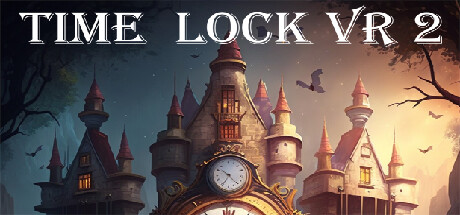
Time Lock VR 2, developed by WR-VRG and published by Whale Rock Games, is a virtual reality puzzle experience built around the intriguing concept of manipulating time within interactive environments. The game frames its journey through a mystical narrative, placing the player in a world where past and present overlap, and where progress depends on the ability to alter events across different temporal states. It’s a premise that naturally lends itself to VR, offering the potential for tactile, immersive problem-solving where players physically engage with objects and space. At a conceptual level, it’s an idea with genuine appeal, especially for those drawn to experimental mechanics in virtual reality.
The core of the experience lies in its time-based interactions. Players can influence objects by rewinding, pausing, or altering their state across different points in time, using these mechanics to solve environmental puzzles. In its stronger moments, this creates a satisfying loop of observation and experimentation, where players must think beyond a single timeline and consider how actions in one state affect another. The physicality of VR adds to this, as interacting with objects directly—grabbing, moving, and repositioning them—can make even simple solutions feel engaging. There are moments where the system clicks, and the game delivers on its promise of immersive, time-driven puzzle solving.
However, this initial sense of novelty begins to fade as the game progresses. The puzzles rarely evolve in complexity in a meaningful way, and the mechanics introduced early on are not expanded upon with the depth needed to sustain long-term engagement. Instead of building toward more intricate or layered challenges, the game often repeats similar patterns with only minor variations. This leads to a sense of stagnation, where the player’s understanding of the mechanics outpaces the game’s ability to challenge them. What could have been a deeply engaging system ends up feeling underdeveloped, as if the foundation is present but never fully realized.
The narrative provides a loose framework for the experience but remains largely in the background. The story of freeing a trapped soul and navigating fragmented timelines is conveyed through minimal exposition and environmental hints, but it rarely develops into something emotionally compelling. Rather than driving the experience forward, the narrative feels more like a thematic backdrop, offering context without creating a strong sense of purpose or urgency. Players are more likely to continue out of curiosity about the puzzles than investment in the story itself.
Visually, the game delivers a mixed presentation. The environments are designed with functionality in mind, ensuring that objects are easy to identify and interact with in VR, which is essential for the gameplay to work. However, the overall visual quality lacks consistency, with some areas appearing clean and readable while others feel generic or lacking detail. There is a noticeable absence of a strong artistic identity, which makes the world feel less memorable than it could have been. While the game is serviceable from a technical standpoint, it does little to stand out in a space where visual immersion plays a significant role.
Design and polish are where the game’s limitations become most apparent. The experience can feel rough around the edges, with certain interactions lacking precision and some mechanics not fully refined. There is also a lingering sense that the game’s components do not always come together cohesively, as though individual ideas were implemented without being fully integrated into a unified vision. This does not render the game unplayable, but it does contribute to a perception of it being more of a prototype or early iteration rather than a fully polished product.
Despite these issues, Time Lock VR 2 does have a certain accessibility that may appeal to a specific audience. Its mechanics are straightforward enough for newcomers to grasp, and its relatively simple structure allows for short, contained play sessions. For players who are new to VR or looking for a light puzzle experience without a steep learning curve, it can offer a few hours of casual engagement. The core idea remains interesting, even if the execution falls short of its potential.
Ultimately, Time Lock VR 2 is a game that revolves around a compelling central concept but struggles to build enough depth around it. The time manipulation mechanics hint at something more ambitious, yet the lack of progression, variety, and polish prevents the experience from reaching that level. It stands as an example of a promising idea that needed further refinement and expansion to truly shine. For those curious about VR puzzle games, it may offer a brief and occasionally engaging diversion, but it is unlikely to leave a lasting impression.
Rating: 6/10