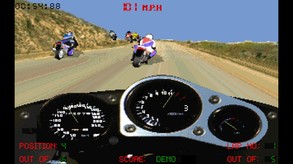
Cyclemania, developed by Compro Games and Accolade and now published by Ziggurat, stands as an eccentric but fascinating artifact from the early era of experimental racing games. Originally released in 1994, it was among a wave of titles that sought to merge full-motion video with interactive gameplay—a fusion that was both ambitious and technologically constrained by the standards of the time. The game uses actual filmed road footage as the foundation for its racing courses, layering player-controlled motorcycles and obstacles over pre-recorded video. This gives Cyclemania a distinctive texture, a sense of speed and realism that polygonal racers of its day could only approximate. It captures a moment in gaming history when developers were trying to push the limits of immersion through video technology, even if the results now feel dated and awkward by modern expectations.
At its core, Cyclemania is a high-speed motorbike racer that places players behind the handlebars of a superbike tearing down winding mountain highways, desert stretches, and coastal roads. The sensation of movement is achieved through FMV backdrops that shift dynamically to simulate turns, slopes, and changes in scenery. Players must react quickly to avoid hazards—cars, oil slicks, wildlife, or sudden turns—that appear within the limited window of the camera. The control scheme is minimal, relying on directional inputs for steering and throttle management, but the simplicity hides a steep learning curve. Because the courses are based on real footage, the player’s control over the bike is constrained by the prerecorded video, creating a constant tension between speed and survival. Success depends on quick reflexes, memorization, and a willingness to wrestle with the game’s idiosyncratic response to player input.
What makes Cyclemania remarkable even today is its audacity. The decision to use live-action road footage gave the game a distinct personality in a genre that, at the time, was dominated by sprite-scaling or early polygonal racers. Each course feels alive with the imperfections of real-world roads—the way sunlight glares off the asphalt, how the scenery blurs past as the bike accelerates, and how oncoming vehicles appear with an almost cinematic unpredictability. The illusion of realism was its greatest selling point in the mid-1990s, and in its own strange way, it remains impressive. The soundtrack complements the experience with gritty rock instrumentals that match the adrenaline of tearing through tight corners and open highways. The visual quality, however, is undeniably rough: the FMV compression creates visible pixelation and distortion, and the limited frame rate can make obstacle timing erratic. Still, there is a charm in its imperfections, a reminder of how game developers once embraced experimentation as part of the creative process.
In terms of structure, the game is relatively simple. Players can choose from several motorcycles, each with its own handling characteristics and speed profiles, before taking on a series of courses. The goal is straightforward—finish as fast as possible while avoiding collisions—but the challenge lies in the unpredictability of each track. The hazards are not always clearly visible due to the FMV’s low resolution, and the tight window for reaction means that progress often depends on trial and error. While that can lead to frustration, it also gives the game an almost arcade-like rhythm, rewarding persistence and pattern recognition. The satisfaction of finally completing a flawless run on one of the trickier courses is genuine, even if the mechanical depth is limited. Cyclemania was not designed for precision or realism in the modern sense; it was designed to evoke the thrill of speed and the danger of the open road through the lens of 1990s technology.
From a modern perspective, Cyclemania’s strengths and weaknesses are inseparable. Its FMV presentation, which was groundbreaking in its time, now feels clunky and restrictive. The illusion of speed sometimes breaks when the video transitions abruptly between segments, and the steering can feel disconnected from what’s happening on-screen. The limited number of courses and the absence of a real progression system mean that replay value is modest once the novelty wears off. Yet, these shortcomings are part of its identity. The game’s appeal lies not in refinement or longevity but in its boldness as a piece of gaming history. It represents an era when developers were experimenting with the boundaries of interactivity and multimedia, long before the industry settled into predictable forms of realism and simulation.
The modern re-release, handled by Ziggurat through DOSBox emulation, does an admirable job of preserving the original experience. The game runs smoothly on modern systems, maintaining the quirks and visual fidelity of the 1994 version while ensuring accessibility for contemporary audiences. The nostalgia factor plays heavily in its favor; for players who grew up with early CD-ROM games, Cyclemania offers a direct portal back to that period of discovery and experimentation. For new players, it functions more as a historical curiosity—a glimpse into how developers once believed FMV might define the future of racing games.
Ultimately, Cyclemania is less about competition or mastery and more about atmosphere and novelty. It is a product of a time when gaming was still in the process of defining what realism meant, when filmed environments seemed like the next big step toward immersion. Today, it stands as a charming relic, a reminder of how ambition and technological limitation can coexist in creative tension. Though it lacks the polish, variety, and precision of modern racers, it carries a unique energy that still resonates with enthusiasts of retro design. Cyclemania may not be fast or smooth by today’s standards, but it remains a testament to a pioneering spirit—one that embraced experimentation over perfection and helped pave the road, quite literally, for the racing experiences that followed.
Rating: 5/10