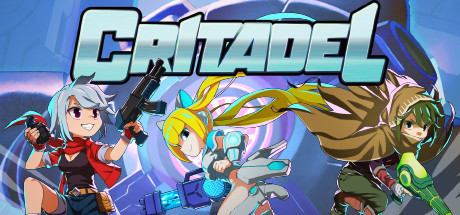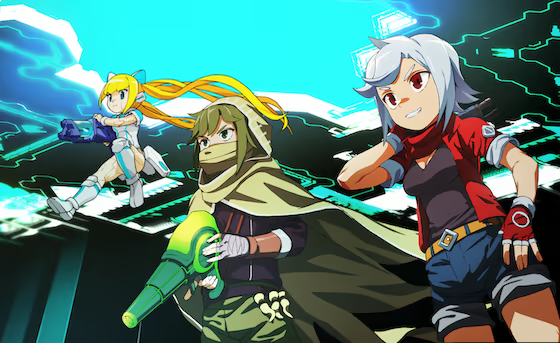
Critadel is a futuristic platform/shooter/roguelike with three playable characters, hundreds of branching paths and over 100,000 unique weapon configurations!
Modeled estimate, not a reported figure. How we estimate →
About

Stats
All-time low is the lowest price we've recorded for this game since we started tracking it.
Languages: English, Korean, Japanese, Traditional Chinese, Spanish - Spain
Engagement
Hours played at review time, across 40 reviews with recorded playtime.
Reviews
Themes across 40 recent reviews and how positive each mention is. A keyword signal, not full sentiment analysis.
positive critical· bar length = how often the theme comes up
Reviews
Like others have said when looking at reviews, this game has a really good core loop but its systems leave a lot to be desired. I have a lot, but here's the most important ones I could name: The weapon durability system I tried very hard to enjoy, but honestly it just incentivized me to only use my starter weapon since it doesn't run on durability. This one is probably the most subjective, maybe others enjoy it but I felt that weapons with durability ran out pretty fast, and since the starter guns have unlimited durability and aren't bad at all I would only use it for all scenarios. The trait system that guns have is also a system that is a good concept but doesn't feel great in practice. All guns have traits and provide buffs if you have enough that share that trait. However, because you can only hold nine at a time, if you want to optimize one of them you're forced to hold basically only guns of the trait you want to buff. This and the fact that weapons have durability (and not a lot of it) I just hoarded guns that buffed stats good for my starter weapon. Dodging in my opinion also feels pretty bad. Your normal dodge feels good and nothing out of the ordinary for a game genre like this, however when you perform a "perfect" dodge you're rewarded with extra lag while deleting projectiles around you that you would've avoided anyways. When playing, I dodged intentionally avoiding perfect dodges because very often after a perfect dodge I'd just continue in the animation and into damage, which felt like a strange habit to pick up because it made me afraid of the "correct"/best type of dodge If I could leave an in-between 'meh' review I would, because it does have things that are worth praising: The art style is cute, the actual feel of the gunplay is satisfying, and the pacing is fast. Despite all of that though, I learn towards not recommending it because the points above seriously hinder my enjoyment
뭔가 좀 조잡한 느낌이 남... 난이도도 너무 어렵고.
게임 자체는 재미있게 만들어뒀는데, 게임 중에 불만이 많아짐. 1. 본인들이 하드모드 단계 만들어두고 막상 최신버전 와서는 막아둠. 몇 년이 지난 상황에서도 업데이트가 안되어있다면 손 놓은게 맞는거 같음. 하드를 계속 플레이해보니 패턴이 중간에 바뀌는거 보면, 자동으로 단계가 올라가는 거 같긴 한데 중요한 건 몇 단계인지 전혀 알 수 없다는거임. 2. 난이도 밸런스가 이상함. 솔직히 말해서 노말이 하드보다 더 어려움. 오르면서 파밍하다 느끼는건데 컵을 강제로 채워야 12층을 볼 수 있기 때문에 미션방을 강제로 방문해야 함. 이 과정에서 적게는 방 하나, 많게는 몇 개의 방을 손해보는 쪽으로 짜게 됨. 이게 스노우볼이 계속 구르기 때문에 스트레스로 이어짐. 3. 층 수 텔레포트가 의미없음. 오히려 파밍 구간을 스킵하는 꼴이라 난이도가 더 올라감. 결국 층 뚫어도 안 씀. 4. 로비에서 아이템 리롤 못하는 거 스트레스임. 개발진들이 이 악물고 리롤 못하게 하려고 2층 이상 올라가서 후퇴해야 로비템 바꿀 수 있게 만들어 둠. 이 점이 더 꼴받음. 지들이 게임 유기해두고, 게임 하는 사람들은 불편함을 계속 감수해야 됨. 이 짓을 참고 할 수 있다면 해도 상관없음. 게임 자체는 재미있긴 한데 각종 시스템이 열받아서 추천은 안함.
This is a good game
Critadel is a fast-paced 2D action roguelike that leans heavily into classic arcade sensibilities while layering in modern procedural systems and an enormous emphasis on gear variety. Developed by Pixelian Studio and published by Nicalis, Inc., the game places players inside a futuristic reimagining of the Tower of Babel, a towering mechanical structure filled with hostile machines, shifting layouts, and escalating danger. From the outset, Critadel makes its intentions clear: this is a game about momentum, reflexes, and improvisation, where survival depends on reading chaotic battlefields and making the most of whatever tools you manage to scavenge during a run. At its core, the gameplay blends twin-stick shooting with light platforming, emphasizing constant movement and spatial awareness. Enemies attack from multiple directions, often filling the screen with projectiles, forcing players to weave, dodge-roll, and reposition continuously. The dodge mechanic, complete with brief invincibility frames, becomes essential rather than optional, and mastering its timing is key to surviving later floors. Level layouts are procedurally generated, offering branching paths that allow players to make risk-reward decisions about whether to chase better loot, safer routes, or potential upgrades. This structure gives each run a different rhythm, even if the core enemy types and environmental hazards become familiar over time. One of Critadel’s most distinctive features is its weapon system, which revolves around a staggering number of possible combinations. Weapons are generated with various traits, elemental effects, and modifiers that can interact in unexpected ways, forming powerful synergies when paired correctly. This system encourages experimentation, as a mediocre gun can suddenly become devastating when combined with the right artifacts or complementary weapon effects. Artifacts further deepen this layer by offering passive bonuses that alter how you approach combat, such as improving survivability, enhancing damage output, or modifying how weapons behave. In theory, this creates a nearly endless sandbox of builds, making each successful run feel like the result of clever adaptation rather than rigid planning. However, this same system can also feel restrictive in practice due to durability and ammo limitations. Weapons degrade quickly, which often discourages players from fully embracing newly found gear, especially when a reliable starter weapon feels safer in the long run. Instead of constantly rotating weapons, players may find themselves hoarding their best options for emergencies, which slightly undercuts the thrill of discovery that the game otherwise promotes. Resource management becomes a delicate balancing act, as players must decide when to spend currency on upgrades or shops and when to conserve it for future floors, knowing that a single mistake can end a long and carefully built run. Visually, Critadel adopts a sharp, retro-inspired pixel art style that recalls handheld and early console action games, but with smoother animations and more elaborate effects. Mechanical enemies explode into showers of pixels, weapons fire in colorful bursts, and environments pulse with neon-tinged sci-fi energy. The presentation may not be flashy by modern indie standards, but it is cohesive and functional, prioritizing readability during intense combat. Complementing the visuals is a driving electronic soundtrack that reinforces the game’s relentless pace, helping maintain tension as players climb higher into increasingly hostile territory. Despite its strengths, Critadel can feel uneven in its pacing and long-term progression. Runs tend to be lengthy, and repeated failures can be discouraging due to the relatively limited sense of meta-progression between attempts. While there are unlocks and new characters to access, the lack of substantial permanent upgrades means that improvement relies heavily on player skill and familiarity rather than a growing sense of power. For some, this purity is part of the appeal, but for others it may make the experience feel punishing or repetitive, especially when difficulty spikes arrive without clear warning or proportional rewards. Ultimately, Critadel is a game that thrives on intensity and player commitment. It rewards those willing to learn its systems, accept its harsh penalties, and experiment within its sprawling web of weapon synergies. Its blend of classic arcade action and modern roguelike design gives it a strong identity, even if certain mechanics feel under-refined or overly restrictive. For players who enjoy demanding action games with a retro soul and a heavy focus on moment-to-moment decision-making, Critadel offers a challenging and memorable climb, one that may frustrate at times but remains compelling through its sheer mechanical ambition and relentless energy. Rating: 7/10
Tenía pintaza, pero me ha resultado bastante costoso de jugar. Lo lamento, a lo mejor es que soy muy torpe.
Que joguinho gostosoooooo!! É bonito, fluido, dá aquele frio na barriga na hora do boss, os minions são diversificados, a curva de aprendizado é gentil, você pega o jeito muito rápido. Tenho poucas horas de jogo e vi que o negócio vai longe ^^
I tried to get into this, but I'm playing this on Steam Deck and, after 30+ runs, I've now had 2 crashes. There's no mid-run saving. And I don't know why they bother with checkpoints since your starting damage is too pathetic without boons gained earlier in the tower - you've got to start every run fresh so you can get a good gun before enemy health starts ramping up. The taglines in the trailer are BS - runs really don't have much variability. Even the same rooms end up getting spawned consistently and bosses are fixed between two options. There's some kind of synergy system where having multiple guns of a certain attribute or type gives you bonuses, but most of them seem so pathetic that the only consistent way to win is to chase after the guns that do big damage and grab as many artifacts as you can to boost your stats. Who cares if having 7 Normal-type guns gives you an extra 7 damage per shot when S-rank guns already do dozens more. And why does an A-rank attachment have the property of keeping crit chances above no less than 0%? If a gun has a negative crit, I guess I could pair it with another attachment to boost it to...10%....wow, who cares? Are you going to use both boost slots on a gun for that instead of just boosting base damage? It was sort of interesting at first, but there's just not enough depth as compared with other roguelikes to keep this interesting. And what is here is so unbalanced or underdeveloped that you just end up playing every run the same anyway.
Twin-stick shooters are one of my favorite genres but for some reason Critadel doesn't click for me. It's not a bad game but just not fun enough to keep playing. Something about the feel of the controls and level design. I have a category for games like this named 'Meh'.
Critadel takes much in the way of direct inspiration from Enter the Gungeon. It apes many of the mechanics, from the post-run currency to the 'ammo' mechanic of the new weapons you find. That isn't a criticism - Enter the Gungeon is one of the greatest roguelikes ever made, so the similarities are largely good things. Unfortunately, the comparison doesn't exactly leave Critadel in a good light. Compared to ETG, it severely lacks polish, aesthetic, content, style, humor, and more. Let me address upfront the big issue - the CURRENT VERSION of the game is *broken*. There are two achievements that are straight-up unattainable without rolling back to a previous version, one of which being due to the fact that they broke the "hard mode", which is supposed to unlock harder difficulties as you complete it. Currently, it does not do this. Devs have not updated the game in years, and likely never will, so consider this a permanent issue. There isn't much to unlock in terms of a post-game progression. Once you complete every second level for the first time (2, 4, 6, 8) you unlock a spread of new weapons and artifacts, but that is all. Despite copying ETG's out-of-level shopkeepers that use permanent currency, none of them sell new items to unlock in the run - they even have a shopkeeper that looks like a *direct* ripoff of the big golem/lady shopkeep duo from ETG, but all they offer are one-run artifacts that are unfortunately awful. You can level up your characters by playing them over and over, but the last couple of levels require multiple beat-the-game runs to level up once, and most of the passive effects you get for the effort are pretty useless, until you get the final one. I can't imagine putting enough time grinding one character in to do so, so if you end up getting one, congrats, I suppose. The poor polish reflects in other aspects of the game, too. I'll lightning-round a few of the things that really ought to be changed. A) There is a sidequest that requires you to talk to a guy, get a random quest from him, and then complete it before you find him and talk to him again. He only shows up in one tile every two floors, so 5 times throughout the entire game, and you need to complete three quests for him. Besides the fact that you'll often have to bend your entire run around reaching these tiles, including giving up on necessary gun repairs or artifact rooms, occasionally, the quest he gives you will be randomly be physically impossible to complete in two floors. (EX: Sometimes the quest will be to kill 60 enemies, which almost always occurs naturally throughout the game. Sometimes, the quest is to Upgrade Weapons 5 times, which can run you over a thousand crystals (which you'll have to save up for several floors to be able to afford) and is NEVER necessary or helpful for you, and sometimes you'll go multiple floors without seeing an anvil.) In other words - you can only afford to skip him once in the entire game if you want to complete his quests - and the rewards are negligible. It's ONLY a pain to complete. So what if you decide not to complete them? Well, you'll make it to the end of the game and find out that you can't actually beat the game unless you completed them. Who decided on this mechanic? B) One thing that ETG does extremely well is make explicitly clear what will hurt you. All bullets or attacks fired by enemies have a distinct look to them, and the color is designed to pop on every background so that your eyes can always find them. Despite aping the design of the bullets in this game, they have forgone this stylistic sensibility. Later in the game, the backgrounds will be so visually noisy that enemy projectiles, ground-effects, and damage-zones are practically invisible. C) It is a sidescrolling game that requires you to often fight enemies on a screen above or below you, but there is no way to identify those enemies, their projectiles, or see them besides dropping/popping into their screen, often on a movement-controlled elevator or by dropping through a floor. Nine times out of ten, you do so into an attack that you can't really avoid. This encourages you to find weapons that allow you to blind-fire through walls and kill them without ever seeing them, since there's no safe way to approach. D) Synergies are not well explained. I spent the first ten hours thinking collecting 5 normal weapons doubled your damage, only to finally do it and not notice any difference in my damage whatsoever. So, if you've read this far, you're no doubt noticing that this is, in fact, a positive review - and it certainly doesn't sound like it, does it? The reason this review is not negative is that, despite the strange design choices, this game does actually excel at creating a satisfying run-and-gun roguelike shooter. You can unlock everything and play through the game in just around ten hours or so, and the curve will be quite fun during that time. It's not a carbon copy of ETG, and has many fun and intriguing mechanics - like how weapon balance and crit chance are handled. Every S-Rank gun legitimately feels excellent to use, and when it works, it works very well. The art is beautiful, clear care was put into making it feel and look nice, and some of the character designs feel special to me. If you were deciding between this game and Enter the Gungeon, then I'd play Enter the Gungeon every time. But if you, like me, have already 100%'d ETG and are looking for a similar experience, you'll probably have more fun playing this than Exit The Gungeon. I would, however, recommend getting it on a sale. For the amount of content, twenty bucks is a bit steep, especially considering you will need to fiddle with versions if you plan on 100%ing it.
Related
Related
Trends
Modeled estimate over time, reconstructed from Steam's monthly review histogram.
Momentum
Pace estimated from the game's recent review growth (our daily snapshots) at its own sales-per-review ratio — a momentum signal, not booked sales.
Audience
Estimated from the language of this game's reviews — a proxy for where players are, not official Steam demographics.
Related
| 7Days Origins | $89.1K | 353 | 86% | $8.99 |
| Darkness Within 1: In Pursuit of Loath Nolder | $89.1K | 626 | 73% | $7.99 |
| Beyond Sunset | $89.1K | 352 | 79% | $9.99 |
| Metal: Hellsinger VR | $89.1K | 129 | 67% | $11.99 |
| Merchant of the Six Kingdoms | $89K | 217 | 92% | $14.99 |
| Mad Experiments: Escape Room | $89K | 423 | 66% | $14.99 |
Related
| 7 Days to Die | $425.3M | 403.5K | 87% | $44.99 |
| Mount & Blade II: Bannerlord | $309.8M | 293.9K | 88% | $49.99 |
| Palworld | $279.6M | 445.8K | 94% | $20.99 |
| Clair Obscur: Expedition 33 | $263.7M | 178K | 95% | $47.99 |
| Terraria | $187.5M | 1.5M | 97% | $9.99 |
| Don't Starve Together | $130.6M | 373.1K | 95% | $14.99 |