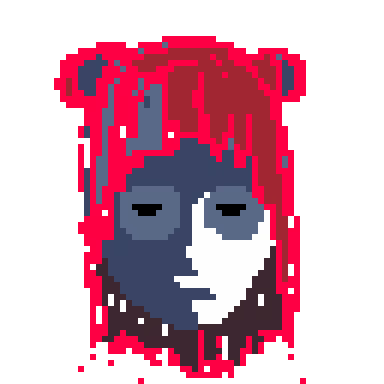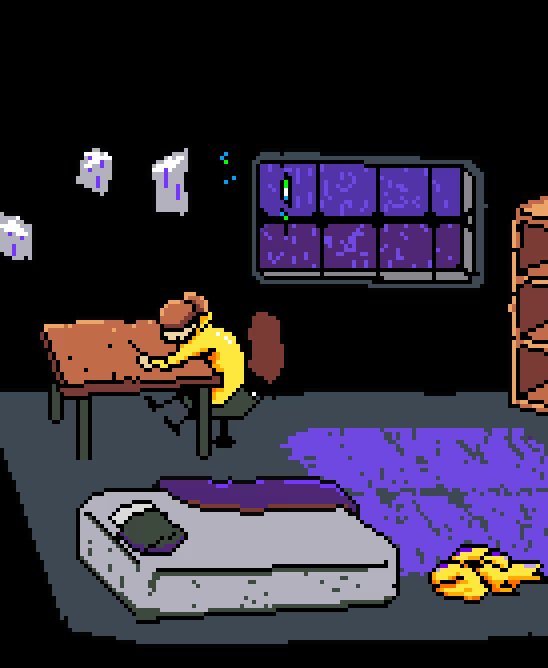
Closer To Home is a dialogue-focused surreal horror exploration game. Navigate connections between reality and dreams, look for weird stuff and make friends. There is no reason to fear death.
Modeled estimate, not a reported figure. How we estimate →
Media

About


Stats
All-time low is the lowest price we've recorded for this game since we started tracking it.
Languages: English*, Russian**languages with full audio support
Engagement
Hours played at review time, across 40 reviews with recorded playtime.
Reviews
Themes across 40 recent reviews and how positive each mention is. A keyword signal, not full sentiment analysis.
positive critical· bar length = how often the theme comes up
Reviews
Мммм, моя улюблена гра "це радше нейтральний відгук", майже негативний, якщо зовсім чесно. Прилетіла до кураторки й я якийсь час її оминав, бо вже втомився від клонів (ви вже маєте здогадатися) Yume Nikki, ще й з купою того, що мені муляло в Jimmy and the Pulsating Mass (крім боїв, їх тут нема), як виявилося. Тільки без мовчазної виразності першої та чудових текстів другої, якесь моє особисте бінго негативних аспектів цих ігор. Багато чого я можу списати на те, що гра мені просто не сподобалася, вона постійно смикається з темою, стилем та стилістикою, що наче й обумовлено зміною станів героя й загальною психоделічністю, але все одно враження, наче втрапив в якийсь ремікс "наша пісня гарна й нова", бо звісно ж купа всього включно з музикою настільки очевидно трішки перероблені прямі запозичення зі Щоденника, що просто прикро, а гра візуально й тематично то по-дитячому наївна й дивна, то пхає серйозні теми й кров, не граючи при цьому на контрасті чи зв'язку між ними. Зовсім ніяк я не можу пояснити ігролад, в сенсі тут є кілька цікавих рішень та ідей, так, але технічний бік страшенно дратує: треба стати піксель в піксель поряд з тим, з чим хочеш взаємодіяти й позаяк взаємодій в цій грі ціла купа, більшість часу я не досліджував світ, а намагався відкрити двері. Десятки, сотні дверей, люків та інших штук, які могли бути просто звичайним проходом. Загалом саме от блукати в цій грі важко, бо суміщати мінімум підказок, автоматичне збереження при вході на локацію й те, що дуже легко застрягти десь, якщо піти проти "системи" себто наміру та логіки розробника, який гравцеві вочевидь невідомий... ну таке. Перезапускав гру три рази, вже не витримував, пішов в посібник зазирнув, не дуже допомогло. Загалом я не вважаю гру прям поганою, але суто мене не зацікавив ані сюжет, ані його подача, тому було страшенно важко не зважати на всі недоліки й очевидні запозичення в цій грі.
Sometimes you will wander without aim but regardless of that fact, you will find a solution, you will find a conclusion. Time brings us all to our appropriate ends.
[i]Find more of my reviews on my curator page: [url=https://store.steampowered.com/curator/45817624-Kasurot-Recommends/]Kasurot Recommends[/url][/i] [h2]Short Summary[/h2] A surreal, lo-fi horror experience that trades combat for conversation. It is a haunting, deliberately confusing journey through grief that rewards patience with genuine emotional depth. [h2]The Breakdown[/h2] [table] [tr] [td][h3]What We Loved[/h3][/td] [td]The "death as a mechanic" system is a brilliant narrative device. Traversing the dreamscape on a skateboard adds a surprising layer of fun to the exploration.[/td] [/tr] [tr] [td][h3]Minor Annoyances[/h3][/td] [td]The game is aggressively "self-obscuring"; getting lost is part of the design, which can be frustrating. Some backtracking is tedious, and the lack of a quest log demands intense player focus.[/td] [/tr] [tr] [td][h3]What It's About[/h3][/td] [td]A psychological descent into a fragmented world to find "pieces of your dad," serving as a dark metaphor for processing trauma and memory.[/td] [/tr] [tr] [td][h3]How It Plays[/h3][/td] [td]Exploration, dialogue, and skating. You wander a non-linear map, talk to entities to unlock paths, and intentionally die to shift between states of reality.[/td] [/tr] [tr] [td][h3]Core Tone[/h3][/td] [td]Oppressive and disorienting, yet strangely sentimental. It captures the specific "brain fog" of depression.[/td] [/tr] [tr] [td][h3]Genre Context[/h3][/td] [td]Reminiscent of [b]Yume Nikki[/b] in its wandering nature, but with the dialogue-heavy focus of a visual novel.[/td] [/tr] [tr] [td][h3]Technical Snapshot[/h3][/td] [td]Lo-fi pixel art style that uses visual distortion effectively. Mostly stable, though some areas suffer from frame drops. The clunky interface is a stylistic choice.[/td] [/tr] [/table] [h2]The Bottom Line[/h2] [h3]Who Is This For?[/h3] Players who enjoy "getting lost" in a narrative and appreciate experimental horror that requires you to piece together the story yourself. [h3]Who Is This Not For?[/h3] Anyone who needs clear objectives, map markers, or traditional gameplay loops; if you dislike "walking simulators" with vague goals, stay away. [quote]A difficult, hostile, yet strangely beautiful little game that asks you to embrace the confusion.[/quote] [h2]Main Review[/h2] [b]Closer To Home[/b] is an exercise in disorientation. You are dropped into a world that operates on nightmare logic, tasked with a seemingly absurd goal: finding pieces of your father. The premise immediately establishes a tone of psychological distress, casting the player not as a hero, but as a confused observer trying to make sense of a fractured reality. It refuses to hold your hand, forcing you to learn its rules through trial, error, and conversation. The gameplay is stripped of traditional conflict, but it isn't just walking. You traverse the world using a skateboard to hop between areas, adding a rhythmic flow to the backtracking. You progress by talking to the bizarre, often grotesque inhabitants of the town, trading items and information to unlock new areas. The standout mechanic is the use of death; rather than a fail state, dying is often a necessary tool to transition between layers of the world or reset a scenario, recontextualizing the horror tropes it employs. The world itself is the primary antagonist. Visually, it utilizes a lo-fi, distorted pixel art style that feels like a corrupted VHS tape. This aesthetic, combined with the lack of clear direction, creates a palpable sense of isolation. You will get lost, and you will backtrack often. While this aimlessness is clearly an intentional design choice to mirror the protagonist’s mental state, it can occasionally veer into tedium when you are stuck looking for a single trigger to advance the plot. Despite its hostility to the player, [b]Closer To Home[/b] succeeds as a piece of interactive fiction. It is a short, focused experience that respects your time by not overstaying its welcome, even if the minutes spent wandering can feel long. It isn't "fun" in the traditional sense, but it is a compelling, memorable dive into the surreal that sticks with you long after the screen fades.
i wisj i could birng my dad back to life too
Made me feel like I was reading the diary of a person that i will never meet. extremely underrated
God darn it's quite hard to put into words how and why this game made me feel the way I did, and this might end up reading like an incoherent ramble, but I wanted to leave a review to bump its numbers up as I think It really deserves it. Closer to Home is gorgeously designed for evoking feelings of the uncanny and weird - from the little details of textures and layout shifting to the often obtuse scribbles and maps you still have to make sense of in order to progress. While many narrative games take a temporal approach to pacing, aka the events of the story are sequenced based on chronology and the tension arc of the plot is built around that, Closer To Home really utilizes the nature of games as spaces. The story is inherently connected to how you navigate said spaces - getting lost in them, trapped in them, seduced by their morbidity. And it's those qualities that really enable you to put yourself in the shoes of the character - feel what they are feeling, see what they are seeing. It's that feeling of apathy and loneliness that is so perfectly transmitted to this open-ended immersive sim-inspired style of game narrative - you are a blank slate and everything is permitted, everything to have some sort of closure.
Frogs :)
yay
very underrated game!
A wonderfully surreal experience that I was very pleasantly surprised by. It's got a unique quality to it that separates itself from the kind of games that inspire it, which I think is very difficult to do! The maps, sketches and notes in game have a really cool style that fits the more abstract and dreamlike atmosphere the game is going for, PLUS THE MUSIC IS GENUINELY SO GOOD. Better experienced knowing as little as possible.
Related
Related
Trends
Modeled estimate over time, reconstructed from Steam's monthly review histogram.
Momentum
Pace estimated from the game's recent review growth (our daily snapshots) at its own sales-per-review ratio — a momentum signal, not booked sales.
Audience
Estimated from the language of this game's reviews — a proxy for where players are, not official Steam demographics.
Related
| Stardew Valley | $243.2M | 1M | 98% | $14.99 |
| Garry's Mod | $197.4M | 1.1M | 97% | $9.99 |
| Factorio | $140.6M | 232.2K | 98% | $35.00 |
| Human Fall Flat | $109.3M | 225.6K | 95% | $19.99 |
| Slay the Spire | $77.4M | 189.7K | 97% | $24.99 |
| Euro Truck Simulator 2 | $75.9M | 746.6K | 97% | $4.99 |
Related
| BEAST CRIMES | $9.9K | 64 | 64% | $9.99 |
| Bad Faith | $9.9K | 64 | 92% | $9.99 |
| Bunker 21 Extended Edition | $9.9K | 60 | 92% | $7.99 |
| Myth Monkey Card | $9.9K | 52 | 100% | $5.99 |
| Terralysia | $9.9K | 60 | 72% | $7.19 |
| Tails Noir: Rebel Rush | $9.9K | 97 | 99% | $4.94 |