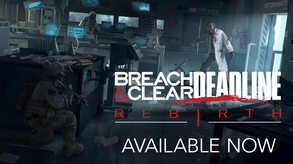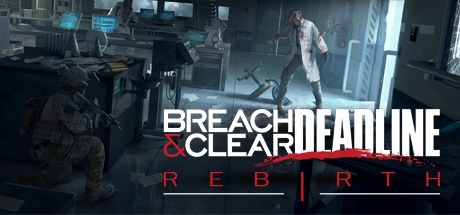
A deadly new breed of human monster is on the rise, and it’s up to players to stop the infestation before it spreads. Breach & Clear: DEADline Rebirth is a new and greatly improved version of B&C: Deadline, the follow-up to Breach & Clear, the critically acclaimed hybrid tactical strategy game.
Modeled estimate, not a reported figure. How we estimate →
Media

About
Stats
All-time low is the lowest price we've recorded for this game since we started tracking it.
Languages: English*, German, Polish, Russian, French*languages with full audio support
Engagement
Hours played at review time, across 40 reviews with recorded playtime.
Reviews
Themes across 40 recent reviews and how positive each mention is. A keyword signal, not full sentiment analysis.
positive critical· bar length = how often the theme comes up
Reviews
[strike] this is the metal gear rising to the breach and clear franchise. goes against the namesake of the first games turn-based mil sim; and is a zombie survival shooter? Plays very similarly to Aliens dark descent where its not a turn-based game, rather you choose when to let the game resume full speed. As EDP445 once said: "I mean its alright" [/strike] this review was written in act 1 of 4 and the games quality SHARPLY drops from mediocre to bad after act 1.
This is an overlooked and great game of the mid-2010's turn-based and isometric real-time modern games rush. It has a unique gameplay mechanic, with these pause and plan, then play out turns in a cinematic style. If the zombies and catastrophic casualty count do not bring you to tears, then it is probable that the short campaign, just maybe 20 hours, will. One issue that this game approaches in an interesting manner is the concept that if DnD style turn-based games are similar to chess, with a sorcerer like a rook, couple of pawns and a knight taking on a variety of usually one or two types of enemies, then the addition of a mostly gun-wielding crew basically turns everyone on both sides into rooks and bishops. Zombies make that a flood of pawns. I am kind of surprised there have not been a few more takes on that as a gaming concept. The biggest improvement that this game offers in terms of the franchise is the addition of an open-world to explore. With such a short campaign, though, this does not make it competitive against the great releases of the time-period.
解成就 拿卡片
Sirens split the dark One squad stands against the plague Deadline comes for all
V istej časti hry som narazil na game-breaking bug - všetky hlavné questy splnené, no hra nezareagovala. riešenia to má, ale žiaľ, mne ani jedno nefungovalo a naozaj odmietam hľadať jeden pixel na celej mape. naviac vďaka úžasnému save systému (máte jeden save, ktorý sa prepisuje s postupom) sa ani nemôžem vrátiť k staršej pozícii a skúsiť prejsť kritický úsek opäť. plus opakované bugy kamery, ktorá sa odmieta otáčať... a celý zážitok z hry je preč. hra ako taká je celkom zábavná a tie hodiny v nej som si v zásade užil, ale z dôvodu vyššie popísaného určite hru neodporúčam kupovať. ak, tak v nejakej slušnej zľave za pár centov.
Дешевая игра по дешевке сойдет.
Breach & Clear: Deadline Rebirth, developed by Mighty Rabbit Studios and Gun Media and published by Good Shepherd Entertainment and Devolver Digital, is a hybrid tactical-action RPG that attempts to blend squad-based military strategy with the chaos of a zombie apocalypse. As a reimagined and rebalanced version of Breach & Clear: Deadline, this edition refines the core systems of the original while keeping its unique combination of real-time combat, pausable tactics, and open-world exploration intact. The result is an ambitious game that straddles two genres rarely combined successfully, offering a mix of deliberate tactical control and visceral gunfights in a dark, decaying city overrun by the undead. While the concept has enormous potential and certain elements deliver on that promise, the execution remains uneven, resulting in an experience that is as intriguing as it is flawed. Set in the quarantined ruins of Harbor City, the story unfolds in a bleak world where a parasitic infection has turned most of the population into violent monstrosities. You lead a four-man Special Operations squad through the crumbling streets, derelict buildings, and infested zones, searching for the source of the outbreak and any surviving pockets of humanity. Each operative can be customized with different classes, weapons, and gear, creating the foundation for strategic depth. The game’s greatest strength lies in this tactical control system. Players can pause combat at any time to issue precise commands—ordering soldiers to take cover, use abilities, or flank enemies—or they can opt to fight in real-time for a more frantic, action-driven approach. This duality gives Breach & Clear: Deadline Rebirth a unique rhythm. When the system works smoothly, it creates a satisfying ebb and flow of command and execution, evoking the intensity of real-time strategy games while retaining the deliberation of a turn-based experience. The combat mechanics are at their most engaging when the player is fully immersed in the micro-management of the squad. Positioning, timing, and resource management all matter in the heat of battle. Each operative class—ranging from medic to demolitions expert—comes with its own abilities, and proper coordination between them often determines success. The moment-to-moment gameplay involves suppressing enemies, tossing grenades to clear out choke points, and managing line-of-sight, all while responding to dynamic threats. However, the effectiveness of this system is often undermined by the uneven behavior of the AI. Squadmates occasionally fail to follow orders, get stuck on terrain, or expose themselves unnecessarily. Enemy AI is similarly inconsistent: while human enemies can pose a tactical challenge, the zombies frequently behave as mindless obstacles, rushing headlong into gunfire without strategy or variation. This lack of intelligent opposition robs the combat of tension after a few hours, making many encounters feel mechanical rather than thrilling. Beyond combat, the game’s structure borrows heavily from action RPG conventions. Harbor City is divided into explorable districts connected by safe zones, each filled with missions, loot caches, and enemy strongholds. Players scavenge weapons, armor, and materials to upgrade their squad, earning experience points to unlock new abilities and improve performance in the field. The looting and leveling systems are functional but uninspired, lacking the sense of excitement or diversity found in more refined RPGs. Many weapons and gear pieces feel interchangeable, and the stat upgrades rarely have a meaningful impact on gameplay. Still, the loop of clearing areas, gathering resources, and customizing the team provides a sense of steady progression that keeps the experience from stagnating entirely. There is an undeniable satisfaction in seeing your squad evolve from fragile survivors into a hardened unit capable of dismantling hordes of infected with precision. Aesthetically, Breach & Clear: Deadline Rebirth captures its grim tone well. The city of Harbor feels convincingly decayed, with dim lighting, shattered streets, and flickering signs that create a sense of isolation and dread. The environments are functional rather than striking, but they effectively communicate the atmosphere of a world that has long since fallen apart. The sound design adds to this tension with echoing gunfire, guttural screams, and a moody ambient soundtrack that reinforces the sense of danger. Despite these strengths, the game’s presentation is hindered by technical limitations. Texture quality is inconsistent, animations can be stiff, and environmental assets are reused frequently. It’s clear that the game was developed with a modest budget, and while it doesn’t detract entirely from the experience, it prevents the world from feeling as immersive as its premise suggests. Narratively, the game offers only a thin thread to connect the missions and objectives. The story is serviceable—a standard military survival plotline with hints of conspiracy and infection lore—but it lacks character depth or emotional weight. Dialogue sequences are sparse, and the squad members, though fully customizable, have little personality beyond their roles in combat. This lack of narrative investment makes the game’s world feel functional but impersonal. Players are driven forward less by the story itself and more by the gameplay loop and the tactical satisfaction of clearing objectives. This design focus works for players who value mechanics over storytelling but may leave those seeking a deeper emotional or thematic experience feeling detached. While Breach & Clear: Deadline Rebirth succeeds in creating a distinctive tactical formula, its limitations become more apparent the longer one plays. Missions start to blend together as the novelty of the hybrid system fades, and the repetition of objectives—clear the area, secure the objective, collect the loot—can wear thin. The open-world structure, while ambitious, is not as dynamic as it could be, with limited interactivity beyond combat and scavenging. Inventory management and user interface issues also detract from the experience, especially on PC, where controller-focused menus can feel cumbersome. Despite the improvements of the Rebirth version, which addressed stability and performance issues, the overall design still feels caught between two genres, never fully committing to either the tactical precision of its roots or the narrative and environmental depth of modern RPGs. In the end, Breach & Clear: Deadline Rebirth is a flawed but fascinating experiment—a game that tries to push the boundaries of tactical action but struggles to maintain consistency. It captures moments of genuine tension and strategic satisfaction, supported by an atmospheric world and solid combat foundations. However, its uneven pacing, shallow progression systems, and technical shortcomings prevent it from reaching the excellence it strives for. Still, for fans of squad tactics and post-apocalyptic settings, it stands as an intriguing entry in a niche genre, one that reflects both the ambition and imperfection of indie game development. It’s a game that doesn’t quite breach greatness, but one that remains worth clearing for players who enjoy exploring unique, hybrid designs. Rating: 5/10
Not bad for 99 cents.
Yes.
Nepovedený port z konzole, který zaspal dobu.
Related
Related
Trends
Modeled estimate over time, reconstructed from Steam's monthly review histogram.
Momentum
Pace estimated from the game's recent review growth (our daily snapshots) at its own sales-per-review ratio — a momentum signal, not booked sales.
Audience
Estimated from the language of this game's reviews — a proxy for where players are, not official Steam demographics.
Related
| Flatworld | $261.8K | 896 | 97% | $14.99 |
| Imperivm RTC - HD Edition "Great Battles of Rome" | $261.9K | 1.3K | 70% | $9.99 |
| Disciples II: Rise of the Elves | $261.9K | 1.4K | 88% | $5.99 |
| Grand Emprise: Time Travel Survival | $261.9K | 843 | 69% | $9.99 |
| Warlords Battlecry III | $261.6K | 945 | 84% | $9.99 |
| TransRoad: USA | $262.1K | 414 | 52% | $19.99 |
Related
| 7 Days to Die | $425.3M | 403.6K | 87% | $44.99 |
| Mount & Blade II: Bannerlord | $309.8M | 294K | 88% | $49.99 |
| Don't Starve Together | $164.7M | 539.5K | 95% | $14.99 |
| Mount & Blade: Warband | $101.9M | 171.6K | 98% | $19.99 |
| The Isle | $60.1M | 116.7K | 80% | $19.99 |
| Warhammer 40,000: Rogue Trader | $48.8M | 46.5K | 88% | $49.99 |