
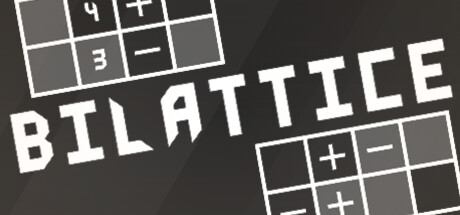
Bilattice is a massive puzzle game featuring over 300 hand-crafted levels and tons of unique mechanics. The mechanics interact with each other in endlessly interesting ways to produce hours of mind-bending content. The sheer number of clever gimmicks offered by this game is hard not to appreciate.
Modeled estimate, not a reported figure. How we estimate →
Media
About
Genres
Stats
All-time low is the lowest price we've recorded for this game since we started tracking it.
Languages: English
Engagement
Hours played at review time, across 40 reviews with recorded playtime.
Reviews
Themes across 40 recent reviews and how positive each mention is. A keyword signal, not full sentiment analysis.
positive critical· bar length = how often the theme comes up
Reviews
Bilattice offers grid logic puzzles you solve by shading cells in the style of Taiji, where you figure out the rules by experimenting. You'll have more fun in this style by playing Taiji before this, or indeed The Witness, Cosmic Express, Understand and Gridspech. Consider this when you're at the point of playing the good version of Pixoji or What the Witness? If instead you come from a paper puzzle background in the Nikoli style, the core rule is the Light & Shadow variant of Nurikabe. You are best served in electronic form by the puzzles presented in the pzv/puzz.link editor/database, pedroworks, or the various versions of penpa/expo. Consider this when you want to face a rolling mix and match of styles that requires little browsing. The learning the rules bit is supported by a curated manual inclusion of area counters, clue validators and automatic grid validation, which is an excellent approach. There's also the option to read the rule straight up that eventually shows up, so you're never hard stuck from ignorance. If you pass it up and eventually concede you need it though, you have to find which specific puzzle randomly contains the "spill the beans" button. The game forgets your solution when you're not looking at it, so experimentation across puzzles or sessions is obnoxious. There's a couple of novel and interesting things eventually done here, one involving a relaxing of shading and one involving puzzle validation, but overall not every rule interacts in an deep, interesting way with every other. In design terms, some boxes in the interaction matrix are pretty sparse. Most of the puzzles aren't for teaching though, but for breeding familiarity and eventually providing challenge. The puzzles themselves seem to be made in different ways, and not all are equally good. There's puzzles whose solving path is designed and you can see it, there's sequences of slightly changing aesthetically pleasing grids, and there's a lot of puzzles where it's very hard to see an articulate, human idea communicated. There's also a couple of options to solve computer generated puzzles under time constraint. The map is astonishingly bad in several ways. Rather than spread out in 2D, it's a scrollable cone that drops into new screens every once in a while. This introduces a ton of clicking and dragging between functionally indestinguishable screens to find open puzzles in mid-game and makes it impossible to remember where a specific puzzle was. It's also thinly connected, so it makes it extra easy to get stuck. The linearity makes sense for tutorials, but most of the game is not that, and the difficulty is not tuned enough to assume subsequent puzzles would also be a problem. The UI is a prank. There's absolutely no keyboard support. There's no undo. Where similar games offer cell colours, border marking, exhausted clues marking, freehand drawing, trial locks and so on this offers the ability to mark a cell as unshaded. The button named Main Menu opens the quit confirmation. The randomiser modes can be found in two different map screens, one of which looks like a puzzle and the other is just a button attached to the terrain opening a menu. The X in a square in the puzzle corner is not quit the puzzle, validate the puzzle, or a checkbox, it's "erase the shading". The 3x3 dot button is not a menu dropdown, it's map despite the map not being a grid. If you want to change how assistance works, you have to leave the puzzle, open a menu, and find the puzzle again instead; and you'll want to move back and forth between settings because you want different ones for tutorials and puzzles where single changes have very wide repercussions and would force you to slowly recalculate a bunch of stuff. The UI slowly broke me. By slowly, I mean I went looking for a refund just after the 2 hour window. I'm resigned to finishing it now. Well, maybe not the integration puzzle. Your mileage may vary.
Ehh, no. Bills itself as a rule discovery game but the vast, vast majority seems to be focused less on clever deduction and more on really. DIGGING. Into the minutia of mechanics and vomited overly complicated puzzles onto you that tend to have obtuse solutions you stumble onto more by accident than intention. I'm fine with puzzle games generally but something about this one in particular really frustrates me to no end and the lack of any driving force or goal other than to "collect the things" isn't really giving me motivation to continue. I peeked enough gems to attempt the endgame "challenge" and saw that it was an annoying timer challenge where even if you solve the puzzles before the timer runs out you have to wait on it and even a single flub means going back to the very start to do it all again and I get the impression the dev simply doesn't respect the player's time because this kind of challenge is simply unfit for a game like this - no, it wasn't cool when the witness did it either, sorry. And barring *any* kind of hint system or nudge in the right direction, I have no desire to beat my head against the wall any further when every new puzzle I open is either a total breeze or makes my brain shut down just looking at it. This might be for someone but it's not for me.
Fun and interesting puzzle mechanics, but lacking polish. Lots of missing features, like the ability to see your previous puzzle solutions.
An simple and incredible rule discovering puzzle game. It reminds me of witness and Taiji minus the world exploring. This could be a feature missing, because it better correlates with reality and artistic view, but not every game needs worlds to be explored. I just don't like the fact that there is a tutorial at the beginning and a character talking to me, but that's just me being nittypicky. If you like rule discovering puzzle games such as witness or taiji, this is definitely a game for you.
このゲームは後半に行くにつれ地雷になる。 まず、The Witness系なのに文字(一部ステージにて制作者のひとこと)がある。 しかもその制作者のひとことが超上から目線 虚数、微分、積分に詳しくないとクリアできないステージがある。もちろん式の説明はなく、煽り気味の文のみ。 あとはわかるな??
少々くどいと感じることや、とっかかりのなさそうな問題に辟易としたこと、案外あっさりと終わってしまったことなど微妙に感じる点も多々あった。 減点方式で評価するなら低評価をつける。 が、加点方式であれば私は高評価をつける。なぜなら、実際楽しくはあったからだ。 記号のルールの推測は楽しかった。ルールは直感的に理解ができた。(これは個人差があるだろう。私がこういうものを得意とするからそう感じるだけかもしれない。) とっかかりのなさそうな問題も、素直に設定した仮定から、案外そのまま解けた。 総合的に見て、私は十分楽しんだと考える。
For me, this game IS NOT similar to taiji at all. If I have to pick a game that it is similar to, I would say a bit like Understand. It is game about learning the rule as you play. What is interesting is the rule is always the same but the more you learn, the more in depth it become. My biggest issue with the game is the puzzle design on some levels. A lot of time, I understand the rule fully but just need to brute force solution by trying different way of arrangement. It could be frustrating at time. But overall, still a solid puzzle game, recommend to anyone who like this genre.
Bilattice is a grid-based rule-discovery puzzle game, of the hardcore variety. Visually very, very simple (but functional), and a bit rough at the edges - on the other hand, many of the puzzles are excellent and quite hard. The only problem I had that there isn't really a sense of progression most of the time, the difficulty is all over the place. If you can live with that, then it's certainly worth a shot.
An unkind person might say this game was made by someone who had [url=https://store.steampowered.com/app/1299400/Understand/]Understand[/url] verbally described to them but didn't get what made Understand good.
If you measure your enjoyment by the amount of time passed between the 'aha!' moment of a puzzle and the completion of the solution, Bilattice is the best puzzle game ever made. The grids in most puzzles are small enough that your triumph happens near simultaneously with your neurons firing up. Sometimes the simplicity leads to accidental guesses, but mostly in the easy puzzles - there are way too many solutions for the complex ones for this to work. This is where my biggest issue arises - there's an excellent period of rule discovery where the levels go by at light speed, and there are the real clunkers which are these impenetrable walls of symbols that require full mastery of the mechanics out of you. There are some in-between puzzles, but there doesn't seem to be enough of them. I think this really hurts the endgame, because after clearing most of the map I'm not sure if I'm ready to tackle any of the hardest puzzles. Elsewhere new interactions are being thrown in the middle of an another puzzle - this seems like an awkward change from sometimes overtutorialized first mechanics, too. The UI didn't bother me much. The people complaining about it are right, but I don't think it hurts the game in a major way. The ability to save the solution would've been cool to remind myself of some previously explained interactions. The map is quirky in a positive way for me, I think anything else would've felt sterile. There's more that slightly bothered me while playing - the design of the challenge, for example - yet I enjoyed the time spent. It's rough around the edges, but fun for the price, especially the rule discovery part of it.
Related
Related
Trends
Modeled estimate over time, reconstructed from Steam's monthly review histogram.
Momentum
Pace estimated from the game's recent review growth (our daily snapshots) at its own sales-per-review ratio — a momentum signal, not booked sales.
Audience
Estimated from the language of this game's reviews — a proxy for where players are, not official Steam demographics.
Related
| Night City 2177 | $6.3K | 104 | 38% | $2.19 |
| Prelogate | $6.3K | 99 | 90% | $3.99 |
| Egghead Gumpty | $6.3K | 68 | 68% | $4.99 |
| The Night Cleaner | $6.3K | 122 | 84% | $2.99 |
| Paintings Thief | $6.3K | 51 | 59% | $5.99 |
| Savage: Ultimate Boss Fight | $6.3K | 65 | 98% | $4.99 |