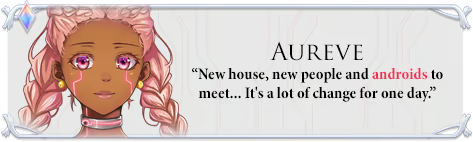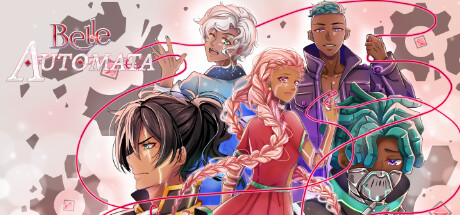
Aureve is content with making tapestries with her master—but when he dies, his family sells her to a reclusive buyer. Thrown into a world of other androids, she must find her place and above all, answer the question: how does one weave a new identity when the strings to the old have been cut?
Modeled estimate, not a reported figure. How we estimate →
About


Genres
Stats
All-time low is the lowest price we've recorded for this game since we started tracking it.
Languages: English**languages with full audio support
Engagement
Reviews
Themes across 41 recent reviews and how positive each mention is. A keyword signal, not full sentiment analysis.
Reviews
Gostei bastante das duas rotas, a forma com que a protagonista tem um bom desenvolvimento e vai aprendendo mais sobre si mesma tambem é otima. É um jogo leve e com um romance fofo, vale a pena pra quem gosta desse tipo de historia
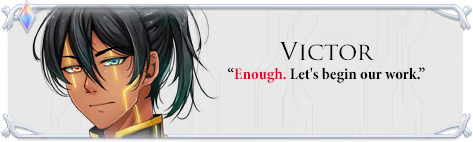
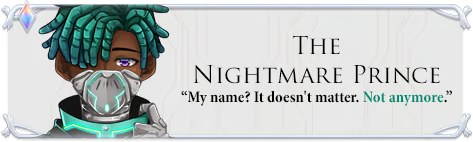
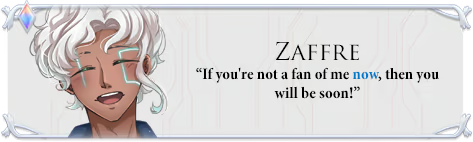
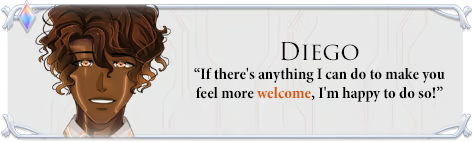
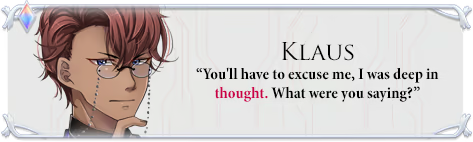
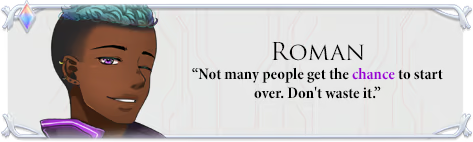
Belle Automata: Chronicle I is an emotionally focused science-fiction visual novel that combines romance, fairy-tale influences, artificial intelligence, and questions about personal identity. Developed and published by Jellyfish Parade, it follows Aureve, a self-aware android whose comfortable existence is suddenly destroyed when her master dies. Aureve previously spent her days creating silk tapestries alongside him, but his family considers her a rogue android and sells her. Her new circumstances bring her into a refuge populated by other self-aware androids, forcing her to confront something she has rarely experienced before: the freedom and responsibility of choosing what she wants her life to become. The premise works particularly well because Aureve's struggle is about more than finding romance. Losing her master also means losing the role that previously defined her existence. She has memories, emotions, skills, and attachments, but no obvious direction for her future. The story consequently examines grief, self-acceptance, independence, and the difficult process of rebuilding an identity after a familiar life has disappeared. The android concept gives these subjects a science-fiction foundation, while the fairy-tale inspiration adds a more romantic and almost storybook quality. These seemingly different influences complement each other because both revolve around characters attempting to transform their circumstances. Aureve is an effective protagonist because she has a recognizable personality and history while still giving the player meaningful control over her decisions. Her name can be changed, but she is not simply an empty avatar. She enters the story carrying emotional baggage from her former life and gradually discovers what having genuine choices means. This gives the game's branching decisions additional thematic significance. Selecting dialogue and relationship choices is not merely about steering toward a preferred ending; it reflects Aureve learning to exercise the independence that was previously denied to her. Chronicle I provides two primary romantic possibilities, Victor and the Nightmare Prince. Victor is portrayed as an extraordinarily capable butler who excels at organizing, cleaning, gardening, and practically everything expected of him. Emotional understanding is another matter. This contrast makes him particularly appropriate for a story involving artificial beings because his competence does not necessarily translate into an ability to recognize or communicate feelings. His relationship with Aureve can therefore explore vulnerability and emotional development rather than relying entirely on immediate romantic attraction. The Nightmare Prince offers a more mysterious alternative. He is Aureve's reclusive purchaser and is initially identified largely through his unusual online name. The intriguing question surrounding him is why someone characterized as a dreamer would come to view himself as a nightmare. His personal mystery gives his storyline a different atmosphere from Victor's route, creating meaningful variety despite Chronicle I containing only two romanceable characters. Victor and the Nightmare Prince are exclusive romance options for this Chronicle, while additional characters are reserved for later portions of the larger Belle Automata story. The supporting cast also strengthens the world beyond the immediate romances. Characters such as Zaffre, Diego, Roman, and others introduce their own struggles involving replacement, guilt, hidden insecurities, and uncertainty about their purpose. Zaffre's situation is especially fitting for the game's themes because he is a former virtual pop star who has been replaced by an upgrade. His circumstances echo the broader question of whether an artificial person's worth should depend entirely on usefulness. Although these characters are associated with later Chronicles as romantic possibilities, their concepts help establish Belle Automata as a broader story about artificial beings searching for identities beyond the functions originally assigned to them. Chronicle I contains more than 100,000 words of dialogue and is designed to provide approximately seven to ten hours of reading depending on the player's pace. There are six endings, providing an incentive to revisit important choices and explore different relationship outcomes. Full English voice acting is another significant feature, with Zoe Sanders portraying Aureve, Brandon P. Jenkins voicing Victor, and Noah Belachew performing the Nightmare Prince. The voice performances complement the character-driven nature of the experience and help conversations feel more personal than they would through text alone. The overall presentation supports the intimate tone effectively. Character sprites, CG illustrations, backgrounds, music, interface design, and audio production all contribute to a polished visual-novel presentation. Jellyfish Parade assembled multiple contributors for the production, including owl. and Shannon Chou for writing, J. Cocco for editing, Keirin for sprite artwork, Sapphire for CG artwork, Goya Munoz for backgrounds, owl. for music, SSAXIFRAGE for interface work, and Matt Dear for audio engineering. This collaborative presentation gives the project an identity that extends beyond its central script. Players should nevertheless understand that Belle Automata: Chronicle I remains fundamentally a visual novel. Despite Steam classifications that include simulation elements, the central experience involves reading dialogue, making choices, following relationships, and discovering different endings. Anyone looking for action, exploration, combat, or complex mechanical systems will find relatively little of that here. Its appeal depends heavily on becoming invested in Aureve and the characters surrounding her. For readers who enjoy otome games and interactive fiction, however, that concentrated approach allows the narrative and relationships to remain at the forefront. Another consideration is Chronicle I's place within a much larger project. The complete Belle Automata concept is designed around six romanceable characters, six routes, eighteen endings, and roughly 330,000 words, whereas this installment concentrates specifically on Victor and the Nightmare Prince. Consequently, Chronicle I feels like an opening chapter to a broader universe rather than an attempt to deliver every planned relationship at once. The narrower focus is not necessarily detrimental, since it provides more room for its two central romances to develop, but players interested in every advertised character need to recognize the episodic structure. What ultimately distinguishes Belle Automata: Chronicle I is the way its romantic premise connects directly with Aureve's search for autonomy. Her status as an android is not simply futuristic decoration. It creates questions about ownership, consciousness, emotional legitimacy, purpose, and whether someone created to fulfill a particular function can redefine themselves after that function disappears. Even Aureve's history of weaving tapestries becomes an appropriate metaphor for rebuilding a life from disconnected threads. The game is therefore best suited to players who appreciate character-driven visual novels, thoughtful romance, branching narratives, and emotionally reflective science fiction. Its gameplay is understandably limited outside reading and decision-making, and the Chronicle format means this installment represents only part of the larger story. Nevertheless, its distinctive android premise, two contrasting romances, six endings, substantial script, full voice acting, attractive presentation, and themes of grief and self-discovery create an engaging beginning. Jellyfish Parade uses romance as only one element of a broader story about an artificial person discovering that freedom means having to decide for herself who she wants to become. Rating: 8/10
Media

Related
Related
Price dynamics, follower growth, revenue and sales trajectories with interactive tooltips
This and every other Pro feature is free until October 20, 2026. A free account is all it takes.
Hours played at review time, across 41 reviews with recorded playtime.
positive critical· bar length = how often the theme comes up
Super cute! I really like Aureve as a character and seeing how she developed in each route was really nice. I love the art style, soundtrack, and even the voice acting. Really lovely experience overall!
I was intrigued by the idea of a Beauty and the Beast-esque romance VN told with androids, and this game fully delivered. In this installment, 2 out of the eventual 6 romance routes are available. There was far more voice acting than I expected, which brought even more life to the story. The game also ran like butter on the Steam Deck, allowing me to easily finish the routes almost all in one evening while swapping to random locations throughout the house. I did have to use a guide to get to some of the endings, as some of the choices that actually led to the perfect end seemed to go against what I felt the character would like/dislike. But it was only maybe one or two choices that I had wrong, and then the rest were pretty easy to figure out as you play through the game. I'm glad that the Kickstarter campaign for this game was a success, as I can't wait to get my hands on the next installments to see the routes that were not included in this game.
[b]Type of Game: [/b] Otome – Romance Visual Novel (heavy focus on romance) [b]Length: [/b] About 7h (for all endings) [b]Story: [/b] 9/10 (8.5 for Victor’s route, 10 for Nightmare Prince’s route) [b]Art: [/b] 9/10 (without CG: 9.5/10) I got a free copy to review this game as a curator. Honestly, I enjoyed this game more than I initially thought I would. It is especially good for an otome game because it has a consistent story and, while the focus is still romance, it manages to describe different kinds of romantic relationships that depend on the heroine’s experiences and the player’s choices. The story is… Well, I was actually pretty surprised to read that the main character is an android, a self-aware android, to be exact. After her previous owner died, she was sold to another family or more like to a shelter for self-aware androids. There, she is supposed to find a way, how to live for herself and not for someone else (like her previous master), and find purpose in her existence. Well, obviously this “new life – new me” story wouldn’t be considered an otome game without romance. As far as I know, the Kickstarter went successful, so there will be part 2 and 3 with the routes for the other guys, but for now we only can choose between Victor and the Nightmare Prince. Victor is the harsh and straightforward butler of the mansion and the Nightmare Prince is the heroine’s saviour and employer. Depending on your choices there will be totally different events going on. Not only does the heroine’s life and future change, but also her appearance, personality and friendships. It actually very cool too see this huge of an impact, although I am not sure if I do fully agree with the actual development of the story (especially with Victor’s route). Besides that, the art is really good, although I was surprised how much worse the CG’s are than the character designs. What I also really liked is the voice acting. Especially because the voices of the androids were changed to really sound similar to how an android would sound. It really helps the game to be immersive. Nevertheless, I did find something I am not that happy about: The difficulty to get the perfect ending. Honestly, I am not that amazing in finding “the right answers” in these types of games, but I think it is still a bit extreme that you get the “normal ending” with the Nightmare Prince already, if you have three wrong answers. I would have liked, if there had been for example “key events” that have an impact instead of the overall accuracy of the answers. It’s not that much of a big deal because you can look up a guide though. Another thing is that you should keep in mind that not that much changes between the endings. So, let’s say, you got a perfect ending. Then, the bad ending will be basically the same story with slightly different dialogues, but with a totally different ending. All in all, I did really enjoy this game and I’m very happy that I had the opportunity to play it. It makes me sad that there are not a lot of reviews, so that this visual novel is very much underrated. The routes were nice and well-written, the character designs are good and the characters are unique and have a consistent personality. Actually, I liked all of them, but found myself in the end falling for the Nightmare Prince. I really adore this guy more than I should. His story was very touching and cute, especially when you get the perfect ending. I didn’t like Victor’s route as much in comparison, to be honest – I didn’t really like, how the heroine was behaving because I couldn’t really relate to it. So, if I’d have to give it a score, I’d give a 10/10 for the Nightmare Prince and an 8.5/10 for Victor probably.
Aureve is just so, so pretty! I love her design. I love her eyes, her hair and her ball-joined features. Everyone’s designs are lovely but the MC is the best in my opinion. I also like her personality – her curiosity about others and just the simple warmth in the way she interacts. She’s a darling. I didn’t except the full voice acting. I don’t usually like full voice acting and usually turn voices off but I liked the electronic touch to the androids’ voices and decided to keep the voice acting on in this game. I think it was quite nice in the end. The CGs are super cute, but the disparity between them and the more elegant art style of the sprites can be a little jarring the very first time, though it’s not something that detracts much from the game, just something I noticed. The story itself is wholesome and sweet. I also enjoyed how Aureve changed her hairstyle in each route. It was cute to see the characters figure out and navigate different emotions. They break down how emotions feel and why they feel them. It feels raw but also soft. Both Victor and the Prince were great love interests in their own ways. In Victor’s route, I was delighted to see Aureve put her own autonomy and decisions over her feelings for him. Their romance was sweet and all about figuring out how to communicate in a way the other understands. In the prince’s route, the two of them were so sweet and awkward. I enjoyed their discussions of change, and the unexpected angst. I love how romance wasn’t ‘be-all, end-all’ in both routes. I’m also curious about Zaffre, Diego, Roman and Klaus. The little hints about the kind of person they are makes me look forward to the next chronicles. The story of this VN is one of self-autonomy, respecting other people’s autonomy and finding out what kind of person you want to be. I like how the characters respect each other’s decisions even when they don’t agree with them. Good communication between characters and their determined attempts to understand one another is what makes this VN enjoyable to me.
Enjoyed it and would say to give it a try. Its different as you are a AI yourself and not a human
Tl;dr: This is a brilliant game. Play this if you're a romance-lover out there who wants to read about respectful, complex and heartfelt love stories, and where your character is treated as an independent, valued and respected person pursuing their own hopes and dreams. This game will make you laugh, blush, AND cry, but you won't regret it. Side effects may include deep philosophical thoughts, dramatically raised standards for romantic games and relationships platonic or otherwise, and potentially even renewed inspiration to pursue your own personal ambitions in life. I recommend this, and all other games by Jellyfish Parade, wholeheartedly. The romances are tender and enchanting, believably woven into the lives of the characters- and while the love stories are central, they are not all the player character/MC is defined by. Aureve/MC goes on a journey of friendship, self-exploration, and discovery, realising inner strengths and ambitions and learning new ones, pursuing her own hopes and dreams thanks to her newfound freedom. None of this, critically, solely revolves around or relies upon the new love in her life. MC/Aureve's successes are due to her own ambition, persistence and diligent hard work, meaning her achievements are her own, irrespective of how the romances end or don't. The MC/player character, Aureve (and I highly recommend sticking with the preset name because the voice actors say it with such emotion, it's worth it) is amazing, in wits and style, and has a distinct personality. Speaking of voice actors- they're incredible, absolutely powerful performances of emotion, and beautiful nuances in the spoken and written dialogue. Even if you're on the fence about how the voicing uses a slightly synthesised effect, I found I acclimated fast and grew to love it, especially with how it fits in perfectly with the androids and setting. All the characters' illustrations, facial expressions, postures- their hands, as well- are so expressive and reflect their personalities so well. The art is stunning, all characters' eyes are like jewels; I love the blink animation that really shows them off. The MC's hair especially, in each iteration, is just fairytale-beautiful. The mansion setting is a classy modern futuristic/space age haven, with occasional 'human' homely touches that make it all the more appealing. There's an exquisite care and attention to detail that draws the reader in- like (minor spoiler?) the mention that the mansion's owner put in specially adapted light switches in the house to open at the pressure of an android's hand, where others were designed to respond to the warmth of a human's. Now, the androids can help themselves when they need something, and can operate and access basic household functions, giving them agency like never before. A very early scene about freedom SO resonated with me, I was instantly hooked. The emotion in the subtle expressions, the words and the voice of Victor in that scene was awe-inspiring in its delivery. These little touches feed beautifully into the MC's journey of friendship, self-exploration, discovering inner strengths and learning new ones. This is not a romance game where the MC may as well be 'a table lamp', with no agency or personality to speak of- or even a bobble-head, nodding along unconditionally with everything their chosen love interest thinks/says/does. In fact, this game actually rewards the player (with increasingly good -> 'perfect' endings) for making choices that are indeed compassionate, but also often choices that are more genuinely thoughtful or even quite direct when necessary. It's not one of the typical otome games that forces the MC to be as people-pleasing and unconditionally agreeable as possible, in order that the love interest might decide to 'love' you back- as if that's an adequate reward for sacrificing all autonomy, integrity, hopes and dreams. This game has the powerful message of finding love by being genuine and true to oneself, maintaining your own hopes and dreams, and pursuing your own ambitions. All MC/Aureve's achievements are due to her own diligent hard work and effort, and her successes are also her own, irrespective of how the love stories themselves end. This message of self-affirmation can't be emphasised enough, especially in this genre. I love the inspiring values at the heart of all Jellyfish Parade's games. I hope the new kickstarter goes well, and that these games get all the notice that such lovingly crafted stories deserve, so that many more can find and enjoy them. I've played so many more hours already on another platform, and regret nothing. There are just SO many artfully crafted details in this game and this world- in things the characters say, or do, and brilliant flares of creative genius throughout; I can't list them and most of them would be spoilers anyway, so all I can say is, enjoy this game and the masterful weaving of words.
I really enjoyed this game. It was cute and also on point with its commentary. The are was beautiful!
love it
Selling now
See how fast this game is selling right now — estimated copies and revenue per day from recent review growth.
Players by region
Where this game's players are, estimated from review languages.
Related
| Game | Estimated lifetime revenue | Reviews | Review score | Price |
|---|---|---|---|---|
| $568.7K | 1.6K | 95% | $6.99 | |
| $39K | 271 | 61% | $4.49 | |
| $9.6K | 15 | 93% | $19.99 | |
| $983 | 2 | 100% | $12.99 | |
| $697 | 10 | 100% | $4.99 | |
| $0 | 64 | 94% | Free |
Related
| Game | Estimated lifetime revenue | Reviews | Review score | Price |
|---|---|---|---|---|
| $20.8K | 153 | 98% | $7.99 | |
| $20.8K | 103 | 42% | $7.99 | |
| $20.8K | 130 | 72% | $4.99 | |
| $20.8K | 146 | 79% | $7.99 | |
| $20.8K | 73 | 51% | $7.99 | |
| $20.8K | 123 | 83% | $6.99 |