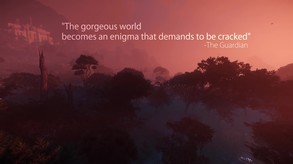
CRYNEGINE Indie Game of 2017. Featuring an incredibly detailed ancient world and a breathtaking soundtrack, Aporia: Beyond the Valley takes open world storytelling to new heights of adventure.
Modeled estimate, not a reported figure. How we estimate →
Media

About
Stats
All-time low is the lowest price we've recorded for this game since we started tracking it.
Languages: English
Engagement
Hours played at review time, across 41 reviews with recorded playtime.
Reviews
Themes across 41 recent reviews and how positive each mention is. A keyword signal, not full sentiment analysis.
positive critical· bar length = how often the theme comes up
Reviews
This game does not support keyboard remapping, so it's unplayable for me. Therefore not recommended to anyone who uses left hand mouse. Real shame.
Avventura in prima persona che ricorda un pò Myst e URU. Gli enigmi sono abbastanza semplici, ma la mappa è un pò confusionaria e capita di girare un po a caso per trovare cosa fare (questo aspetto era migliorabile). Mi sono piaciute molto le ambientazioni (il Cryengine è ancora attuale e infatti impegna a dovere il mio pc master race, ma è anche vero che lo faccio girare su una TV 4k a 120hz). Anche le musiche sono ottime. La longevità non è elevatissima ma se volete trovare tutti i cristalli della valle vi serviranno alcune ore in più. Nel complesso è un gioco che mi ha sorpreso positivamente e lo consiglio. voto 7,5/10
Aporia: Beyond The Valley, developed and published by Invisible Walls, is a hauntingly beautiful first-person adventure that blends exploration, environmental storytelling, and light puzzle-solving into an atmospheric experience about memory, civilization, and loss. Built on CryEngine, it uses its technology to craft a world both ancient and alive—a once-thriving valley now overtaken by nature and silence, filled with forgotten structures and the ghosts of a culture long gone. Rather than guiding players through text or dialogue, the game relies entirely on visual cues and environmental details to communicate its narrative, encouraging players to uncover the story through observation and discovery rather than exposition. It is a journey that values contemplation over urgency, and its slow, deliberate pace allows its world to breathe in a way few modern games attempt. The story begins with the player awakening alone in the ruins of a temple, surrounded by remnants of a mysterious civilization that has vanished. There is no introduction, no tutorial, and no immediate explanation—only the quiet hum of wind, the soft rustle of trees, and the faint echo of the world’s forgotten history. As you step into the valley, your only guide is a strange glowing vessel, a vial of energy that can activate ancient mechanisms and illuminate paths forward. This tool becomes the centerpiece of both gameplay and symbolism, serving as a bridge between the living and the long-dead technology of the valley. Every door, machine, and puzzle is powered by this energy, creating a tactile connection between the player and the world’s hidden systems. The puzzles themselves are not designed to stump but to engage the player’s curiosity, inviting experimentation with logic and light rather than presenting arbitrary obstacles. Visually, Aporia is breathtaking. The valley’s forests, temples, and caverns are rendered with astonishing attention to detail. Shafts of light pierce through cracked ceilings, vines crawl across stone relics, and vast open vistas invite a sense of scale and wonder. The world feels tangible yet mysterious, as if every corner hides a story waiting to be uncovered. The environmental design itself functions as a kind of visual narrative: murals painted on walls depict fragments of history, ancient artifacts hint at ritualistic practices, and decaying machinery reminds you of the civilization’s once-great technological prowess. The lack of spoken language amplifies the game’s visual storytelling—players must interpret scenes and symbols on their own, forming personal theories about what transpired in this lost world. This silent storytelling lends Aporia a meditative quality, allowing each player’s interpretation to feel uniquely their own. The game’s soundtrack and sound design further enhance the immersion. The ambient score is understated yet evocative, weaving through moments of serenity and melancholy with grace. Subtle environmental sounds—the crackling of torches, the distant murmur of waterfalls, the echo of footsteps—immerse you in the rhythm of the valley. The absence of dialogue means every sound carries emotional weight; even the smallest auditory cues take on importance, signaling shifts in mood or discovery. Together, these elements create an atmosphere that feels almost sacred, as if you are not merely exploring ruins but trespassing in a forgotten temple of time itself. Aporia’s puzzle design is intentionally restrained. Most challenges involve using your energy vial to power devices, reroute energy streams, or manipulate objects in the environment. The puzzles are more about understanding than difficulty—they rarely frustrate, but they require patience and careful attention to environmental hints. Occasionally, the pacing slows to a crawl, with extended stretches of exploration punctuated by brief puzzle sequences. For some players, this rhythm may feel too slow, especially since the game offers little handholding or direct guidance. Yet, for others, this quiet pacing is precisely what gives Aporia its charm—it invites mindfulness and reflection, encouraging you to absorb the sights and atmosphere rather than rush from task to task. The game’s narrative unfolds through imagery and discovery, building a story of human ambition and inevitable downfall. You piece together the events of a civilization that grew powerful through technology, only to destroy itself through hubris and misuse of its energy source. This story mirrors the player’s own journey, as you awaken to rediscover not just what happened to the world but who you are within it. The ambiguity of this storytelling approach adds to its emotional resonance; there are no explicit answers, only clues and implications that force players to draw their own conclusions. It’s a world that feels lived-in yet empty, haunted not by ghosts but by memories and echoes of choices long past. When the ending finally arrives, it is more contemplative than conclusive, leaving you with a lingering sense of melancholy rather than closure. Despite its many strengths, Aporia: Beyond The Valley is not without flaws. Some puzzles feel underdeveloped, more like interruptions in the flow of exploration than meaningful challenges. A few sequences suffer from uneven pacing, with long stretches of walking through beautiful but static environments. The game also introduces a few light stealth or chase moments involving a mysterious shadowy figure, but these encounters feel out of place in an otherwise peaceful experience. Performance-wise, while CryEngine delivers stunning visuals, it can occasionally cause frame drops or minor technical glitches. These are small distractions, but in a game that relies so heavily on immersion, they stand out. Even with its imperfections, Aporia succeeds in creating something that few games manage to achieve—a sense of place so tangible that it feels almost real. It is less about solving puzzles and more about uncovering meaning, about connecting with a world that tells its story through the traces it left behind. Every mural, every broken artifact, every gust of wind feels purposeful. The silence of the game becomes its greatest strength, allowing players to project their own emotions onto the experience. It’s a game that doesn’t demand attention but earns it through beauty and restraint. In the end, Aporia: Beyond The Valley stands as a testament to the power of atmosphere and environmental storytelling in games. It may not appeal to those seeking fast-paced gameplay or intricate mechanics, but for players who appreciate introspective journeys and quiet discovery, it offers a deeply rewarding experience. It captures the feeling of solitude without loneliness, of mystery without fear, and of beauty tinged with sadness. It is both a love letter to exploration and a meditation on the fragility of human achievement. Aporia invites you not to conquer its world, but to listen to it—to walk through its ruins, feel its history, and find peace in its silence. Rating: 8/10
A game I really tried to like but unfortunately a very forgettable experience. On the positive, the way the story is told and the light mechanics are pretty interesting and creative. It's also not a horror game per se but some parts really nailed down setting a tense ambience. The story itself is a bit of a mixed bag. It's really immersive and there's a nice build up for the most part, but then it really falls flat on its face at the end with a lot of questions left unanswered and just overall a rushed conclusion. It's a bummer because with a longer game it could've honestly been great. As for the bad: while the game is generally graphically appealing there are SO MANY visual bugs and visual oddities (especially with the lighting) that distract from it. It's also not very well optimized as some scripted sequences have really bad framerate drops. The puzzles are also terrible. It's either following a path or resolving something that looks totally out of place in the world just to get a candy. A lot of potential but sadly not a game I recommend at full price. As previously said: a very forgettable 7 hours of gameplay.
Visually it's okay. However, it's a walking sim that has you wander between mediocre puzzles, has no unique mechanics and feels overall very forgettable. The majority of players quits around when the 1st chapter ends, possibly because it's easy to get lost at any point or because of a somewhat complex puzzle that happens around the end of the chapter or because of possible performance issues. There are significant frame drops during chases (or when you want to go fast in general), which can be very frustrating. 100% achievement completion boils down to making it through a sadistic collectathon. There is no in-game tracker for anything related to it, but there are some guides that can help, so it's okay.
Что может быть лучше, чем вечером засесть за вот такую приятную, атмосферную игру. Когда я только начинал проходить Апорию- она своим визуалом напомнила мне ту игру с девахой Ксенуа (там где Вальгалла была и много чертей и деваха болтала сама с собой). Игра кроме атмосферы, привлекает ещё наличием головоломок, где вы можете что то крутануть, что то найти, что то нажать и потом чего то произойдёт. 1 словом-нормальное взаимодействие. Сюжет в игре непонятен. Если честно когда я проходил, я не совсем понял кто я и информация передавалась через прикладную анимацию в виде диафильмов, рассказывая о какой то цивилизации, чем то напоминающую Шумеров и Ассирийцев... Честно говоря, сюжет игры я так понял, раскрываеться только ближе к концу, когда уже как говорят: "все "карты на руках". Так как до этого, вы всего лишь будете бродить по всяким красивым локациям, ориентируясь по карте, собирая при этом всякие части чего то....Открывая новые загадки (мне не удалось только разгадать загадку с мозайкой и + ещё я непонял, как делать загадку с шаром и каменной плитой, где был рисунок со звёздами и полу-луной) Единственное я обратил внимание, что рисунок на мяче не совпадал и у меня возникла теория, что мячей может быть несколько, а где лежал другой, чума их знает. Сказал бы я что игра хорошая, да вот тока у неё есть 1 недостаток-она в каких то моментах, очень любит делать краш)). Играете вы спокойно и тут хуякс, вы вылетаете на рабочий стол...Хорошо что разрабы всё предусмотрели и сделали автосейв.. А так, если не обращать на такие недочёты, вы будете кайфовать от того что видите в самой игре, потому что разнообразия у неё выше крыши...
Walking sim in the forest and mountains. I couldn't pass the water basin puzzle so I didn’t complete the game. Good visuals for a 2017 game but don’t expect it to compete with modern games. I think the only real puzzle is the water basin, where you’re in a giant drainage channel with many switches and pipes and you turn each switch to redirect water from waterfalls to fill a big pool in the middle. Or at least that’s what I think to do. I did notice the only drained outlet has a pair of scales at the end and when I put a weight on it, the scales block the way and I can’t do anything to do. Anyway, the puzzle was too difficult for me I can’t get water near the exit so I gave up. The game gave me a few other achievements for solving puzzles, but those were not really puzzles just picking up yellow bottles, retrieving shining stones, escaping from a cave and being swept away by the water etc., they’re just part of the walking sim until this actual water puzzle appears. There’s little story, just some slides on stones about life and death, common sense more than stories. I give a positive for the cheap price but I don’t really recommend it. [u] [url=https://store.steampowered.com/curator/43342176-Why-Not-Games/#browse] My curator page[/url][/u]
more about a story than puzzles. sometimes it's very touching.
Finished it and now my thoughts feel like forgotten temples whispering cosmic secrets.
I played this like 5 years ago for a few hours and got a bit annoyed by the crashes, mostly forgot about it, tried playing it again and got annoyed by the crashes, tried tweaking some graphics settings, and got annoyed by the crashes.
Related
Related
Trends
Concurrent players on Steam, sampled daily since tracking started.
Audience
Estimated from the language of this game's reviews — a proxy for where players are, not official Steam demographics.
Related
| Mob Factory | $209.1K | 477 | 73% | $14.99 |
| Drakensang | $209.1K | 793 | 81% | $9.99 |
| Hearthlands | $209.2K | 413 | 83% | $15.99 |
| TRAIN CREW | $209K | 466 | 99% | $13.25 |
| Dungeons and Dragons: Daggerdale | $209.2K | 497 | 31% | $14.99 |
| Pastelia Stories | $208.9K | 798 | 64% | $9.99 |
Related
| 7 Days to Die | $425.3M | 403.5K | 87% | $44.99 |
| Euro Truck Simulator 2 | $421.6M | 932.1K | 97% | $19.99 |
| Mount & Blade II: Bannerlord | $309.8M | 293.9K | 88% | $49.99 |
| Palworld | $279.6M | 445.8K | 94% | $20.99 |
| The Forest | $254.8M | 678.5K | 96% | $19.99 |
| Clair Obscur: Expedition 33 | $243.3M | 273.2K | 95% | $47.99 |