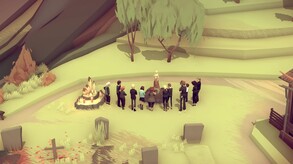
Closer the Distance is a slice-of-life sim that tells a deeply emotional story about the connections between family and friends in the face of tragedy. Unearth long kept secrets, repair strained relationships, and help your loved ones move on.
Modeled estimate, not a reported figure. How we estimate →
Media
About
Genres
Stats
All-time low is the lowest price we've recorded for this game since we started tracking it.
Languages: English*, French, German*, Spanish - Spain, Simplified Chinese*languages with full audio support
Engagement
Hours played at review time, across 40 reviews with recorded playtime.
Reviews
Themes across 40 recent reviews and how positive each mention is. A keyword signal, not full sentiment analysis.
positive critical· bar length = how often the theme comes up
Reviews
This game is messy. I fully agree with some ratings that say it is easy to get overwhelmed, because I did for sure. But at the same time, I think it is by design. The characters are overwhelmed. Grief is messy. Life is messy. This game is absolutely beautiful, in art, storytelling, voice acting, music, its message... Yes, it is messy, but it is so incredibly beautiful, too.
Closer the Distance is a really beautiful and unique simulation experience about loss and how different people in a small, tight-knit community deal with it. Instead of focusing on one protagonist, the game lets you see how grief ripples through multiple lives, showing different ways people cope, heal, and connect with each other. It’s a slow, thoughtful experience with a lot of heart, and it treats its themes with surprising care and empathy. If you enjoy narrative-driven games that explore real emotions rather than action, this one is definitely worth playing. ˚ʚ♡ɞ˚
This is one of my favorite games of all time. The flow of balancing multiple characters with differing needs and wants (which some characters needs make it hard to accomplish what they want) helps illuminate a heartfelt story about love, loss, and how to hold on and let go to the people you love. I will say, as others have, it is annoying to keep track of hunger while balancing so many other needs, but that is incredibly true to life. When I lost someone very dear to me, finding the time and energy to eat was one of the most difficult things to do. I love this game and I keep returning to it since my first playthrough over a year and a quarter ago.
I really enjoyed this game and am, in fact, going through another play through. The script is well written, the characters heartfelt, the social challenge of keeping a town together after tragedy...hard but worth the effort. I found myself wary at first, as I was looking into the lives of these characters. My heart broke for some of them as I saw relationships strain. I could relate to Angela and Connie...to some degree, having recently gone through a car accident in real life and having to pick up the pieces. The good news for me, is that this game began to heal me. Through Connie's courageous actions of trying to help her sister put things back in order, I felt my heart begin to open once again and through tears, I was able to help a community try to repair. While I don't agree with every philosophy in the game, I was willing to listen to the characters to see how I could possibly help them feel better and succeed. I would give this game 4.5 stars. As I don't care for the swearing and some concepts. But that's truly my opinion. The game, characters, and the situation everyone finds themselves in is very real and now it's up to you, a hand tied angel/ghost, and brave little Connie to help a town in need.
Closer the Distance erzählt eine ruhige, emotionale Geschichte über Trauer und Gemeinschaft in einem kleinen Dorf. Nach dem Tod von Angela erlebt man aus einer besonderen Perspektive, wie ihr Verlust das Leben der Dorfbewohner verändert. Jeder Charakter geht anders mit Schmerz, Erinnerungen und ungelösten Beziehungen um. Durch subtile Entscheidungen kann ich ihre Entwicklung und ihr Miteinander beeinflussen. Das Spiel konzentriert sich stark auf Gefühle, Atmosphäre und zwischenmenschliche Nähe. "Closer the Distance" hat mich von Anfang an emotional abgeholt und nachhaltig beeindruckt. Besonders die Geschichte und die ruhige, ungewöhnliche Art des Gameplays haben mir sehr gefallen. Das Spiel schafft es, das Thema Trauer sensibel, ehrlich und ohne Übertreibung darzustellen, wodurch bei mir starke und tiefgehende Emotionen ausgelöst wurden. Obwohl das Gameplay bewusst entschleunigt und man nicht ständig aktiv handeln muss, empfand ich genau diese Ruhe als große Stärke. Die Möglichkeit, die Handlungen der Charaktere und ihre Entscheidungen subtil zu beeinflussen, hat mir das Gefühl gegeben, wirklich Teil dieser Gemeinschaft zu sein. Einige Momente gingen mir besonders nahe und haben mich emotional sehr mitgenommen, weil die dargestellten Schicksale unglaublich traurig und gleichzeitig sehr menschlich wirkten. Als jemand, der narrative Spiele wie "Life is Strange" oder die Telltale-Titel liebt, hat "Closer the Distance" genau meinen Geschmack getroffen. Ich kann dieses Spiel allen wärmstens empfehlen, die emotionale Geschichten und atmosphärische Spielerlebnisse schätzen
[h1]Closer the Distance[/h1] I'll recommend the game because I appreciate what it's trying to do in such a novel way but it has a couple of glaring, almost fatal flaws. Clloser the Distance tells a narrative tale of grief, loss and the hole it leaves. Unlike most games of this type, Closer tells this tale through multiple characters, some of whom you can control and others you can't. You'll witness conflicts, emotional breakdowns, mania, sadness and just the general trauma of such a loss. It's an accurate representation of grief and this impact on this sad little corner of the world. The game, as it is, has you switching between multiple characters and choosing to run tasks for them and experience those discussions / consequences. So mechanically it's very simple - select a task (usually an interaction with another character), watch your player walk over to do it, experience the impact and repeat. You also have to balance meters like hunger, tiredness and the like as well. So you might have a choice of taking care of that character's physical needs or going to help someone else. The story will shift depending on these choices, though to what extent I'm not sure since I'm not replaying the game. Replaying titles like these is something I commonly do but the mechanics of Closer don't make me want to revisit the title. First of all, need balancing didn't add anything to the game besides annoyance. I'm here to experience a tale, not worry about making something for dinner. The needs bars sometimes drop far too quickly, so you might work to fill one up, walk across the map to talk to another character and it's already run down again. It's an unnecessary, distracting and counterproductive game mechanic that should have been thrown out. Another mechanical issue is the control of multiple characters. When characters have an important event, you'll see a "!" on their picture. The problem is that you might get 2 or 3 of those at the same time. This makes experiencing those events a hurried and sometimes distracting experience as you want to get to the other one as well. You don't get to linger with these characters and you'll miss conversations that would help you feel closer to these characters. Since there is a ticking clock on some events, it becomes an unnecessarily hurried affair. The art style is nice enough but I wouldn't say it's anything special. The voice acting is generally okay but very uneven at points, with some lines coming out far too flat. The music is very predictable, with it being limited to "one guy singing folk playing a guitar" after every major event. The lack of variety got old very quickly, even from someone who enjoyed a similar approach in Life is Strange. It's just very, very generic emo string guitar music. So as a story, Closer the Distance is a fairly decent one. But they really let the game mechanics interfere with the telling of that story rather than complimenting it. Instead of being able to slowly wallow in the grief and experience it as the characters do, we're forced to manage hunger bars and hurry through the very dialog options that are meant to evoke an emotional response. If you're a fan of games like this, I'd recommend getting this while on sale. But if you don't have much experience with emotional narrative games then there are better titles to get first.
There are many things I really love about this game. Above all, the powerful, emotional and slow paced narrative about life after two deaths in a small village community. The wonderful soundtrack accompanies this narrative in a very emotional way. The game captures the feelings and thoughts of the villagers, their dealing with anger and grief, very well and in a very honest way. It also shows that even in times of grief, life goes on, with all its often small and mundane activities. The game does this with Sims-like mechanics. Unfortunately, I find the task and event mechanics to be very poorly implemented for this type of story driven game. At times, sadly the game feels more like a mediocre management game, forcing you to do certain task in sometimes very limited time frames or with other restrictions. In addition, the simultaneity of some events sometimes makes it impossible to follow all the conversations and plot lines, which disrupted my immersion into the story. Towards the end, the game focuses more on the story again, which redeemed me somewhat and i can still give it a positive rating.
Closer the Distance is a quietly powerful narrative-focused life simulation developed by Osmotic Studios and published by Skybound Games, and it immediately sets itself apart by centering not on heroics or survival, but on grief, memory, and the fragile bonds that hold a community together after loss. The game opens with the sudden death of Angela, a young woman from the small coastal town of Yesterby, and instead of following a conventional arc of mystery or recovery, it asks the player to inhabit Angela’s lingering presence. You are not alive, not entirely gone, and not able to act directly—an unusual perspective that shapes every part of the experience. From the outset, the game makes it clear that this will be a slow, emotionally driven journey, one that values empathy and observation over control or spectacle. Gameplay blends life-simulation mechanics with narrative choice in a way that feels deliberately restrained. Rather than commanding characters outright, you gently influence the lives of Angela’s loved ones and other townsfolk as they struggle to cope with her absence. Each character maintains daily routines, emotional needs, relationships, and internal conflicts, and your role is to subtly guide them toward healthier choices or meaningful interactions. You might encourage someone to reconnect with family, pursue a long-neglected passion, or simply rest when the weight of grief becomes overwhelming. This indirect control can feel disempowering at first, especially for players accustomed to more assertive management systems, but over time it becomes one of the game’s strongest thematic tools. The lack of total control reinforces the reality that healing cannot be forced, only supported. The town of Yesterby itself plays a crucial role in grounding the experience. Its environments are thoughtfully designed, with soft, muted colors and an autumnal palette that reinforces the game’s reflective tone. Homes feel lived-in, workplaces feel routine-bound, and communal spaces quietly echo with the routines of everyday life continuing despite tragedy. The camera allows you to peer into homes with a dollhouse-like intimacy, emphasizing how private moments of grief unfold behind closed doors. Ambient sound design—wind through trees, distant waves, rainfall—adds to the sense of stillness and emotional weight, making the town feel less like a backdrop and more like a shared emotional space shaped by collective loss. The characters are where Closer the Distance truly shines. Each individual in Angela’s orbit is written with nuance and care, carrying their own regrets, unresolved tensions, and coping mechanisms. Angela’s sister struggles with identity and abandonment, friends wrestle with guilt and missed opportunities, and other townspeople grapple with how one death can ripple outward in unexpected ways. Dialogue is natural and understated, avoiding melodrama in favor of quiet honesty, and strong voice acting gives each character emotional texture. Moments of warmth, awkward humor, and small kindnesses punctuate the heavier themes, making the cast feel authentically human rather than symbolic stand-ins for grief. Choice and consequence are woven subtly into the experience. The game does not frame decisions as “right” or “wrong,” nor does it always provide immediate feedback. Instead, outcomes emerge gradually through changes in relationships, emotional states, and long-term personal trajectories. Some people may heal, some may stagnate, and others may grow in ways that are bittersweet rather than purely positive. This ambiguity enhances replay value, as different priorities and interventions can lead to markedly different emotional conclusions. Importantly, the game respects the idea that not all wounds fully close, and that progress often comes in small, imperfect steps. Mechanically, the game can feel slow and occasionally opaque, particularly when juggling the needs of multiple characters with limited opportunities to intervene. Some players may find the pacing overly deliberate, and the hands-off nature of interaction can lead to moments of uncertainty about whether your actions are truly making a difference. Yet these frustrations feel thematically intentional, echoing the real-world helplessness that often accompanies grief. The experience asks for patience and emotional engagement rather than optimization, and players who approach it with that mindset are likely to find its rhythm deeply affecting. Ultimately, Closer the Distance is less concerned with traditional gameplay satisfaction and more focused on emotional resonance. It is a game about listening, watching, and caring from a distance—about understanding that presence alone can matter, even when words and actions fall short. For players willing to engage with its subdued pacing and emotionally heavy subject matter, it offers a rare and meaningful exploration of loss, community, and the quiet resilience of human connection. It lingers not because of dramatic twists or mechanical mastery, but because it captures something deeply personal and universal: the slow, uncertain process of learning how to live with absence. Rating: 8/10
honestly one of the best games i've played for the past year, was confusing at first but when i got the hang of it i couldn't stop
This game is kind of like The Sims but centered around a poignant tale of grief and loss. There are some occasional frustrations and odd moments but overall it is a work of art. I could not put it down.
Related
Related
Trends
Modeled estimate over time, reconstructed from Steam's monthly review histogram.
Momentum
Pace estimated from the game's recent review growth (our daily snapshots) at its own sales-per-review ratio — a momentum signal, not booked sales.
Audience
Estimated from the language of this game's reviews — a proxy for where players are, not official Steam demographics.
Related
| Paradise | $185.7K | 573 | 90% | $19.99 |
| Lost Nova | $185.8K | 424 | 92% | $14.99 |
| Perfect Crime | $185.6K | 476 | 69% | $9.49 |
| S.H.E.L.T.E.R. - An Apocalyptic Tale | $185.9K | 783 | 88% | $17.99 |
| FACEMINER | $185.6K | 1.4K | 90% | $3.99 |
| Spaceland: Sci-Fi Indie Tactics | $185.5K | 411 | 77% | $19.99 |