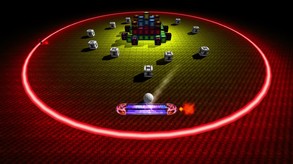
In ANOIX you travel through 84 levels trying to protect the ball. Don't let the soundtrack hypnotize you.
Modeled estimate, not a reported figure. How we estimate →
Media

About
Genres
Stats
All-time low is the lowest price we've recorded for this game since we started tracking it.
Languages: English*, French*, Italian*, German*, Spanish - Spain*, Arabic*, Bulgarian*, Czech*, Danish*, Dutch*, Finnish*, Greek* +91 more
Engagement
Reviews
Themes across 40 recent reviews and how positive each mention is. A keyword signal, not full sentiment analysis.
Reviews
3D Breakout. 🔥
A fun arcade game with a great soundtrack. However there are a few things which make are not as good as they could be: The art style on this game is quite ugly and textures are repeated often, it's difficult to see where the ball is if it's mid air and it's difficult to consistently get the ball to bounce off the "ship" in the direction you want it to go.
ANOIX, developed and published by Unusualsoft, is an inventive attempt to reimagine the classic brick-breaker formula within a three-dimensional space. Rather than simply repeating the familiar mechanics of Arkanoid or Breakout, it introduces a spatial twist that fundamentally alters how players approach the action. Instead of a flat, two-dimensional plane, ANOIX places you in an enclosed 3D arena where the ball moves freely within depth, while the player’s paddle controls are bound to a single axis of defense. The objective remains recognizable—destroy all the blocks while preventing the ball from escaping—but the added dimension transforms the experience into something fresh and occasionally disorienting. Every bounce, deflection, and angle carries new consequences, and the sense of space challenges players to think more dynamically than in the traditional genre it builds upon. The game’s structure spans across more than eighty levels divided into five distinct worlds, each introducing new spatial arrangements, colors, and challenges. The early stages ease the player into the mechanics, allowing time to adjust to the way the ball moves and interacts with surfaces in depth. As progress continues, the designs grow more ambitious, often stacking bricks in layers or placing them at varying depths that require sharp perception and quick reflexes. The moment-to-moment gameplay hinges on anticipation and control, with the player needing to predict trajectories that now include height and distance as well as lateral direction. The familiar satisfaction of clearing blocks one by one is still there, but it’s reframed within a more kinetic, almost chaotic environment where precision matters as much as reaction speed. From a visual and auditory standpoint, ANOIX succeeds in creating an immersive atmosphere that complements its modernized gameplay. The presentation leans toward minimalist futurism, with glowing neon colors, sleek geometric design, and smooth animations that emphasize motion and rhythm. The soundtrack plays a crucial role in defining the tone—an electronic, ambient pulse that gives the game an almost hypnotic quality. Together, these elements make the act of deflecting a ball and clearing blocks feel more meditative than frantic, creating a kind of trance-like flow when everything aligns. The visual clarity also helps distinguish depth and movement, though in some cases the glowing effects can obscure fine details when the action gets busy, making it harder to anticipate how certain collisions will unfold. Mechanically, the game offers a handful of power-ups and bonuses that help to vary the flow of play. These include effects like expanding the paddle’s reach, spawning multiple balls, or introducing temporary abilities that affect the physics of the ball. Collecting and managing these bonuses adds an extra layer of strategy, since the player must weigh the risks of chasing a power-up against the danger of letting the ball escape. The physics system underpins much of the tension and unpredictability. On good runs, it feels responsive and satisfying, allowing you to guide shots and rebounds with precision. At other times, it can behave unpredictably, causing the ball to take unexpected bounces or clip awkwardly against surfaces. These inconsistencies are not game-breaking, but they do occasionally interrupt the sense of control and flow that the game works so hard to build. The challenge curve in ANOIX can feel steep in later levels, as the game becomes more demanding both in speed and complexity. Some stages introduce unconventional angles or narrow openings that require perfect positioning to exploit. The satisfaction of overcoming these trials is rewarding, especially when you manage to chain successful rebounds and clear a cluster of bricks in rapid succession. However, there are moments where frustration creeps in due to the unpredictability of the ball’s path, making skill and chance blur together. Players who thrive on precision and rhythm will likely enjoy the learning curve, while others might find it occasionally punishing. The pacing remains engaging, with each new level feeling distinct enough to maintain curiosity, though the repetition inherent to the genre can set in if played for extended sessions. On the technical side, ANOIX performs smoothly and offers both keyboard and controller support. The controls are straightforward, though some players might wish for finer sensitivity adjustments to better handle quick movements. The game’s user interface is clean and unobtrusive, allowing focus to remain on the action. Performance is generally stable, with only rare frame dips or glitches reported. It’s a game designed for accessibility—simple to grasp yet challenging to master. The presentation makes it feel modern despite its retro lineage, and the low system requirements make it an easy fit for most setups. Overall, ANOIX stands as an intriguing experiment in breathing new life into one of gaming’s oldest templates. It preserves the timeless satisfaction of breaking bricks and chasing high scores but recontextualizes it through space, depth, and motion. The result is an experience that feels simultaneously nostalgic and novel. While it’s not without its rough edges—chiefly in its unpredictable physics and uneven difficulty—it captures a distinct rhythm that keeps players engaged. For fans of arcade classics looking for something with a modern twist, ANOIX offers a fascinating balance of challenge, creativity, and visual flair. It’s not just a reinvention of Breakout—it’s a reminder that even the simplest genres can still surprise when given a new dimension to explore. Rating: 6/10
Related
Related
Trends
Concurrent players on Steam, sampled daily since tracking started.
Hours played at review time, across 40 reviews with recorded playtime.
positive critical· bar length = how often the theme comes up
Man muss den Spielball im Spielfeld halten. Angelehnt an die Regeln von Arkanoid. Es ist ein gelungenes Remake! Ich habe nur gerade wenig Zeit um weiter spiele zu können. In 3D. Mit räumlicher Tiefe und Geschicklichkeit. Außerdem etwas schnell einschätzen können. Dies sind so die Anforderungen. Und FREI VON GEWALT! Ich finde das Spiel Klasse. Es kommt auf etwas ähnliche weise an Arkanoid heran. Ich wünsche mir noch schießen zu können wie bei Arkanoid (80er Game). Danke für diesen Remake.
awesome game! worth it and very fun. the other reviews about strange physics confuses me because i saw nothing of the sort, very fun and dare i say polished
☀️
cool
Keep the ball inside the circle with the bumper and remove the boxes on each level. Simple and engaging gameplay.
nie polecam
funny anoix goes jump jump
Audience
Estimated from the language of this game's reviews — a proxy for where players are, not official Steam demographics.
Related
| Doug and Lily | $9.5K | 94 | 82% | $4.99 |
| Sunny Cafe | $9.5K | 52 | 92% | $12.99 |
| Avernum 6 | $9.5K | 81 | 89% | $4.79 |
| Alchemist's Garden | $9.5K | 138 | 95% | $3.99 |
| Lust Bunker [18+] | $9.5K | 136 | 68% | $2.49 |
| The Titty-Fucking Hot Spring Ryokan Ghost | $9.5K | 61 | 100% | $9.99 |