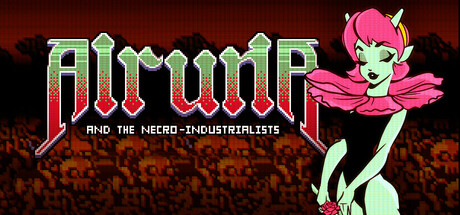
Alruna is a compact and high-density Metroidvania, with a focus on sequence-breaking and playing things out of order.
Modeled estimate, not a reported figure. How we estimate →
Media

About
Welcome to a compact, tightly packed Metroidvania, where the Square Aspect Ratio and Single Screen Level Design allows every one of the 200+ rooms to slot into the larger puzzle-box of the world; where secrets, exploits and sequence-breaking are built into the very foundation of the game; and where the overarching story doesn’t care too much which path you happen to take through the game.

Play the bosses out of order, why don’t you? Spawn your own Climbing Vines and sneak past difficult puzzles. Find a fifth secret temple in the east. Skip picking up any weapon and get by using only special abilities. Is it possible? Who knows!
Alruna is a dryad in a dying world – a spirit of life in the land of the dead. The earth is sucked dry. There is only The Sprawl. Poor, bedraggled skele-men dot the Wasteland of the Necro-Industrialists and shuffle endlessly back and forth in a toiling mockery of life. But are they the real enemy? Or do the skeletons suffer just as much as the dryads under the domination of the Necro-Industrialists?
And salvation? Is it possible? Dead men yearn for Heaven. But the dead can only dig...
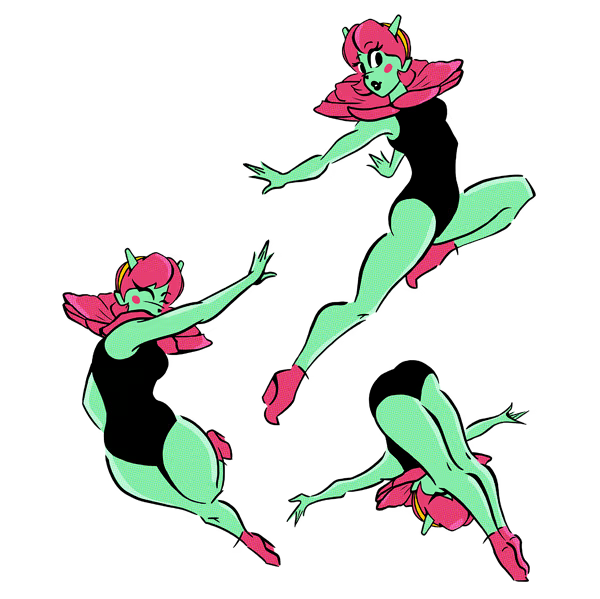
An overworld that connects all areas of the game.
Four large “temples”, each one with a powerful upgrade and a formidable boss.
Maybe a secret fifth temple? There are rumors…
A star-crossed enemies-to-lovers romance with a rival adventurer. No spoilers!
Multiple endings, let’s call them the “combat ending” and the “exploration ending”.
Hidden mini-games, power-ups, shortcuts and secrets behind every wall.

Stats
All-time low is the lowest price we've recorded for this game since we started tracking it.
Languages: English**languages with full audio support
Engagement
Hours played at review time, across 40 reviews with recorded playtime.
Reviews
Themes across 40 recent reviews and how positive each mention is. A keyword signal, not full sentiment analysis.
positive critical· bar length = how often the theme comes up
Reviews
A delightful little gem with great level design.
A fun brief romp through a lovingly sprited retro world. Controls are a little awkward at times but don't ruin the experience. Looking forward to playing the next one.
A real Metroidvania. This game is really fun to play. I was invested the whole time. Some really clever puzzles too. However, being a 'platformy' game that requires a degree of precision, I'm sure you'll run into a bug or two. Still, great game in my opinion.
As a metroidvania, this game does its job actually very good (bosses, shortcuts and new routes becoming accessible with skills acquired later on). It also offers enough quality of life support like fast travel and near-boss-checkpoints. Why a negative review then? Well, the gameplay did it for me. It is not constantly buggy, but in conjunction with some possibly weird design choices, at some point it became hard to tell. I do not want to fight the controls. (I should probably mention here that I played with a gamepad.) Maybe some retro-affine players prefer the close-quarter hardships the game gives as part of its design. Funnily enough, there appear to be some options to circumvent some of the trouble. But again, at some point I could not tell anymore if things were simply overlooked or intentionally possible. I finished the game nevertheless, so I do not think it is awful. Just leaving a bad taste that ruined some of the fun. Hint: Check for the ending save lock to avoid some late-game disappointment.
I’ve played the two games of the series in a reverse order, with the second one first, but they both maintain the same look and share the mechanics so you will fit right in regardless of which one you pick first. As a matter of fact, you can pretty much copy-paste your experience between the two, while the main difference is the storyline and conversations you have with some occasional characters. The dryad, Alruna, starts with a few abilities already unlocked, but the game introduces them gradually so you don’t feel overwhelmed. Usually, a move is explained the first time you encounter an obstacle that requires it. Alongside a standard jump, you can perform a high jump by crouching for a few seconds to charge it, and slide underneath tight openings. The shooter from the second game is replaced with a whip, but although range is still small, damage is quite nice and can take out enemies with a few hits. Most simply patrol back and forth while firing different projectiles. In many cases, it’s easier to ignore them entirely since they don’t drop anything useful when defeated, apart from the occasional heart when your health is running low. Enemies respawn whenever you move between screens, making it easy to fully restore your health. This is especially true because hearts placed throughout the environment also reappear when you switch screens. In fact, almost everything respawns except doors that require keys and other shortcuts that stay open once you press a switch. Progression takes place through a series of single screen rooms connected into one large, interconnected world. Most rooms contain a mix of platforming challenges, enemies, and obstacles that either require your current abilities or encourage you to return later with new ones. As expected from a metroidvania, there’s a map to fill out and plenty of secrets to discover. The map is fairly standard, consisting of squares that become visible the first time you enter a room. Each square represents a single room, and different colors help distinguish the various environments and biomes. Save points and healing spots appear as flowers and red dots, while the main collectibles are Drops, which are marked in blue. Drops are used to water a tree that grows up and leads to new secrets. Exploration is heavily encouraged, especially once your growing collection of abilities comes into play. Early on, you gain an exploding seed that can be thrown near specific blocks to blow them up, and later you gain more seeds that let you explore even further, like a seed to create a climbable vines or platforms, or trigger electricity.
I like the game, it's fun that it lets you do wacky ♥♥♥♥ that defies the normal progression path and at some point I'm not even sure these are optional anymore. The graphics are good, visually it's appealing and most of the time the game controls fairly well (if it doesn't glitch out again) even if it's just a bog standard pixel jumpy hitty game. The little quirks of the dialogue how the abilities work and their interesting uses beyond the obvious usages make the game more interesting to me than the visual simplicity of the game suggests. Overall I had fun and I will play the sequel right after. I feel like after experiencing how the game is structured I'm very keen to see what else this dev will cook up. But the game has three downsides: No proper settings, if you do one ending you don't get to see the other one... why did I bother to 100% collect those damn dew drops and worst of all: The game's player state machine is buggy af. - You can get stuck inside bricks after a slide and most need to quit out - Attacking just right before landing might make alruna walk forwards a good few steps for no reason - Getting hit when landing or attacking sometimes takes all your controls away till you get hit again - Sounds like the chainsaws and flayling ceiling skeleton mantis doods can persist across scenes, deaths and even menu resets forcing you to quit the game to get rid of it - get randomly stuck in the air and have to quit And these happen to me multiple times in a play session.
Хиден гем, хорошая игра с интересным исследованием секретов, однако я абсолютно случайно прошел игру на одну из концовок до того как я даже до финального босса дошел и набрал 100% на сейве, и теперь не могу зайти на этот сейв обратно, как не очень прикольно так делать...
This is an interesting one: overall, I liked it, but it's definitely short. It's filled with rock song references, and that's sort of cool? I guess? But sort of immersion-breaking, too. Where Alruna really excels is in its exploration/secrets. If you enjoy Metroidvanias stuffed with hidden rooms and secret shortcuts, you'll love it. It is also [i]surprisingly[/i] open for sequence breaking. I'm fairly certain I inadvertently circumvented the final boss/skipped to the ending while testing out some platforming tech. I could go back and do it "properly" but I'm satisfied to stop where I am. (Note: I had one possible bug: my sprite was able to wander into the title screen of the game and I wasn't sure whether it was an intentional easter egg or not. It felt like I couldn't get out of it unless I exited to the main title, but who knows?) Anyway, on the whole, if the above sounds good to you and the artwork is appealing, Alruna and the Necro-Industrialists is a decently fun, not-too-challenging Metroidvania.
I would recommend if it goes on sale for under $5 dollars. A short and easy game, about 6 hours to beat it with 95% completion. The graphics and sound are good and the navigation around the map is easy without much issue with the controls. The game is easy, not much of a challenge for anyone who has played metroidvania games. The biggest negative is when you beat the game it locks the save file and you cannot go back and get 100% and/or get the good ending. The last few items needed for the 100% are extremely vague on how to retrieve them, its a bizarre sequence where you have to throw a seed and duck 3 times and hope it sends out a secret fairy to retrieve them. It's a "move" you never use in the game and only one NPC mentions that you can unlock a secret dance but at no point would you think it's required to get these items. Overall a 6/10 game, get if it's 3 dollars... otherwise wait for a sale.
It's decent little metroidvania, but 'focus on sequence-breaking' is a very big exaggeration. While this is not a bad thing in itself, it is main marketing point of the title. So I want to take my shots at it: - game does not acknowledge sequence-breaking - Act itself mostly boils down to knowing where are the invisible walls you can slide into - Some of these are one-way - probably to disallow sequence-breaking that softlocks the game, lol. - Game is not designed around all of them: yes, you can skip the weapon. And likely even beat the game without it. Don't know why would you want to, as, again, there is neither an aknowledgement, nor any sort of meta message about it. - These "sequence breaks" are nothing more than somewhat hidden ability to choose the order of areas you will visit, which in itself is kind of a norm for the genre. Also, there are multiple ([spoiler]2[/spoiler]) endings. Completing one locks your save file, forcing you to either beat the game again or open youtube. I can't help but think that this was made so that players try this "sequence-break" mechanic, but... eh.
Related
Related
Trends
Concurrent players on Steam, sampled daily since tracking started.
Audience
Estimated from the language of this game's reviews — a proxy for where players are, not official Steam demographics.
Related
| The Curse Of Yendor | $19.6K | 75 | 93% | $9.99 |
| Wacky Wheels | $19.6K | 173 | 78% | $4.99 |
| Construct: Escape the System | $19.6K | 173 | 75% | $4.99 |
| Startup Freak | $19.6K | 53 | 70% | $11.99 |
| Spheria's Familiar | $19.6K | 70 | 64% | $14.99 |
| RoboSkate | $19.6K | 100 | 89% | $6.99 |