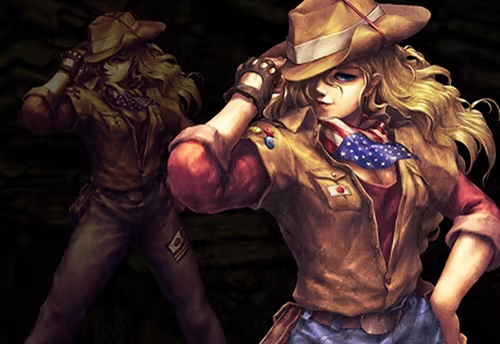
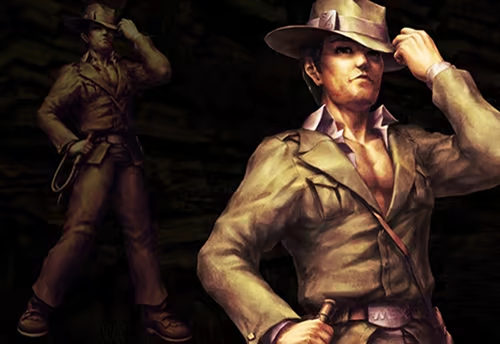
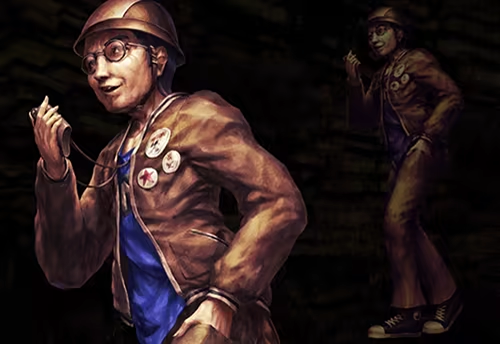
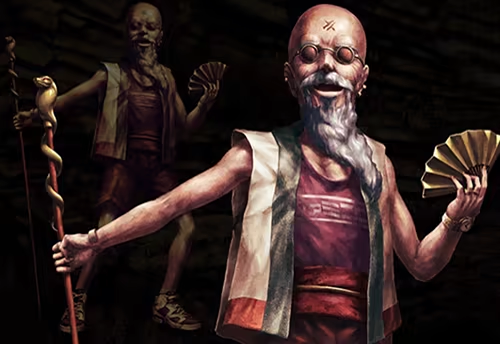
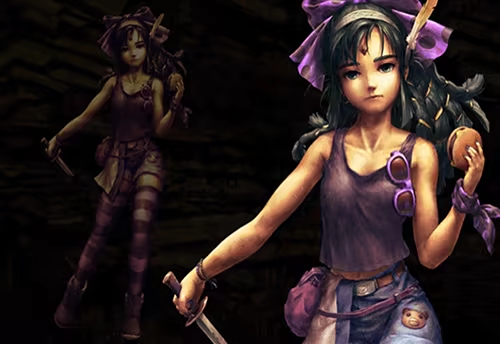
The long-awaited sequel to La-Mulana, La-Mulana 2 follows Lumisa Kosugi as she explores the ancient ruins of La-Mulana. Desperate to find the cause of the recent slew of monsters appearing from the ruins, Lumisa discovers the "other" La-Mulana: the ruins known as Eg-Lana.
Modeled estimate, not a reported figure. How we estimate →
Media
About


Genres
Stats
All-time low is the lowest price we've recorded for this game since we started tracking it.
Engagement
Hours played at review time, across 40 reviews with recorded playtime.
Reviews
Themes across 40 recent reviews and how positive each mention is. A keyword signal, not full sentiment analysis.
positive critical· bar length = how often the theme comes up
Reviews
La-Mulana 2 is an uncompromising, deeply cerebral sequel developed by NIGORO and published by PLAYISM that expands upon the philosophy and design ethos of its cult-classic predecessor. Rather than softening its edges or streamlining its systems to appeal to a wider audience, the game doubles down on dense exploration, cryptic puzzle-solving, and a refusal to guide the player overtly. It is a game that expects curiosity, patience, and persistence, and it rewards those qualities with one of the most intricate and memorable exploration experiences in the modern Metroidvania genre. The narrative follows Lumisa Kosugi, daughter of the original protagonist, as she ventures into the newly discovered ruins of Eg-Lana to investigate a sudden outbreak of monsters and uncover the deeper secrets buried within the labyrinth. Storytelling is largely environmental and fragmentary, conveyed through ancient tablets, murals, and cryptic inscriptions scattered throughout the ruins. Rather than presenting plot points in a linear fashion, the game encourages players to piece together lore and context gradually, often long after encountering the initial clues. This method of storytelling reinforces the feeling that Eg-Lana is a place with its own ancient history, indifferent to the player’s presence and unwilling to reveal its truths easily. Exploration is the core pillar of La-Mulana 2, and the scale of Eg-Lana is both intimidating and exhilarating. The ruins are vast, interconnected, and layered vertically and horizontally, with multiple paths open early on. Progression is rarely blocked by a single obvious obstacle; instead, advancement often depends on understanding subtle hints found hours earlier and applying that knowledge in a completely different location. The game assumes players will take notes, remember symbols, and mentally map relationships between areas and riddles. This design philosophy creates moments of profound satisfaction when a long-standing mystery finally clicks, but it also ensures that frustration is an ever-present companion for the unprepared. Puzzle design is where La-Mulana 2 most clearly defines its identity. Puzzles are rarely isolated challenges; many span large portions of the map and require synthesizing information from multiple tablets, visual cues, and contextual clues. Solutions often involve interpreting mythology-inspired language or recognizing symbolic patterns rather than interacting with obvious switches or mechanisms. The game almost never confirms whether you are on the right track, making progress feel earned rather than granted. For players who enjoy intellectual problem-solving and the feeling of genuine discovery, this approach is deeply rewarding. For others, it can feel opaque or even hostile, especially when progress stalls due to a single overlooked line of text. Mechanically, the game blends classic platforming and combat with deliberate, old-school sensibilities. Movement is precise but weighty, demanding respect for spacing and timing, particularly when navigating traps or hazardous terrain. Combat is serviceable rather than flashy, designed to complement exploration rather than dominate it. Enemies can be dangerous, especially when encountered in cramped spaces, and boss fights often test pattern recognition and endurance more than raw reflexes. Death carries meaningful consequences, encouraging cautious play and reinforcing the tension of deep exploration. Despite its difficulty, La-Mulana 2 is not careless in its design. The ruins are filled with checkpoints, shortcuts, and fast-travel options that gradually mitigate the sheer size of the world. There are no permanently missable items, which reduces the anxiety of exploration and allows players to tackle the ruins in their own order. This balance between freedom and structure ensures that while the game is demanding, it is rarely unfair, provided the player is willing to engage with its rules on its own terms. Visually, the game embraces richly detailed pixel art that evokes the 16-bit era while benefiting from modern polish. Environments are packed with visual storytelling, from ominous statues to subtle background details that hint at forgotten civilizations. Enemy and boss designs are imaginative and often grotesque, reinforcing the sense that Eg-Lana is a hostile and ancient place. Animations are expressive and purposeful, contributing to the game’s atmosphere without distracting from gameplay. The audio design further enhances immersion, with a soundtrack that ranges from haunting and mysterious to bombastic during boss encounters. Music often shifts subtly as players move between regions, reinforcing the identity of each area and providing emotional cues that complement exploration and discovery. Sound effects are crisp and functional, ensuring that hazards, enemy attacks, and interactions are clearly communicated even during tense moments. In terms of pacing, La-Mulana 2 is deliberately slow-burning. Progress can stall for long stretches as players search for meaning in cryptic clues, but these pauses are integral to the experience. The game is not interested in constant forward momentum; instead, it thrives on moments of reflection, backtracking, and sudden insight. When progress resumes after a breakthrough, it feels transformative, reshaping the player’s understanding of the world and their place within it. Ultimately, La-Mulana 2 is a game designed for a very specific audience: players who crave challenge not just in execution, but in thought. It stands as a bold statement against hand-holding and convenience-driven design, offering instead a labyrinth that must be understood, respected, and conquered through intellect and perseverance. While its difficulty and opacity will undoubtedly alienate some, for those willing to embrace its demands, it delivers a uniquely profound sense of accomplishment and stands as one of the most ambitious and uncompromising exploration games of its generation. Rating: 8/10
La-Mulana 2 dares to ask a blasphemous question: What if La-Mulana was actually fun?
The original La-Mulana was just such a fascinating game to me. When I played the MSX style version like a decade ago it felt like I'd happened upon some truly archaic ♥♥♥♥, a game that seemed to actively discourage you from making progress. I love a game where the theme kind of mirrors the feeling you get playing it, and solving puzzles in La-Mulana truly feels like you're stumbling through ancient mechanisms designed to trick interlopers. The sequel pretty much delivered exactly what I wanted and expected. It is at its core just more La-Mulana, with some nice quality of life features and a little less obtuse puzzle solving. I think they did a better job ramping up the difficulty in the early game. Where as LM1 can make you feel like you hit a brick wall within the first hour, LM2 gives you a gentler introduction to what the game will come to expect of you, and allows you a little more freedom early on to just explore without having to necessarily solve anything. Eventually that pace picks up and you get into the real meat of the puzzle solving, with classic LM puzzles that span across multiple areas. I think the late game gets a bit tedious and honestly many of the bosses are a pain (they generally weren't great in LM1 either) but La-Mulana still remains a completely unique experience.
The only flaw this game has is that it eventually ends.
i would like to play the video game without being launched a thousand miles into space by every single ♥♥♥♥♥♥♥ bat in these ♥♥♥♥♥♥♥ ruins
Very memorable game, requires lots of note taking and meticulous exploration. I wish more games could have the opportunity to be as demanding as this. The only criticism I have is, in a game like this, one singular bad puzzle sours a lot of the rest of the experience. I started to doubt every time I got stuck with no previous leads to go on: What if this is a similar situation to that one bad puzzle? Do i really need to go through most of the areas AGAIN? Sometimes the answer is yes, sometimes no. I found using a "text dump" sheet of all the tablets/dialog very helpful for when i had missed a tablet or didnt write one down somehow I still recommend playing it if you want to experience games that demand a lot from you. The progression is very satisfying
This is La-Mulana 2.
"Thank you, sir. May I have another?": The Game.
Have you ever played La Mulana? Have you ever wanted to get your behind kicked in the same format for a second time? Look no further! It is equally as punishing as it's predecessor, however, somewhat more accessible than the former. You will still be drinking your own tears, you will still be having your own tears spit into your own mouth, but by god you'll know what's coming this time around!
Has the same issues as the first game - clunky and infuriating movement & knockback mechanics. Bad boss fight designs (and actually reaching them in the first place), too overwhelming and complex and unlinear map structure combined with really vague hints that apply all over the place. I really tried to get into this game but it has too many issues to justify continuing and being able to enjoy this.
Related
Related
Trends
Concurrent players on Steam, sampled daily since tracking started.
Momentum
Pace estimated from the game's recent review growth (our daily snapshots) at its own sales-per-review ratio — a momentum signal, not booked sales.
Audience
Languages: English, Japanese, Simplified Chinese
Estimated from the language of this game's reviews — a proxy for where players are, not official Steam demographics.
Related
| KYOTO XANADU -the Blooming Phantom- | $563.7K | 262 | 87% | $54.99 |
| Glass Masquerade | $563.4K | 7K | 97% | $4.99 |
| Fairy Fencer F | $564.4K | 2.4K | 89% | $9.99 |
| EARTH DEFENSE FORCE: WORLD BROTHERS | $564.4K | 802 | 81% | $39.99 |
| Railbound | $562.7K | 1.9K | 95% | $6.49 |
| Ghost Song | $562.6K | 1.4K | 83% | $19.99 |