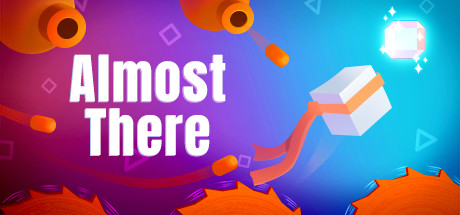
Sprint between saw blades while dodging homing missiles. Duck under lasers while the floor crumbles beneath you. Almost There was designed specifically for fans of the hardcore platforming genre - you've been warned.
Modeled estimate, not a reported figure. How we estimate →
About

Stats
All-time low is the lowest price we've recorded for this game since we started tracking it.
Languages: English, French, Italian, German, Spanish - Spain, Czech, Danish, Dutch, Finnish, Hungarian, Japanese, Korean +11 more
Engagement
Hours played at review time, across 40 reviews with recorded playtime.
Reviews
Themes across 40 recent reviews and how positive each mention is. A keyword signal, not full sentiment analysis.
positive critical· bar length = how often the theme comes up
Reviews
This is true game!
Pick any other popular precision platformer. Buy it instead (doesn't matter which). It will have better personality and style than this game. Made for gamers who hate themselves.
Almost There: The Platformer, developed by Bony Yousuf and published by The Quantum Astrophysicists Guild, is a stripped-down precision platformer that commits completely to mechanical challenge over presentation or narrative. It doesn’t try to charm you with characters or immerse you in a story; instead, it focuses entirely on execution, asking players to master movement through a series of tightly designed obstacle courses. From the outset, it’s clear that this is a game built for players who enjoy testing their reflexes and patience rather than exploring or experimenting. The core mechanics are deceptively simple. You run, jump, and occasionally interact with walls or momentum-based movement, guiding a small geometric avatar through levels packed with hazards. The simplicity is intentional, as it allows the game to build difficulty purely through level design rather than introducing an overwhelming number of mechanics. Early stages act as training grounds, gradually teaching players how to handle timing, spacing, and rhythm. As the game progresses, these elements are layered together into increasingly demanding sequences that require near-perfect execution. What makes the experience work is the reliability of its controls. Movement feels consistent and responsive, which is essential in a game where success often comes down to fractions of a second. Failures rarely feel unfair; instead, they push the player to refine their timing and approach. This creates a loop that can be both satisfying and exhausting, where each attempt brings you slightly closer to success. The frequent checkpoints and instant restarts help maintain momentum, encouraging players to keep trying rather than becoming discouraged by repeated failure. Level design is the driving force behind the game’s appeal. With a large number of stages divided across multiple worlds, the game offers a steady stream of challenges that are quick to attempt but difficult to master. Each level is compact, often taking only seconds to complete, which makes progress feel immediate even when failure is frequent. However, while the difficulty increases, the overall structure remains consistent. Over time, this can lead to a sense of repetition, as many levels rely on similar patterns of hazards and timing challenges. Visually, the game adopts a minimalist style that prioritizes clarity over flair. Bold colors and simple shapes make it easy to distinguish between safe surfaces and deadly obstacles, which is crucial for a precision-based platformer. While this approach is functional, it also means the game lacks a strong visual identity. There’s little variation in themes or environments, and the presentation rarely evolves alongside the gameplay. As a result, the experience can feel somewhat sterile, especially during longer sessions. One of the more noticeable limitations is the lack of progression beyond completing levels. There are no meaningful upgrades, narrative incentives, or significant rewards to motivate continued play. The primary drive comes from personal improvement and the satisfaction of overcoming difficult challenges. For players who enjoy honing their skills and chasing perfection, this is enough. For others, the absence of external rewards may make the experience feel less engaging over time. Despite its narrow focus, Almost There: The Platformer succeeds in delivering exactly what it promises. It’s a game about precision, persistence, and incremental improvement, offering a steady challenge that rewards dedication. It doesn’t attempt to broaden its appeal, and that clarity of purpose works in its favor, even if it limits its reach. In the end, Almost There: The Platformer is a solid but specialized experience. Its tight controls and challenging level design make it appealing to fans of difficult platformers, but its lack of variety and progression systems prevent it from standing out among the genre’s best. It’s a game that knows what it is and sticks to it, for better and for worse. Rating: 7/10
really bad control, really bad feedback, mostly when we have to stick to the wall. It was unpleasant to play but it have a great potential :)
¿tienes ganísimas de demostrarte a tí misma que eres una inú-til? Creías que ya era hora de que tu autoestima bajase a un nivel del inframundo? Quieres desear cortarte los dedos con el cuchillo jamonero de tu abuela porque no son suficientemente hábiles? Crees que la vida no es suficientemente dura y necesitas torturarte en tu tiempo libre? Has pensado que estás en ese punto de tu vida que necesitas hacerte profesional de un juego que no conoce ni conocerá nadie en tu ciudad de tres cientos mil habitantes? Te sobra tiempo? Este es tu juego. Púdrete en él pero luego no vengas con lloriqueos de que no te habían avisado.
carpal tunnel simulator
G
just get super meat boy, very bare bones.
A very straightforward 2D platformer. As you can see in the trailer, the visuals are as basic as you can get, and the gameplay itself isn’t much more inspired. That doesn’t mean the game isn’t fun, in fact, it’s pretty satisfying to speed through those short levels until you hit the perfect 3-star time. Getting a 3-star time on every level is challenging at times but always doable. As the player, you only have two special abilities. One is the ability to accelerate after moving in one direction on the floor for long enough, but the acceleration happens instantly instead of gradually, which feels pretty awkward. The other mechanic is wall jumping, which also allows you to perform an air jump right after. At first, that mechanic felt odd, but once I got used to it, it became satisfying to use. There are a couple of environmental hazards like saws, lasers, and rockets, but nothing too interesting. I think the game would have benefited from giving the player more movement abilities because, in its current state, the 155 levels start feeling quite repetitive. If you like these kinds of platformer games, consider picking it up during a sale.
Related
Related
Trends
Concurrent players on Steam, sampled daily since tracking started.
Momentum
Pace estimated from the game's recent review growth (our daily snapshots) at its own sales-per-review ratio — a momentum signal, not booked sales.
Audience
Estimated from the language of this game's reviews — a proxy for where players are, not official Steam demographics.
Related
| The Holy Gosh Darn | $109.4K | 337 | 96% | $19.99 |
| Helicopter Gunship DEX | $109.4K | 208 | 87% | $17.99 |
| Hybrids Arena | $109.4K | 413 | 55% | $6.99 |
| WAR PARTY | $109.4K | 456 | 68% | $9.99 |
| Spring Falls | $109.5K | 1K | 97% | $6.99 |
| Cafe Owner Simulator | $109.5K | 1.1K | 63% | $3.79 |