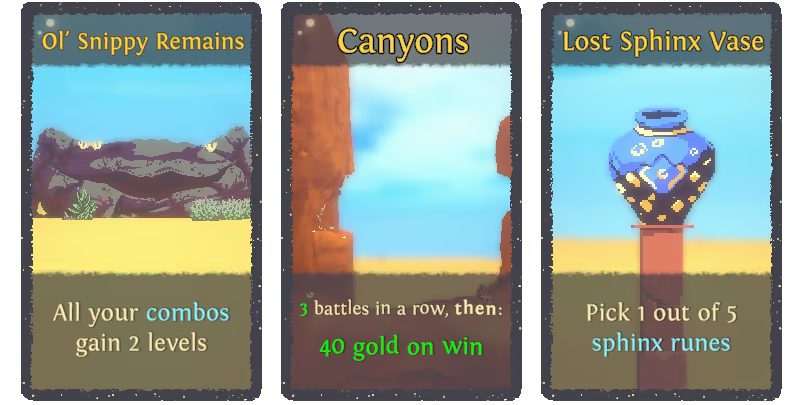
Combine tiles and run-changing cards to unleash power-packed combos and crush your enemies. Fight your way through the scorching desert of Samsara and stop the Djinn!
Modeled estimate, not a reported figure. How we estimate →
Media

About


A DARK DJINN'S RETURN
The last surviving human clans endure a nomadic existence fraught with hardship. As generations passed, the history of Samsara faded into oblivion. Long forgotten, a dark Djinn has found its way back, driven by an insatiable desire to reclaim its full powers and extend its supreme will on the desert and beyond.
Stats
All-time low is the lowest price we've recorded for this game since we started tracking it.
Languages: English, Simplified Chinese, Italian, Ukrainian, French, German, Spanish - Spain, Japanese, Portuguese - Brazil
Engagement
Hours played at review time, across 22 reviews with recorded playtime.
Reviews
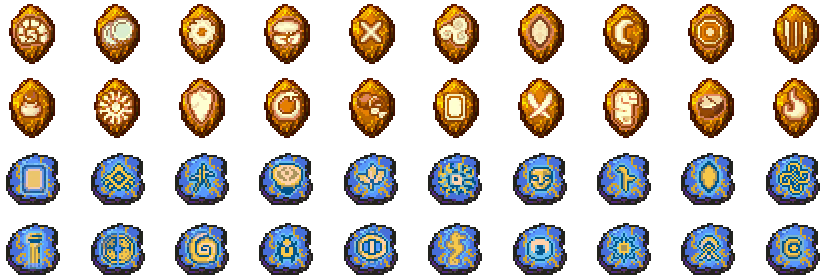
[i] Heavily inspired by Balatro, and for the most part, it's fun. Don't expect the same staying power, however. [/i] [h1]📝 Main Pros & Cons, followed by a high level comparison to Balatro and the Review:[/h1] 🟩 Pros: + Prayers offer special abilities at the cost of water + Afflictions and blessings add variance to each run + Combination based tile gameplay is easy to understand + Buying tiles and vases allows for easy deck upgrades and adjustments + I LOVE that overpower damage is applied to subsequent enemies, rather than disappearing + Full HP restore after each battle allows for a more focused experience without stressing about HP + A lot of content, featuring 7 characters, 20 prayers, 40 runes, 20 signets, 175 cards and 90 tiles (among other things) 🟥 Cons: - Cards don’t feel all that fun or exciting (to me) - I had a card which disabled Prayers, once sold, Prayers were still disabled - Health feels too low on the beginning character to experiment with some of the -HP risk reward mechanics [h1] Inspired by Balatro, but it Falls Short [/h1] [table] [tr] [th]Aliosso[/th] [th]Balatro[/th] [/tr] [tr] [td]Cards[/td] [td]Jokers[/td] [/tr] [tr] [td]Yellow Runes & Sphinx Runes[/td] [td]Tarot Cards & Spectral Cards[/td] [/tr] [tr] [td]Tiles & Decks[/td] [td]Decks[/td] [/tr] [tr] [td]Scenarios[/td] [td]Antes[/td] [/tr] [tr] [td]Signets[/td] [td]Tags[/td] [/tr] [/table] You know what made Balatro great to me? My familiarity with, and addiction to Poker, and the presence of well-designed, game breaking Jokers. For me, this is where Aliosso fails. It’s close enough that the similarities are obvious, but distinct enough that it never captures the same addictive “one more run” feeling I had with Balatro. That makes Aliosso worse for me, but it doesn’t make it a bad game, just a different one, and not one for me. In Aliosso, tiles have fixed values and combining them generates Tak and Ni. Tak determines your attack power while Ni acts as a multiplier. After each battle, you visit a merchant to spend your gold on additional cards, tiles, runes, and signets. From there, venture out and choose between three cards: Battle, and two random events. Picking battle immediately leads to an easier fight but earns less gold and skips the random events. Choosing the random events, on the other hand, makes the final battle harder, but increases your gold rewards. This is a simple generalisation and doesn’t apply 100% of the time, but 99% of the time, this is what you’ll experience. I love the addition of Prayers – These skills can greatly impact a run and are often the difference between game over and success. Unfortunately, they aren’t enough to carry Aliosso for me. It’s in no way a bad game and I did have fun with it (and I do intend to play more), but it doesn’t have the same staying power as Balatro (for me). And you know what? That’s okay! It’s a good game, especially for the price, and if you’re a fan of these types of games, give it a try. [quote][url=https://store.steampowered.com/curator/44931904-Bite-Sized-Reviews//]If you enjoyed my review and would like to support me, I would love if you followed [b]BSR[/b] for more bite sized reviews.[/url][/quote] [quote][url=https://store.steampowered.com/curator/32732116-IndieGems/]Follow our curator page: [b]IndieGems[/b] if you like and want to see more reviews like this one.[/url][/quote]
This one is one of the best deckbuilders I have played in a very long time. Aliosso is a Balatro-like adventure roguelike deckbuilder. You play as one of several wanderers, moving through the desert of Samsara, battling djinn, orcs, and other monsters, pausing only to shop and drink water. Each wanderer has, as is standard in deckbuilders, their own unique abilities and decks, with those decks being able to be customised and changed depending on the upgrades and new cards the player encounters along the way. Each battle is more difficult than the last, but so too does the wanderer toughen up and grow as they wander ever closer to the end of Samsara. In describing Aliosso as a “Balatro-like,” I am, in some ways, selling the game short. While some elements of Aliosso are extremely familiar to anyone who has invested dozens of hours into Balatro (the shop layout and what it has to offer are a near clone of Balatro, as is the general level system for combos), this belies the complexity and sheer diversity of mechanics to be explored in Aliosso. I have rarely come across a deckbuilder that so deftly combines elements of different games to create something wholly and utterly unique. There is no experience quite like Aliosso, and I love it for that. As much as Aliosso is a deckbuilder, it has the heart and soul of an adventure game. Each wanderer’s adventure consists of twenty-seven encounters, every third of which is guaranteed to be a battle. At each encounter, the wanderer is given a choice of destinations—do they wish to have a fight out in the desert under the blazing sun? Battle their way through an abandoned temple? Pray to a giant ammonite for water? While there may not be a written story, or a particular path the game advocates following, which path and which decisions the player makes have as much impact on the shape their deck takes as the contents of their deck. Encountering a giant ammonite early on, for instance, might encourage the player to use their water supply as a weapon as opposed to a mana pool, while constant battles might encourage them to use their newfound wealth to constantly reroll the shop. Setting aside the actual contents of the deck, the story each run tells and the decisions the player makes to get there are fundamental to the experience of playing this game. This is, of course, not to undersell the actual deckbuilding mechanics. Aliosso’s combat mechanics are easy to understand, but wildly complex in the sheer diversity of ways in which they can be approached. Winning encounters is simple. Playing up to five tiles at a time, players must create a combination of tiles with the same symbol. This can be five of the same, two of one and three of another, or any smaller number of tiles. This mechanic is, once again, familiar to anyone who has played any amount of Balatro—deckbuilding consists fundamentally of stacking a deck to draw tiles that match or power up matches in a very precise way. https://steamcommunity.com/sharedfiles/filedetails/?id=3656744831 Where Aliosso excels, however, is in how players can twist this basic mechanic into absurd combinations. Each character has their own deck, and while there are core suits common to all characters, the unique tiles are themselves unique suits. This creates initial decks with thirteen different suits, making it difficult to build large combinations of cards right off the bat. However, within those suits, there may be cards that gain a permanent buff when cards around them are discarded. Other suits might destroy everything they are combined with. Others provide massive buffs if held in hand. Suits themselves become a delicate balancing act of wanting to hone in on a few suits, while recognising the benefit of diversifying. When paired with global buffs in the form of cards, this balance only grows more complex, with each card offering potential bonuses to some strategies at the expense of others. However, tiles are not defined solely by their suit. Each tile consists of a suit (essentially its myriad of potential mechanics) as well as a value. This value (or tak, to use the game’s terminology) can be added to a particular hand, to a combo’s value, or to the value of every subsequent hand ever played, depending on what the player chooses to focus on and what buffs they might have. Some builds may support increasing this value, others might prefer it be lowered—everything is up to whatever the desert brings. You can see how this game gets very complex very quickly. The marvel is how, despite the complexity, it still remains accessible and understandable. https://steamcommunity.com/sharedfiles/filedetails/?id=3656744957 In addition to the complexity of the deck itself, Aliosso also includes a mana mechanic in the form of water. This being a desert game, water is a valuable resource. Running out of water penalises the player, deactivating random tiles; however, while the player has water, they can use it to fuel powerful abilities, known as prayers. Prayers can range from providing armour to providing cards to themselves being a buff for the tiles in hand. Which prayers a player has equipped is as much a part of the deck as the tiles and cards, and can mean the difference between a successful run and a failure. There is, of course, the risk of too much complexity. Just because mechanics can be added doesn’t mean their addition is always necessarily to the game’s benefit. However, in the case of Aliosso, the interplay between these mechanics is stellar. While runs with the same character may have similarities, the sheer diversity of cards, prayers, events, and tile draw means that there is constant variation and the constant ability to try new combinations and adapt to the obstacles ahead of them. https://steamcommunity.com/sharedfiles/filedetails/?id=3656745137 To be clear, the mechanics are all there really is to Aliosso. There is no real story, beyond the story the player crafts for themselves. The music and sound design are at their best when they are ignorable, the graphics are straight out of the 90s, and there are many, many spelling, grammar, and punctuation errors (though, if I’m honest, at some point, describing tiles as having “editions” rather than “additions” just became endearing). As much as it’s unfair to judge a book by its cover, Aliosso is filled with exactly the sort of presentation errors that would ordinarily lead me to dismiss a game like this. It is visually and auditorily ugly, and that can be hard to overlook. At least until you realise your attention isn’t on the art or the music or the little cluster of pixels spewing a font that can best be described as a Temu Comic Sans. Your attention is on the mechanics, on the crafting, on the minute decisions that will define the run in ways you can’t predict, but can pretend to control. That I love this game despite the presentation is a testament to how good its mechanics and deckbuilding possibilities actually are. There is true passion in this game where it matters, and it’s that passion that players looking for their next deckbuilder are going to delight in. This game is like the desert it depicts, its challenges ever-shifting, potential strategies mirages, and its surface appearance belying something truly unique and beautiful. It’s a delightful trek and worth undertaking by anyone looking for a true deckbuilding adventure. [quote] If you enjoyed this review, you can find more at the Summit Reviews [url=https://summitreviews.biz/] website [/url] and [url=https://store.steampowered.com/curator/41449676/] curator page. [/url] Thanks for reading! [/quote]

The best way I can describe this game is "What if Balatro and Slay the Spire had a child in the desert?" I really enjoyed the demo of this game and the full version looks like it has a ton of content. Definitely recommend!
Great game with lots of combinations. Infinite mode scaling is extremely hard to beat.
The game is amazing. I checked the demo last year and lots of things changed since then it seems. The Balatro inspiration is very much clear but Aliosso does it's own thing and I find the deckbuilding aspect very promising. The potential for different strategies is high, and that's just the impression I've got from playing two characters. The currency isn't as scarce as it is in Balatro, so deckbuilding is way more free and fun in my opinion. The presentation could've been a bit better, as sometimes the terms are a bit too obscure to get a hang of them at first, and hiding the "hands" table behind a very small button in the inventory (when not in battle) is a strange decision. I sincerely hope more people will discover this game, it's great and deserves to be successful! ---- Окремо дякую за українську :)
[code] [url=https://store.steampowered.com/curator/36948155-Card-Game-KING/] FOR MORE CARD AND BOARD GAMES FOLLOW US [b]CARD GAME KING [/b][/url] [/code] [i]Note: The game mostly uses tiles instead of cards, but since the difference is purely aesthetic so we're covering it as it's still a deckbuilder[/i] "Well, that escalated quickly", is a valid comment to make after getting a few upgrades. This is due to the score x multiplier gameplay (yes, it's Balatro inspired) that gives you a lot of firepower to melt enemies, that is, if you play your 'cards' right. To describe briefly: you draw tiles, make a combo of identical tiles and dish out thousands of damage. Franky, the tiles are just like card values and suits, but without being limited by the actual classic set of suits and values. This in turn allows for more special tiles and bigger card values and I really enjoyed that. The special tiles are fun and impactful but they are just one part of your combo engine. In addition there are passives, consumable items, tile drafting, tile and multiplier upgrades. The game does has some drawbacks; in some runs, the pieces simply just don't come together quickly enough and the engine falls apart. Having a good engine going early, means more gold and more gold means getting even stronger. But that loop is easily broken with some bad luck. Other than that, the game is fun to play, and while it's (very) similar to Balatro, it still feels enjoyable on its own. [h1]Favorite mechanics[/h1] • Being able to choose battle and shop or get a straight up bonus [h1][b]The positive[/b] [/h1] + Wombo-combo playstyle + Easy to learn + Quick runs + Decent selection of heroes and variations of each [h1][b]The neutral[/b][/h1] * Some descriptions of abilities don't always display [h1][b]The negative[/b][/h1] - Feast or famine game loop can leave some runs dead in the water [h1][b]Conclusion:[/b] [/h1] Balatro inspired, combo based deckbuilder that's easy to learn, quick to play and simply fun. Recommended 7.5/10
The actual game through the Djinn is relatively straightforward. There are a variety of combinations which can win and lots of ways to get there. This is great. But, frankly, it is perhaps [b]TOO EASY[/b] at times, even with all of the difficulty modifiers. I didn't feel like this game was particularly interesting when only played through to the Djinn. Simultaneously, the game past the Djinn is luck based in the extreme and requires you to high roll toward specific infinite combinations which have the potential to put out the right amount of damage to complete the game. The power scaling post-Djinn is obscene, and most non-exponential decks cannot get more than 10 or 15 levels in, even with great discards. Specific issues with inconsistency: - There are rounds of it that you will lose on Level 5, because you cannot consistently put out 700 damage in the early game as low level combos do essentially no damage - full houses and quads seem almost required. - Obtaining a viable combo can be very difficult: on one memorable occasion, I rolled the right tiles in the vase, but they were replacement only, and the tiles to replace were all parts of my combo as well... - Powering up your combo requires a great deal of luck throughout the game: you need the right combo of tiles to appear during events/vases/etc. and this does not always happen - Streamlining your deck is extremely difficult: it is rare for you to be able to streamline it down to the point where you can be consistent in your combos. What would help immensely to improve consistency (and therefore allow variety) would be: - more ways to exponentially gain Tak - more ways to control your deck size - ways to control what tiles you draw (e.g., cards which allow you to nominate some tiles to always be in your opening hand) - more consistency in how cards like Lightning Strike apply "random" benefits (e.g., "The first tile you trigger.." rather than "a random tile you trigger") - allowing you to select which cards you want to make Ethereal so that you can control which cards are going to be around in the late game - additional runes or cards which offer an exponential growth of Tak (e.g., "The first triggered tile each turn gains 1.5x Tak") Which is a bizarre complaint about a rougelite deckbuilding game, I accept, but having played other rougelite deckbuilders, this one feels more random than all of them at the moment in a way that reduces the value of skill expression. Extending Infinite so that it scales to the current power level over 54 additional levels, rather than 27 additional levels, may also help to prevent reliance on exponential combos: would a Stampede deck built around five-tile combos be viable if it had an additional 27 levels to take things further? Well, maybe..! That's a lot of time to hunt for additional parts of your combo. There are also a number of quality of life issues like: - turns being very slow to resolve once you have large combos (especially if you have lots of effects that apply on-trigger). Expect to spend up to 5 minutes waiting for large combos to resolve. - freezes and soft-stops (e.g., if you open your deck whilst a battle is resolving, the button to progress to the next level disappears) - rounding errors (e.g., a monster can have 244 visible health, but 244.1 actual health, and dealing 244 damage results in a 0.1 health monster still able to damage you) - out-of-order effects (e.g., dealing 100 damage to a vulnerable creature can take 100 power rather than 50 power) - occasional lack of clarity surrounding how runes interact with tile activations (e.g., Chiselers don't trigger runes when they activate when other cards trigger) This game is a great experiment, but fundamentally isn't offering anything better than the games it draws inspiration from. Perhaps alright if you want a change, but lacks sufficient consistency to allow for depth of skill expression and, therefore, fails to be truly interesting.
in a sea of deckbuilders here's the new gem, it's really good to play. I really connected to this in loads of ways, absolutely lovely 90's graphics and animation, truly well thought out gameplay and an absolute ton of depth. Would recommend checking out the dev release notes to see the journey they went on and how they got to here, it really should be a hit. Straddling roguelike and rogue-lite (depending on whether you win or not) there are so many cards, variants, multipliers and buffs (and inverse buffs) not to mention archetypes with all THEIR own variants, it hard to get bored via familiarity. When I play these games, and I will reference Slay the Spire, it needs to be addictively playable and moreish, and the devs have succeeded in this crucial point. 12 hours in and I know I've barely scratched the surface and I am nowhere near ready to stop playing. Fully recommend this for deckbuilder likers and rogue lovers, and it also manages to feel a bit different from all the others you've played
Enjoying the game so far, I've played similar ones in the past but it's rare to find such a variety of viable builds to actually progress through the game, so that's a big plus. Looking forward to unlocking all the cards, tiles and what not.
Plays like a cross between Balatro and Slay the Spire, and I've enjoyed what I've played so far a lot. Mechanics are easy to grasp but have depth, with numerous things to unlock over many runs, so replayability seems good too.
Related
Related
Trends
Concurrent players on Steam, sampled daily since tracking started.
Momentum
Pace estimated from the game's recent review growth (our daily snapshots) at its own sales-per-review ratio — a momentum signal, not booked sales.
Audience
Estimated from the language of this game's reviews — a proxy for where players are, not official Steam demographics.
Related
| I commissioned some bunnies | $6.3K | 113 | 96% | $3.99 |
| Robot vs Birds Zombies | $6.3K | 250 | 62% | $0.74 |
| Corpse of Discovery | $6.3K | 186 | 65% | $1.99 |
| Score a goal 2 (Physical football) | $6.3K | 110 | 71% | $2.99 |
| Element Space | $6.3K | 295 | 55% | $0.99 |
| Snow White Solitaire. Charmed Kingdom | $6.3K | 57 | 89% | $6.99 |