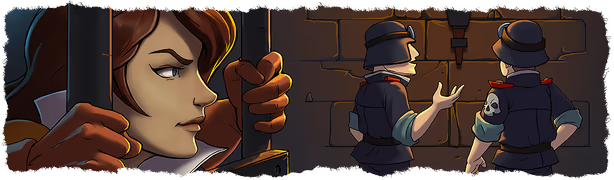
Alicia Quatermain 2: The Stone of Fate, developed by Jetdogs Studios and Whalebox and published by Jetdogs Studios, continues the charming blend of adventure storytelling and time management gameplay that defined the first game in the series. Once again, players join the spirited explorer Alicia Quatermain, the granddaughter of the legendary adventurer Alan Quatermain, as she embarks on another globe-trotting expedition. This time, Alicia sets out to uncover the secrets of the mythical Stone of Fate, a powerful artifact said to hold mystical energy and ancient wisdom. The story unfolds across a variety of exotic locations—from the dense jungles of India to snow-covered mountain ranges and mysterious hidden temples. The narrative is lighthearted but effective, serving as a pleasant backdrop for the puzzle and strategy-driven gameplay. It evokes the spirit of classic adventure tales, mixing archaeology, mystery, and humor in a way that keeps the pacing engaging without overwhelming the player with exposition.
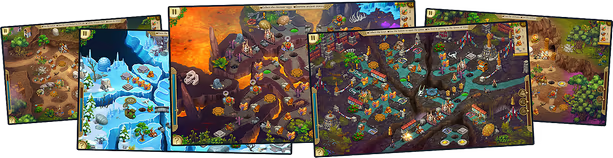
The gameplay remains firmly rooted in the time management and resource optimization formula that Jetdogs Studios has refined over the years. Each level presents a map filled with obstacles, collectibles, and construction points that must be cleared or built in the right sequence to achieve success within the allotted time. You control a small group of workers—often assisted by Alicia herself—and direct them to perform tasks such as gathering resources, repairing bridges, building camps, defusing traps, or rescuing endangered animals. Every action requires careful timing and prioritization, as each worker can only handle one task at a time, forcing you to think several steps ahead. The Stone of Fate expands upon this system with a more intricate level structure, offering more paths, multi-layered objectives, and hidden challenges that test the player’s efficiency and planning. This depth keeps the gameplay loop satisfying for those who enjoy strategic puzzle-solving, and the gradual increase in difficulty ensures a consistent sense of progress and reward.
While the sequel maintains the strengths of its predecessor, it also introduces some notable design changes that alter the rhythm of play. One of the most discussed differences among fans is the removal of automated resource gathering. In the original game, workers would automatically collect nearby resources, reducing micromanagement and allowing players to focus more on long-term strategy. In The Stone of Fate, every collection must be ordered manually, which increases player involvement but also adds a layer of busywork. This change divides opinion—some players appreciate the added challenge and control, while others feel it disrupts the smooth flow of earlier titles. Regardless of preference, the added micromanagement makes timing more critical, especially in the later levels where the margin for error narrows considerably. The game rewards players who can manage priorities efficiently and penalizes hesitation or wasted actions. When mastered, the process feels deeply satisfying, but the steeper learning curve may discourage more casual players seeking a relaxed experience.
One of the most appealing aspects of Alicia Quatermain 2 is its level design. Each map is carefully structured to encourage strategic thinking, requiring players to determine the most efficient path through a network of obstacles and objectives. The game rewards experimentation, as there are often multiple solutions to a level depending on which resources you prioritize first. Some maps emphasize puzzle-solving—figuring out how to reach a blocked area with limited tools—while others lean toward pure efficiency challenges where speed and precision matter most. The developers have struck a careful balance between accessibility and depth, ensuring that every new chapter introduces fresh mechanics or environmental twists to keep the gameplay from feeling repetitive. The presence of hidden collectibles and optional tasks adds replay value, encouraging perfectionists to return and optimize their scores.
Visually, The Stone of Fate continues Jetdogs Studios’ tradition of colorful, detailed, and inviting artwork. The environments are vibrant and distinct, with each region offering a visual identity that reflects its cultural and geographical setting. The Indian jungles are lush and teeming with life, while the Himalayan mountains feel cold, vast, and foreboding. The art direction manages to maintain clarity even when the screen becomes crowded with activity—a vital quality in time management games. Character animations are simple but expressive enough to convey personality, and the overall presentation feels polished and cohesive. The sound design complements the visuals with an upbeat, adventurous score that captures the sense of exploration and urgency. The music never overpowers the gameplay, but it enhances the mood, whether you’re racing against time to complete a level or pausing to admire the environment’s details.
Where the game falters slightly is in pacing and variety. Although the locations change and new mechanics are introduced, the core loop remains largely the same throughout. By the time you reach the final levels, you’ll have mastered most of what the game asks of you, leaving little room for genuine surprise. Some players may also find the manual micromanagement to be tiring over long sessions, especially since every level follows a similar rhythm of collect-build-upgrade-repeat. The story, while fun and occasionally humorous, is not particularly deep or emotionally engaging, functioning mainly as connective tissue between gameplay sections. These issues don’t detract from the overall enjoyment but do limit the game’s appeal to those who prefer more narrative or mechanical variety. It’s a game best enjoyed in bursts, where each level feels like a satisfying, self-contained challenge rather than part of an extended grind.
Despite these shortcomings, Alicia Quatermain 2: The Stone of Fate remains a well-crafted and enjoyable entry in the time management genre. Its balance of strategic thinking, quick decision-making, and lighthearted storytelling makes it a perfect fit for fans of series like 12 Labours of Hercules or Roads of Rome. The sense of accomplishment that comes from executing a flawless run—where every second counts and every move is perfectly timed—is deeply rewarding. Jetdogs Studios demonstrates once again that they understand what makes these kinds of games engaging: clear goals, steady escalation, and a strong visual identity that keeps players immersed in the world of adventure. For newcomers, The Stone of Fate offers an approachable entry point into the genre, while veterans will appreciate its increased challenge and intricate map design.
In conclusion, Alicia Quatermain 2: The Stone of Fate is a charming and thoughtfully designed sequel that builds upon the foundations of its predecessor while experimenting with new mechanics and tighter control systems. Its blend of puzzle-solving and time management delivers a steady stream of satisfying moments, and its colorful art and lighthearted tone make it a pleasant experience from start to finish. Though it doesn’t reinvent the genre, it refines it with care and polish. For players who enjoy games that reward focus, precision, and efficiency, The Stone of Fate is a worthy adventure—one that captures the thrill of exploration and the satisfaction of perfect execution in equal measure.
Rating: 8/10