A falling-sand sandbox built on the **real periodic table**. Every element has genuine physical properties, and reactions emerge from real chemistry — rust iron, ignite thermite, run a galvanic cell, split a uranium pile to criticality. Discover it all in an encyclopedia that fills as you play.
Modeled estimate, not a reported figure. How we estimate →
About
Alembic is a falling-sand laboratory built on the real periodic table.
Pour elements together. Heat them, cool them, dissolve them, electrify them, compress them, irradiate them and see what happens.
Reactions emerge from physical and chemical properties rather than fixed crafting recipes — and now you can build machines around those reactions, route matter through entire systems, generate electricity, and experiment with nuclear physics.
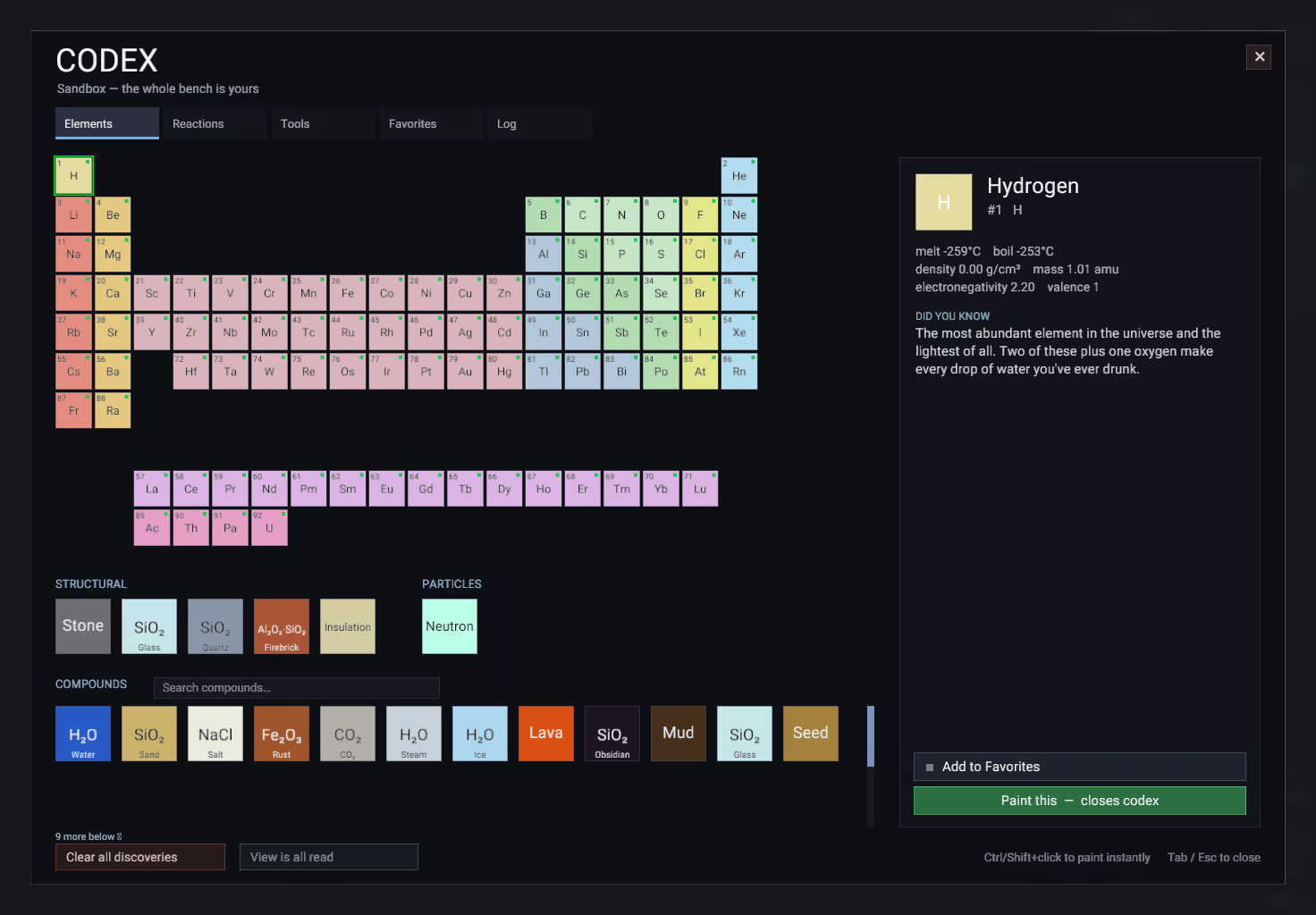
Every element carries properties derived from the real thing: density, phase transitions, atomic mass, electronegativity, valence and more.
Drop sodium into water and watch it react. Grind aluminium over iron oxide and ignite thermite. Dissolve salts, distill solutions, plate metals through electrolysis, form alloys and amalgams, oxidize iron into rust, melt silica into glass, and push materials through phase changes.
There is no recipe book deciding that “A + B = C.” The simulation asks what the materials are, what state they are in, and what environment you put them in.
Pipes carry liquids and gases through the world. Fans create real pressure gradients and drive flow. Filters separate phases. Conveyors move loose matter. Thermal plates heat and cool what touches them. Sensors watch the simulation and control equipment.
Generators don't simply produce power because you placed one. Matter has to move through them. Drive a fast gas stream with a fan, drop water through one, or build a steam cycle and turn heat into electricity.
The machines aren't operating on a separate automation layer. They interact with the exact same particles, heat, pressure and electricity as everything else in the sandbox.
Radioactivity is part of the simulation, not a canned explosion effect.
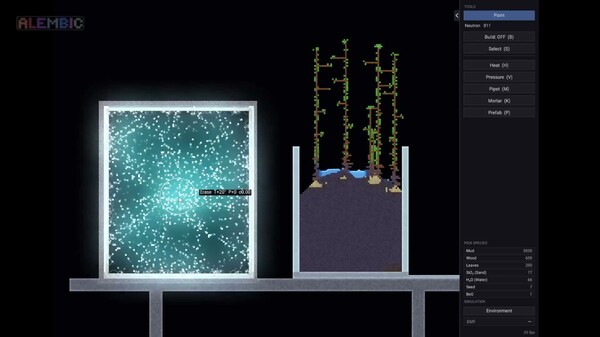
Radioactive materials emit radiation. Neutrons travel through matter, lose energy in moderators, scatter, reflect from suitable materials and disappear into neutron absorbers. Uranium and other nuclear fuels can undergo fission, producing heat and more neutrons.
Geometry matters. Fuel arrangement matters. Moderation matters. Reflection matters. Control material matters.
Keep the neutron population under control and you can sustain fission long enough to heat coolant, make steam and extract power.
Let the chain run away and the microscopic simulation hands off to something much less microscopic.
Yes, the molten lead raining out of the wreckage is simulated too.
Heat doesn't stop being heat because it entered a pipe. Pressure doesn't disappear because it crossed a machine. Matter doesn't become decorative when it enters a generator.
Water finds its level. Steam expands. Gas compresses inside sealed spaces. Dense materials sink beneath lighter ones. Hot objects conduct into their surroundings. Electrical resistance generates heat. Pressure can rupture structures. Explosions throw matter according to the material standing in their way.
Those systems overlap — which means solving one problem can create another.
Water finds its level. Through pipes, under walls, around corners, like real communicating vessels.
Trap gas under a diving bell and the sea compresses it; crack the seal and it erupts. Mercury is so dense that nearly everything you drop in it floats back out.
Hold Shift and shake the actual game window.
The contents feel every jerk and stop: powders slam into walls, leap for the lid, and fold into each other; liquids slosh, surge, and swallow whatever you stirred up. It's not a mini-game. It's the mixing tool.
You don't begin with a completed encyclopedia.
Experiments fill the Codex as you play: elements, reactions, phenomena and tools are recorded as you encounter them. Much of the periodic table opens through actual discoveries rather than a conventional progression tree.
If a completely blank sandbox isn't enough direction, Challenges give you experiments to pursue — from distillation and metallurgy to chemistry, engineering and nuclear destruction — with Bronze, Silver and Gold targets.
Or enable Sandbox mode and take the entire laboratory immediately.
Chemistry: combustion, oxidation, thermite, acid-base reactions, electrochemistry, alloys, amalgams, dissolution, crystallization and distillation
Fluids & pressure: buoyancy, communicating vessels, compression, vacuum, steam expansion, pressure-driven flow and structural rupture
Electricity: batteries, galvanic cells, electrolysis, resistance heating, high-voltage arcs and generators
Machines: fans, pipes, filters, conveyors, thermal plates, generators, sensors and material spawners
Nuclear physics: radioactive decay, alpha radiation, neutron production, moderation, absorption, reflection, fission, fuel burnup and criticality
Materials: melting, boiling, freezing, condensation, heat conduction, density and phase-dependent behavior
Tools: heat, pressure, vacuum, pipetting, mortar/grinding, prefabs — and physically shaking the game window
Genres
Stats
All-time low is the lowest price we've recorded for this game since we started tracking it.
English, French, Italian, German, Spanish - Spain, Japanese, Korean, Polish, Portuguese - Brazil, Russian, Simplified Chinese, Traditional Chinese +2 more
Add-ons
Each DLC is estimated with the same model as a game, then summed — a modeled figure, not reported DLC sales.
Reviews
This is amazingly intricate, you can do almost any chemical reaction you know. Start simple mix some elements get compounds: Hydrogen + Oxygen = water(H20) Carbon + Oxygen = Carbon Dioxide(CO2) 5 minutes later you are melting alloys, mixing acids, discovering compounds you never even knew possible. Make a galvanic battery that hums with electricity, make gunpowder and other explosive materials. You blink and before you know what has happened you are building reaction chambers and trying to cause nuclear reactions.
I've been waiting for a game like this ever since I was a wee child. I started playing powder sandbox games with danball, moved onto powder toy and the powder sandbox world remained stagnant for years. The comes Alembic and rewrites everything I knew about particle sandbox games, but don't be fooled by it's simple appearance, this is a true chemistry game for nerds. I had to make my own solutions in order to create a galvanic battery, even tho there is simpler ways, the real world methods actually functioned. A little bit of copper, a little bit of zinc, a solution of Copper sulfate, a solution of zinc sulfate and a salt bridge, BAM! A functioning galvanic battery. This is TPT on steroids, this is the only particle sandbox game you should be playing going forward. You'll learn real chemistry, you'll make ♥♥♥♥ that explodes and you'll discover compounds you didn't even know existed. 10/10 I have no words for how much I am enjoying this.
Media

Related
Related
Price dynamics, follower growth, revenue and sales trajectories with interactive tooltips
This and every other Pro feature is free until October 20, 2026. A free account is all it takes.
love it
No recipes, no "A + B = C." Every element has real properties, and reactions come out of what the material is and what you do to it. That makes experimenting the whole point, and any idea you have is worth trying. It's deep too. Pipes, fans, filters and generators all run on the same particles, heat and pressure as the rest of the sim, so building a system means actually moving matter through it. Even the nuclear physics is properly simulated. The Codex fills in as you discover things, so most of the periodic table unlocks through real experiments instead of a menu. Challenges give you direction, Sandbox mode gives you everything. Massive replayability. Recommended if you like sandboxes that reward curiosity.
是一个很不错的烧杯类游戏,可以看出制作组雄心勃勃地希望在游戏内复刻一张元素周期表,且创意性地增添了电、衰变以及生命的元素。意外惊喜的是,制作者还在文案中灌注了不少心思,每次查看反应、现象或挑战的文案时真的会让我会心一笑。但是,游戏对于中文的支持尚且不足,所有的角标全是口口口,三氧化硫和二氧化硫全部表现为SO口;同时,作为一款类烧杯游戏,虽然游戏有着广阔的雄心,但实质上的深度远远不足,大部分元素几乎是背景板,其存在意义就是产生几种颜色光泽各异的化合物,电、不稳定元素也局限于电弧、电解、衰变、核爆;尽管游戏创新性地为游戏增添了几个机械结构预制件,其本质作为一个烧杯游戏内容也实在有限;最后才是游戏的ui以及操作逻辑还有待优化,ui互相遮挡或者按键逻辑失效或意义不明的bug还需要修复 It's a genuinely impressive beaker-style game. You can tell the team is ambitious — they clearly set out to recreate a full periodic table in-game, and they've creatively thrown in elements like electricity, decay, and life. A pleasant surprise was how much care went into the writing: every time I read the flavor text for a reaction, phenomenon, or challenge, it actually made me smile. That said, Chinese language support is still lacking. All the subscripts render as missing-glyph boxes, so both sulfur trioxide and sulfur dioxide just show up as "SO□". And for a beaker-style title, despite its grand ambitions, the actual depth falls well short. Most elements are little more than set dressing — their whole purpose is to churn out a handful of compounds in different colors and glows. Electricity and the unstable elements are likewise confined to arcs, electrolysis, decay, and nuclear blasts. Even though the game makes a novel addition of a few ready-made mechanical components, at its core it's still a beaker game, and the content really is thin. Last but not least, the UI and control logic need polish: overlapping interface elements, buttons that stop responding, and bugs that are either broken or just plain confusing all still need fixing.
第一次当第一篇简体中文评论😋 非常好的游戏,可以理解为手机上那个《烧杯》的 Pro Max 开放世界版。那个软件的问题就是烧杯是绝对不损坏的,但这个游戏里没有,一切仪器都是你造(画)出来的。貌似还有电化学甚至核化学,我还没玩到。有机可能比较复杂,超出这个游戏能模拟的范畴了,目前看这个游戏应该主要是无机化学和物理学。30块真不亏。
pretty cool, i liek mixing random stuff
its peak🤯
не рекомендую часто зависает и проблема не в симуляции к ней вопросов ноль очень классно сделано но если нажимаешь кнопку зависает иногда на секунду иногда на пару минут своих денег игра не стоит
Juego muy entretenido, llevaba esperando un juego así bastante tiempo. La traducción al español es bastante buena, el único problema es que los textos a veces sobresalen un poco de la interfaz. En mi opinión falta un poco de QoL para hacer que los experimentos sean más fluidos y cómodos de hacer. También me gustaría que tuviera opciones para reducir o aumentar el tamaño de la interfaz y la resolución del juego. En lo relativo a la simulación de las reacciones me parece excelente. El juego tiene en cuenta muchos factores externos como la temperatura, presión, etc, lo cual lo hace bastante realista. No lo recomiendo a la persona promedio que no le guste la química o no esté muy familiarizado. Hay que tomarse el juego como lo que es: un sandbox educativo. Si te gusta la química, te lo vas a gozar.
Selling now
See how fast this game is selling right now — estimated copies and revenue per day from recent review growth.
Related
| Game | Estimated lifetime revenue | Reviews | Review score | Price |
|---|---|---|---|---|
| $77.8K | 1.7K | 94% | $1.99 | |
| $39.9K | 1.2K | 95% | $0.99 | |
| $90.3K | 247 | 96% | $9.99 | |
| $852 | 5 | 100% | $4.99 | |
| $629 | 5 | 80% | $4.99 | |
| $185 | 1 | 100% | $4.99 |
Related
| Game | Estimated lifetime revenue | Reviews | Review score | Price |
|---|---|---|---|---|
| $2.3K | 51 | 65% | $2.99 | |
| $2.3K | 51 | 78% | $4.99 | |
| $2.3K | 63 | 73% | $1.99 | |
| $2.3K | 121 | 66% | $0.99 | |
| $2.3K | 68 | 76% | $2.99 | |
| $2.3K | 116 | 86% | $0.99 |