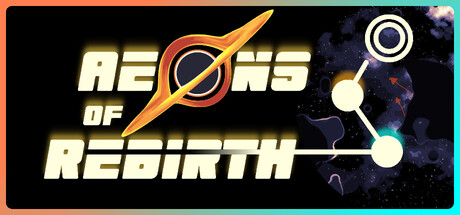
Aeons of Rebirth is a short, strategic incremental journey about exploring planets and building the greatest space empires ever!
Modeled estimate, not a reported figure. How we estimate →
Media

About
Aeons of Rebirth is a short, unique incremental journey about exploring planets and building the greatest space empires ever.


Relaxing incremental progression,
13+ classes of planets with procedural appearance,
Civ-like tree of technologies to explore,
Short and sweet experience (~2.5hr playtime),
Chill ambient soundtrack, composed by SkinDecay.
Stats
All-time low is the lowest price we've recorded for this game since we started tracking it.
Languages: English**languages with full audio support
Engagement
Hours played at review time, across 40 reviews with recorded playtime.
Reviews
Themes across 40 recent reviews and how positive each mention is. A keyword signal, not full sentiment analysis.
positive critical· bar length = how often the theme comes up
Reviews
Normally, I only write a review when I’ve earned all achievements in a game, when the game completely blows me away, or—as in this case—when I have something important to say. I actually advise against buying it. Five euros or dollars are too much for the tiny amount of content the game offers. The gameplay is linear, just as you’d expect from this type of game, which isn’t inherently bad, but there are no special mechanics, no large tech tree, and no real variety of enemies. You play a round, and as soon as you earn points—here called Dark Matter—you reset and invest them into upgrades so that your next run, which plays exactly the same as the previous one, starts with more resources and better planets. So far, so acceptable—if only there weren’t so few upgrades. There are about 37 in total, and that’s it. Once you have them all, the game is basically over. I finished the story in under two hours and then had to play the endless mode for the remaining achievements. And oh boy, it truly lives up to its name… it goes on forever. No wonder the ‘hidden achievements’ sit at around 0.1% of players. I let the game run for two nights straight and made no progress because resource generation slows down more and more. The game simply isn’t designed for that many planets or such heavy calculations. With every additional spawn, the game slows down and performance collapses. To me, it feels like the developers don’t want players to refund the game and instead artificially stretch the ‘content’. Anyone who isn’t willing to let the game run for days—or maybe weeks—just for a few trophies, stressing their PC while barely making progress, should NOT buy it. I actually love small games like this, but this one is a complete disappointment. I hope the developer(s) will address and fix these issues. For example, they could drastically reduce upgrade costs, stop increasing them after a certain point, or reintroduce the tech tree in endless mode with expanded bonuses. If that happens, I’d be willing to update my review. Until then, this is where I stand.
Beat the game in 2 hours with literally AFKing to eat dinner Endless mode doesn't allow rebirth so had to start over for remaining achievements Way too little content for $5, if you actively play it you could probably get all achievements in under an hour
It's a very straightforward sort of almost mobile-game sort of thing. It's not really reasonable to call it strategy, all you do is click things to upgrade them to produce more resources to click other things. It's a bit like a clicker game, like cookie clicker. That said it's got an interesting sort of tone and the upgrades at least feel fun. I think it's priced pretty reasonably for what you get.
7.5 / 10. Graphics are good, sound and music are decent and don't grow tiresome. This game is good, but it's short -- I beat the game at 3.5 hours with all but one achievement ("Store 50 dark matter" which I think would probably take about another couple hours of play tops). I also played about 20 minutes of endless at the time of writing. I liked it and had fun with it. If you like incremental games, I'd recommend trying the demo. The full game is a direct continuation and expansion. It feels maybe a little undercooked. The mechanics are a little simple. I would have liked there to be more of a reason to make certain connections instead of others. Instead, you just maximize the number of connections. The modifiers for the homework kind of change the strategy a little, but as far as I can tell the limitations about overlapping, and the way the math works out you should just create as many connections for every planet as you can. It's just easier to find more planets and add them to the network than it is to try to min-max an 8 planet network. I would have liked there to be more to the destroyer and pirates in the game. I would have liked there to be more explanation and more consequences to what's going on. They got introduced in one run, and I immediately bought the auto destroyer tech the next rebirth. I never had to think about them again. I'm not quite sure why Science is used as the resource for finding planets. It seemed more natural to me that new planets should be revealed simply over time rather than costing anything. Especially because once the opposition is revealed, it's clear that finding more planets is the way to start the challenge clocks ticking. And if the alien planets do scale over time, they could scale beyond the player and force them to rebirth. I don't think that's bad. You are a little subject to RNG with the planets placed -- I got a few runs with an inordinate number of dead cores and black holes -- but the story concept here is that you have to keep starting over to survive. So why wouldn't the player start over more? The pacing is a little uneven. I felt like I just flew through the early stages of this game. Getting 3 dark matter (or more!) just seems excessive with such a short tech tree. 1 or 2 maximum would have been much more my speed. The game seemed to introduce pirates and aliens at the same time -- literally 5 minutes apart for me -- which was also just too fast. Also, I think there are two kinds of aliens, but I got to the last mission before I figured that out. Before that, once you get to the boss, the game suddenly gets incredibly grindy. Just getting enough Science to research level 10 capital ships was, completely by itself, about an hour of play on a single level. And it wasn't particularly active play, either. I would just explore a planet, connect it to the trade network, and then wait for the mills to generate enough production to build the upgraded structures. Just very slow scaling up to being able to afford the tech I needed to win. The game keeps telling you that if you don't move fast that the defenses of the aliens will be too great, but I can't actually tell that that has happened. For most of the game, I instantly wiped out alien planets. There is some lack of feedback in the game, and some lack of instruction. I'm still not at all sure how the influence mechanic or tourism mechanics work. Once I beat the boss, which gates those mechanics, I had 8 or 10 dark matter so I could easily just finish the whole tree. They're introduced so late, and you only use them in basically one mission. It took me awhile to realize that when influence isn't high enough -- which is completely down to RNG, because even though I had 50 planets, the "blood" boss planet doesn't care about influence, and then I had 2 alien planets way out at the galactic rim by themselves surrounded by alien planets I *had* captured... but that had no tourism themselves. I had to buy the Tourism upgrade about 20 or 30 times. It wasn't difficult or challenging. It was just tedious because I was just waiting for the 200 or 300 Terascience it took to expand the tourism bubbles that far. And, yeah, I could have just sent in the capital ships, but it kind of felt like I wasn't supposed to do that. Honestly I'm surprised I could still buy capital ships. Genuinely, I'm surprised that the end game didn't introduce a new planet type with a new tourism structure that you had to build. That's what I was expecting. Oh, also, it wasn't explained how the infinity button on the lower left panel works. For those that need to know, if the infinity is "on" then all sites will autobuy mills, labs, and trade connections. If the infinity button is off, then all autobuyers are disabled. Once I found this button, I never toggled an autobuyer any other way again. It's useful to turn this off if you suddenly need production to emergency construct destroyers or capital ships. That's about it. Otherwise, just leave it always on. I did find a handful of minor things I consider bugs or design issues. Overall they're small, but I definitely noticed them. They kind of make the game feel a bit less polished. 1. On rare occasions, planets can spawn where network connections already exist. This can make it really difficult to click on the planet. I mean, you're going to want to delete the trade connection anyways, but doing that is sometimes just a little awkward. Especially if you're really zoomed out, it's an alien planet, you didn't have enough productivity to send a large enough fleet of capital ships, and you're scrabbling to select the planet again. 2. Pirate attacks get this big red warning sign when they hit a connection. Hostile alien planets... are just red dots. They're easy to lose, especially when they spawn inside your network. 3. The autobuy is both a little too good, and a little incomplete. Like it doesn't autobuy science and it doesn't autobuy sensors. But it will autobuy trade connection upgrades (thank god), mills, and labs. The weird part is that there are pop-ups for trade connections, mills, and labs that you can click on, but science upgrades and sensor upgrades both require you to open a window and do something there. It's odd. The thing that had some QoL features to it also has the autobuyer. While science and sensors never do. Honestly, I think the autobuyer should be something on the tech tree. And if it actually is something on the tech tree, then I didn't see it because you get too many upgrades between runs. 4. Sensors, destroyers, and capital ships *never* start a run unlocked, and it's annoying. Yes, it's true that the story is that we're in a new universe. But the story is also that I'm remembering the stuff I need. It's a little irritating to be always reactive about it. 5. Holy cow, you need to change the "delete" network connection button. You put an X icon in the upper right of a pop-up window that you have to click twice to delete. No! I can't tell you how many time I deleted a connection on accident. 6. If the number of trade connections exceeds 100 -- which I think it must at the end of the game given the costs involved -- then in the information panel shows something like 72/++ for upgraded and total trade connections. You can't tell how close the thing is to finishing a total network upgrade. Which is important because if you reveal an alien planet next, you don't want to be resource starved if you need to build an emergency capital fleet. (That's assuming the alien defenses actually improve over time, I never witnessed this.) Just expand that window to be the same size as the rest. It's a little bit to show the totals in most cases. I need to know how much longer I'm going to be waiting. I know I sound harsh here, but I did like this game. It was fun! If you like incrementals, give it a try. I am genuinely looking forward to more from Short Scale! It's a good first outing! Edit: Spelling, clarity.
Could finish the game in 30 minutes, but they implemented a luck base factor to stretch the game
Got to 100 planets. was letting it all tick. checked my task manager and this game is a massive resource hog even while minimised.
Unintuitive, buggy and cannot be completed due to bugs. Not worth the $.
genuinely nice concept, it is a bit short and rough around the edges but the dev is responsive and already fixed a bunch of the rough edges so i can see this game getting pretty good eventually. It already plays kinda like simplified and more chill version of slipways and also gives some masters of orion lite vibes
Aeons of Rebirth, developed and published by Short Scale, is a compact incremental strategy experience that blends idle progression with stripped-down 4X-inspired systems. Rather than aiming for sprawling complexity or long-form empire building, it focuses on delivering a tightly scoped loop centered around growth, optimization, and repeated cycles of advancement. The result is a game that feels deliberate in its simplicity, offering just enough strategic depth to stay engaging without overwhelming the player. At its core, the gameplay revolves around managing resources across a collection of procedurally generated planets. Players gradually expand their reach by developing these worlds, establishing production chains, and unlocking technologies that improve efficiency. The structure is immediately familiar to fans of incremental games, with numbers steadily increasing and new upgrades unlocking over time. However, what gives the experience a bit more substance is how it incorporates light strategic decisions into this loop. Choosing how to allocate resources, which planets to prioritize, and how to structure growth introduces a layer of planning that goes beyond purely passive progression. The game’s interpretation of 4X mechanics is intentionally minimalistic. Exploration and expansion are represented through the discovery and development of new planets, while progression is tied to a branching technology system that gradually opens up more efficient strategies. These systems are not deeply complex, but they provide enough structure to make each run feel purposeful. The satisfaction comes from finding more effective ways to grow, refining decisions with each attempt, and gradually understanding how different elements of the system interact. Central to the experience is its rebirth mechanic, which encourages players to reset their progress in exchange for long-term bonuses. This system forms the backbone of the game’s pacing, turning each run into a stepping stone toward greater efficiency. Early cycles focus on learning the basics, while later ones emphasize optimization and faster progression. The sense of improvement is tangible, as each reset allows players to reach milestones more quickly and experiment with more refined strategies. This loop creates a strong sense of momentum, even within the game’s relatively short overall playtime. That brevity is one of the game’s defining characteristics. Unlike many strategy or incremental titles that aim for endless progression, Aeons of Rebirth is designed to be experienced over a limited number of hours. This focused approach works in its favor by keeping the gameplay concise and avoiding unnecessary padding. However, it also means that the game does not offer the same level of long-term depth or variety found in more expansive titles. Once the core systems have been mastered, there is little new content to extend the experience. Visually, the game adopts a clean and functional style that prioritizes clarity. The interface is straightforward, presenting information in a way that makes it easy to track resources, upgrades, and planetary development. Procedurally generated elements add some variation, but the overall presentation remains understated. This simplicity aligns well with the game’s design philosophy, ensuring that the focus remains on progression and decision-making rather than visual spectacle. The pacing is generally smooth in the early stages, with a steady flow of upgrades and milestones that keep players engaged. As the game progresses, however, certain segments can feel slower, particularly when waiting for resources to accumulate. This shift can interrupt the otherwise satisfying rhythm, making later stages feel more passive than strategic. While this is a common trait in incremental games, it is more noticeable here due to the game’s relatively short length and limited variety. Despite these limitations, Aeons of Rebirth succeeds in delivering a cohesive and enjoyable experience within its scope. It captures the essence of incremental progression while introducing just enough strategic elements to keep players involved. The balance between active decision-making and passive growth is handled well, making it easy to engage with the game at different levels of attention. Ultimately, the game stands as a focused interpretation of both incremental and strategy genres, offering a streamlined experience that emphasizes efficiency and iteration. It may not provide the depth or longevity of larger titles, but it delivers a satisfying progression loop that is well-suited for shorter play sessions. For players who enjoy optimizing systems and watching their efforts compound over time, it offers a rewarding, if brief, journey. Rating: 7/10
Very cool idle/incremental game, currently it feels a tad short for the 5 dollar price tag but it is still very enjoyable. The Dev said they would be adding a few things which is great news! Hopefully this will resolve some of the end game pacing issues and extend the game lenght a bit. Overall I think this is a great little indie game that is worth playing but would love to see it expanded upon,
Related
Related
Trends
Concurrent players on Steam, sampled daily since tracking started.
Audience
Estimated from the language of this game's reviews — a proxy for where players are, not official Steam demographics.
Related
| Furry Orgasm | $3.6K | 217 | 76% | $0.59 |
| Firelight Fantasy: Vengeance | $3.6K | 198 | 68% | $0.97 |
| Oscuro Blossom's Glow | $3.6K | 70 | 94% | $2.99 |
| Zoop! - Hunter's Grimm | $3.6K | 322 | 60% | $0.55 |
| Undefeated | $3.6K | 182 | 81% | $0.79 |
| RedEx | $3.6K | 107 | 77% | $1.99 |
Related
| Euro Truck Simulator 2 | $421.6M | 932.3K | 97% | $19.99 |
| Stardew Valley | $258.9M | 881.6K | 99% | $14.99 |
| Garry's Mod | $228.7M | 1.3M | 97% | $9.99 |
| Factorio | $206.6M | 189.7K | 98% | $35.00 |
| Human Fall Flat | $109.3M | 225.6K | 95% | $19.99 |
| American Truck Simulator | $103.7M | 194.2K | 97% | $19.99 |