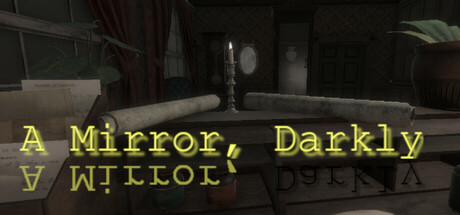
Explore your surrounds in this short narrative using a novel mechanic to find objects in a mirror's reflection
Modeled estimate, not a reported figure. How we estimate →
Media
About
"The mirror is a thing not meant for mortal eyes, its frame slick with an unnatural sheen as though carved from the petrified bones of something long dead yet never truly silent. The surface not mere glass, but a pane wrought from the void itself, the reflection warped in ways too subtle to notice at first. Wrong beyond articulation"
In A Mirror, Darkly things may not be as they seem. In this first-person puzzle game, you find objects in the mirror's reflection in order to escape the nightmare world you have been brought to.
Explore the world in first-person perspective, interacting with your surroundings
Find objects using a novel mechanic - using a mirror to look behind you to see if the object appears differently and identify it to progress.
Psychological horror, building tension through audio and visual elements.
A short experience, akin to an H.P. Lovecraft novel or internet creepypasta.
Steam Deck and Xbox controller support
Stats
All-time low is the lowest price we've recorded for this game since we started tracking it.
Languages: English
Reviews
거울을 비춰서 현실과 달리 숨겨진 무언가를 찾는게임으로 저는 16개를 찾았는데 더있는지는 몰루?
A Mirror, Darkly, developed and published by tombasche, is a tightly focused first-person psychological horror experience that revolves around a single, compelling idea: perception cannot be trusted, and reality may only reveal its truth when seen indirectly. Rather than building itself around traditional survival horror elements like combat or resource management, the game commits to a quieter, more introspective form of tension, where observation and interpretation become the primary tools for progression. The result is a deliberately minimalistic but concept-driven experience that feels more like an interactive short story than a conventional game. The central mechanic—using mirrors to uncover hidden aspects of the environment—is both the game’s greatest strength and its defining limitation. As players explore its eerie spaces, they quickly learn that what appears normal at first glance often hides something more disturbing beneath the surface. Objects shift, details emerge, and clues only become visible when reflected, creating a constant push-and-pull between what is seen and what is understood. This mechanic encourages a slower, more deliberate style of play, where careful observation replaces reflex-driven action. It also introduces a persistent sense of doubt, as players are never entirely sure whether they are interpreting the environment correctly, which naturally feeds into the game’s psychological tension. Atmosphere plays a central role in maintaining engagement. The game leans heavily into subtle horror, favoring unease over shock. Its environments are sparse but intentionally designed, with dim lighting, distorted visuals, and unsettling sound design working together to create a sense of quiet dread. There is an almost dreamlike quality to the spaces, as if they exist somewhere between memory and nightmare. Rather than relying on direct storytelling, the game communicates its narrative through environmental cues and fragmented details, leaving players to piece together meaning from what they observe. This approach gives the experience a slightly abstract quality, which can be intriguing for those who enjoy interpretive storytelling, though it may feel vague or underdeveloped to others. Because of its concise scope, the game unfolds at a steady and controlled pace, guiding players through its mechanics without overwhelming them. The puzzles themselves are not overly complex, instead focusing on reinforcing the core idea of altered perception. This makes the experience accessible, but it also means that the challenge level remains relatively low. The game seems more interested in maintaining mood and thematic consistency than in pushing players through increasingly demanding obstacles. As a result, the journey feels cohesive but somewhat limited, never quite expanding beyond its initial concept in a meaningful way. Visually, A Mirror, Darkly adopts a restrained approach that complements its tone. The graphical fidelity is modest, but the use of lighting and contrast helps emphasize important details and guide attention toward reflective surfaces. The simplicity of the presentation ensures that the central mechanic remains clear and readable, though it occasionally gives the impression of a project with limited resources. Still, this minimalism works in favor of the game’s atmosphere, allowing the unsettling elements to stand out without distraction. Where the experience ultimately divides opinion is in its brevity and lack of broader systems. It is designed to be completed in a single sitting, and once its puzzles have been solved, there is little reason to return. There are no alternative paths, no meaningful replay incentives, and no additional layers of progression to explore. For some players, this will feel like a focused and intentional design choice—a concise exploration of a single idea without unnecessary padding. For others, it may come across as underdeveloped, as though the concept had the potential to support a much larger and more varied experience. Despite these limitations, the game succeeds in what it sets out to do. It offers a distinctive take on psychological horror by shifting the emphasis from external threats to internal uncertainty, using its mirror-based mechanic to create a subtle but persistent sense of unease. It doesn’t aim to compete with larger, more content-rich titles, but instead carves out a niche as a small, experimental project that prioritizes concept and mood over scale. It is best approached with the expectation of a brief, atmospheric journey rather than a deeply layered or mechanically complex game. In the end, A Mirror, Darkly stands as a creative and thoughtful indie effort that makes the most of its central idea, even if it doesn’t fully explore its potential. It leaves a quiet impression rather than a lasting one, offering just enough intrigue to be memorable without overstaying its welcome. Rating: 6/10
Related
Related
Trends
Concurrent players on Steam, sampled daily since tracking started.
Got me obsessed with finding all the secrets. Cool setting, interesting (though sometimes irritating!) mechanic and overall a well crafted game, especially for the price. Could be longer, but still easily worth the money.
买游戏送BUG???游戏人物能够自己动,我还玩个屁啊! 别研发游戏了,你不适合
poor performance and bugged achievements
Momentum
Pace estimated from the game's recent review growth (our daily snapshots) at its own sales-per-review ratio — a momentum signal, not booked sales.
Related
| Glasses and Girls | $315.6 | 51 | 82% | $0.49 |
| Bongo Quest | $315.6 | 51 | 45% | $0.49 |
| Food and Girls | $315.6 | 51 | 86% | $0.49 |
| Dances and Girls | $322 | 52 | 83% | $0.49 |
| Anime Sunset Ride | $334.4 | 54 | 67% | $0.49 |
| Carnival and Girls | $334.4 | 53 | 85% | $0.49 |