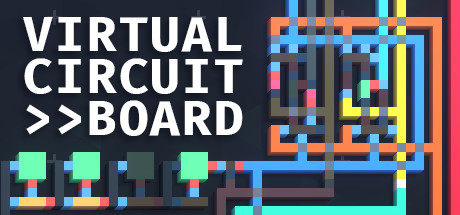
Virtual Circuit Board, developed and published by Reverie Foundry, is a remarkably deep and creative sandbox simulation that bridges the worlds of engineering, logic design, and interactive art. It stands out as a unique experience not by offering missions or challenges, but by giving players a fully open environment in which to create and simulate their own digital circuits. Rather than holding your hand through tutorials or campaigns, it provides the building blocks of computation—logic gates, flip-flops, memory units, and assembly code support—and simply says, “go make something.” This approach immediately defines its audience: it’s a game designed for thinkers, tinkerers, and digital architects who take satisfaction in understanding systems from the ground up. For those willing to engage with its complexity, Virtual Circuit Board becomes a playground of electronic imagination.
At its core, the game revolves around constructing and testing digital logic systems. You start with a blank grid and populate it with logic gates such as AND, OR, NOT, NAND, and NOR, then connect them using color-coded traces that carry signals across the circuit. Every connection and delay matters, as the simulation is fully tick-based—each pulse of the clock advances the logic, allowing you to watch signals propagate through the network. This real-time feedback transforms the act of design into a living process. The simulation engine is fast, responsive, and capable of handling surprisingly large systems, though it demands organization and efficiency from the player as circuits grow more complex. Watching your first working adder or flip-flop chain function correctly after careful planning is immensely rewarding, and the sense of progression comes not from levels, but from your growing mastery of logic itself.
A defining feature of Virtual Circuit Board is its inclusion of a built-in assembler that allows players to define and implement their own instruction sets. This elevates the experience from simple logic design to actual computer architecture. You can create custom CPUs, write basic assembly programs, and visualize how instructions are executed at the gate level. The level of control is extraordinary, allowing players to design everything from simple calculators to functioning processors with memory and input/output interfaces. The result is a rare sense of creative empowerment, where logic, code, and visualization merge into a single, coherent system. It is not an exaggeration to say that Virtual Circuit Board can teach you the foundations of how computers think—if you have the patience to explore it deeply enough.
The interface and presentation are minimalist yet effective. Circuits are rendered as clean, colorful schematics, with wires and components clearly distinguished by type and function. The color-coded system not only helps with aesthetics but also serves a practical purpose, allowing for easy identification of different data or control lines. Decorative and labeling tools are available so you can annotate or design your boards in visually organized ways, which becomes essential when working on large-scale projects. However, as your creations expand, the limits of the interface become apparent. Panning and zooming across sprawling layouts can feel cumbersome, and fine adjustments to wiring can occasionally test your patience. Still, the visual clarity of the simulation, combined with its consistent design language, helps maintain readability even when your circuit fills the screen with activity.
From a technical perspective, the game runs smoothly on modest hardware. The engine handles thousands of components with stability, and while performance dips can occur during extremely complex simulations, it remains stable and predictable overall. The developers’ choice to prioritize functionality and clarity over visual flash pays off in the long run. The sound design is minimal, serving primarily to provide subtle feedback when interacting with the editor. There’s a distinct sense of calm focus while working—the hum of logic, the flow of connections, and the visual dance of signals combine to create something meditative, even artistic.
One of Virtual Circuit Board’s greatest strengths is also its main limitation: the complete lack of guided structure. There are no tutorials, objectives, or campaigns to introduce concepts or motivate progress. This means that newcomers to digital logic may feel overwhelmed at first. The game assumes a level of familiarity with concepts like binary operations, clock cycles, and signal propagation. For beginners, this can be a daunting entry point, but for enthusiasts, it’s liberating. Without imposed constraints, you can build whatever you can imagine, from a basic calculator to a full-blown 8-bit CPU. The sense of self-directed learning and accomplishment becomes the driving force, and the community’s shared creations—posted through screenshots and videos—serve as inspiration rather than competition.
Despite its niche appeal, the community surrounding Virtual Circuit Board is active and enthusiastic. Players share complex builds, troubleshoot design issues, and exchange tips on efficient circuit organization. Some have even managed to replicate classic computing systems or run simulations of retro-inspired processors within the game. The developers have earned praise for their responsiveness and for crafting a tool that straddles the line between educational platform and creative sandbox. There are requests for additional features—modular sub-circuits, workshop support, and improved debugging tools—but even in its current form, the depth of what can be achieved is impressive.
Ultimately, Virtual Circuit Board is not a conventional game but a digital laboratory for creative problem solving. It challenges the player to think like an engineer, to visualize the invisible flow of logic that underpins modern computation, and to appreciate the elegance of systems built from simple binary rules. It is patient, methodical, and unapologetically complex, yet those who invest time into understanding it will find a deeply rewarding experience. Whether you see it as an educational tool, a meditative hobby, or a testing ground for digital artistry, it succeeds in offering something truly distinctive. In an age of instant gratification and pre-packaged gameplay, Virtual Circuit Board dares to remind us of the quiet joy of building something from nothing—and watching it come alive through logic alone.
Rating: 9/10