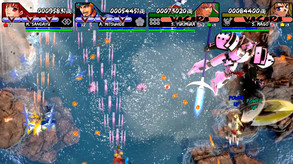
For the very first time, highly acclaimed Japanese Arcade Shoot’em Ups - VASARA (2000) and VASARA 2 (2001) - are made available to the whole world via this package: VASARA COLLECTION!
Modeled estimate, not a reported figure. How we estimate →
About
For the very first time, highly acclaimed Japanese Arcade Shoot’em Ups - VASARA (2000) and VASARA 2 (2001) - are made available to the whole world via this package: VASARA COLLECTION!
Science Fiction meets History in these arcade classics which take place in an alternate timeline Feudal Japan where technologically advanced weaponry and equipment are a reality, and heroes use flying motorcycles with amazing firepower and fierce melee weapons to destroy their enemies.
Try and stay alive on this frantic game where everyone, and everything, is out to kill you!
New Gameplay mode: Timeless mode
Main features:
Tate Mode/ Vertical Mode support;
8 playable characters inspired by real Japanese historical figures;
Sci-Fi meets Feudal Japan in this retelling of historical battles;
Fight Robots and Samurais using traditional shooting and powerful melee attacks;
Heavily skill-based gameplay for Experts;
Easy Mode for Starters;
Branching Paths and Multiple Endings according to your characters and in-game actions;
Highly acclaimed Japanese Arcade Shoot’em: VASARA and VASARA 2

Stats
All-time low is the lowest price we've recorded for this game since we started tracking it.
Languages: English, Japanese**languages with full audio support
Engagement
Hours played at review time, across 40 reviews with recorded playtime.
Reviews
Themes across 40 recent reviews and how positive each mention is. A keyword signal, not full sentiment analysis.
positive critical· bar length = how often the theme comes up
Reviews
Vasara Collection is a title released by the Brazilian studio QUByte Interactive (99Vidas), which brings together the two games in the Vasara series. A "spaceship" game, where we shoot and dodge the thousands of shots fired by enemies. We collect items to increase our firepower and collect crystals to charge our special attack, Vasara.
体力ゲージ性を採用すべきだった残念なゲームです。自機のドデカ判定がやる気を失わせてくれます。中盤までは遊べなくもないのですが、ラス面のコンテニュー時最初からと解ってからやる気なくなりました。どこかぐわんげを移植してくれないか。
2のキチっている難易度。 ラス面コンテ最初からって。 CAVEだってコンティニューさせてくれるぜ!!!!!!!!!!!!!!!!
2024年6月13日08点23分 爽快度不足,而且太糊了
Acheté sur Xbox en premier, puis sur PC pour voir, j'aime beaucoup. Dans l'achat, il y a le premier, le deuxième, et une nouvelle version, le tout tournant nickel, même sur ma modeste machine. Je préfère le 1, le 2 est pour moi qu'une relecture de son aîné. C'est un jeu qui est difficile, mais oh combien bien fait, je bute toujours sur le dernier niveau, j'arrive au boss, pis plus de vies. Retour à la case départ. Ce n'est pas mon shmup préféré, mais de temps en temps, j'aime bien m'y replonger, avec un stick arcade, ça a encore plus de saveurs.
this is what retro gaming is all about one of an infinite library of great retro classics
shmupslop
买来就后悔了,摸你做的一拖四,原创宽屏版关卡做的一拖四。
Jogo bem divertido, da até pra jogar com 2 player local, muito bom e nostálgico, e MUITO DOIDOO kkkk
✍️ A Theory of Shmup Evolution By: Joseph Salomonsen Gradius → R‑Type → Darius → Toaplan → Cave / Treasure / G.rev 🟨 Foundations — Designed Space Gradius (Konami, 1985) The origin of control: resource systems, checkpoints, and authored space. The player shapes their ship to survive the level. R‑Type (Irem, 1987) The Force system: space becomes weaponized. A slow, methodical philosophy—positioning over reflex. Darius (Taito, 1987) Branching structure and spectacle. The first step toward non-linear shmup identity. 🟥 Line 1 — Density → Pattern → Bullet Hell (Toaplan → Cave) Twin Cobra (Toaplan, 1987) The definitive military shooter. Discipline, routing, survival. (my personal fave) Truxton / Tatsujin (Toaplan, 1988) The birth of the “Mega-Bomb” aesthetic—power as expression. Batsugun (Toaplan, 1993) The bridge to Bullet Hell. Density begins to dominate space. DoDonPachi (Cave, 1997) The system is complete. Patterns become language. Mushihimesama (Cave, 2004) The organic extreme. Bullets form ecosystems, not just obstacles. Deathsmiles (Cave, 2007) A divergence: horizontal design fused with atmosphere. Bullet hell becomes mood, not just system. 🟩 Line 2 — Weight → Realism → Physicality (Seibu → G.rev) Raiden II / DX (Seibu, 1993) The peak of “Heavy Metal” sprite-work. Industrial, grounded, uncompromising. Under Defeat (G.rev, 2005) The final expression of the military shmup. Momentum, recoil, and battlefield physics replace abstraction. Here: space > bullets weight > pattern movement > memorization 🟦 Line 3 — Mechanics → Abstraction → Philosophy (Iuchi Lineage) Hiroshi Iuchi ❤️ Radiant Silvergun → Judgment Silversword → Ikaruga → Kokuga → Ubusuna Treasure → M‑KAI → G.rev → M2 Radiant Silvergun (Treasure, 1998) The maximalist foundation. A shmup with layered systems and narrative ambition rarely seen in arcades. Judgment Silversword (M‑KAI, 2004) The technical bridge. The “Silver” philosophy reduced to pure system and code. Ikaruga (Treasure, 2001) The minimalist apex. Seven weapons collapse into one binary system: Black or White. The “chess” of shmups. Kokuga (G.rev, 2012) The tactical pivot. The ship becomes a tank. Weight replaces speed. Strategy replaces reaction. Ubusuna (M2, 2025/2026) The philosophical return. A synthesis of polarity and modern standards—a reflection on the lineage itself. ✅ Synthesis Shmups do not evolve in a single line. They fragment into three competing philosophies: Toaplan → Cave = density / pattern / abstraction of space Seibu → G.rev = weight / realism / physical presence Treasure → Iuchi = system / reduction / philosophy All of them emerge from: Gradius = designed systems R‑Type = controlled space Darius = structural possibility ✅ Final statement From Gradius’ authored space to Cave’s infinite bullet fields, from Iuchi’s compression of systems to G.rev’s return to physicality— The shmup is not just reflex, but a philosophy of dynamic control.
Related
Related
Trends
Modeled estimate over time, reconstructed from Steam's monthly review histogram.
Momentum
Pace estimated from the game's recent review growth (our daily snapshots) at its own sales-per-review ratio — a momentum signal, not booked sales.
Audience
Estimated from the language of this game's reviews — a proxy for where players are, not official Steam demographics.
Related
| The Moment of Silence | $30.4K | 114 | 65% | $14.99 |
| Aeonic | $30.4K | 522 | 25% | $3.99 |
| Mahjong Club | $30.5K | 315 | 70% | $4.99 |
| The Tales of Bayun | $30.4K | 210 | 76% | $6.99 |
| I dont Fall | $30.4K | 189 | 84% | $6.99 |
| 7 Wonders: Treasures of Seven | $30.5K | 154 | 75% | $9.99 |