Blademaster Lyla went missing while investigating the forest anomaly. You ventured into the forest in search of Laila. You'll experience a small story through chapter after chapter of levels. Defeat countless enemies in each chapter!
Modeled estimate, not a reported figure. How we estimate →
Media

About
Stats
All-time low is the lowest price we've recorded for this game since we started tracking it.
Languages: English, French, Italian, German, Spanish - Spain, Danish, Ukrainian, Russian, Bulgarian, Hungarian, Indonesian, Turkish +18 more
Reviews
起初以为是鼠标操纵移动,但是感觉很生涩走不动,走路滞缓还似乎瞄不准方向。结果发现键盘走路更顺畅。 移动和ZXCV一样,缺少按键提示,ZXCV各是什么作用一定要说清楚,T键里面浮动窗卖物品需要点击后才能选中卖掉,也要有更清晰明示。为什么开局直接物品就满了,我都还没来得及买东西。 功能有点全面,建议今后功能再精简,让核心玩法出彩,打磨精致,再额外添加功能。
Bu hayatta kalma oyununda görülecek pek bir şey yok ve sunduğu tek şey, bu türde genellikle bekleyeceğiniz sıradan bir oynanış. Karakterinizi hareket ettiriyor, düşmanları öldürüyor ve para kazanıyorsunuz. Saldırı otomatik, ancak daha hızlı hareket etmek için bir depar ve atılmanın yanı sıra bir alan saldırısı da var. Geliştirilse güzel olacak.
Vampire Awakening: Elven Sword Chronicles Survival, developed and published by Queen Vampire, is a compact, combat-driven action survival game that embraces the growing trend of short, repeatable, progression-based stages rather than sprawling, narrative-heavy campaigns. It begins with a simple premise: a mysterious forest anomaly has swallowed the legendary Blademaster Lyla, and your character ventures in to uncover what happened. The setup is intentionally light, serving more as thematic framing than as a central storytelling pillar, but it helps establish a sense of purpose behind the repeated expeditions into increasingly dangerous environments. From the very first chapter, the game makes it clear that its strengths lie not in lore but in immediacy—dropping you into arenas, surrounding you with enemies, and pushing you to survive long enough to grow stronger. The gameplay loop reflects this focus. Each chapter functions as a self-contained survival trial, lasting under half an hour, where waves of enemies generate gold, loot, weapons, and stat-boosting collectibles. Combat strikes a middle ground between hack-and-slash and auto-attacking horde survival, giving players enough agency to feel involved without demanding high mechanical precision. As you progress, weapons, accessories, and passive upgrades begin to stack, transforming early fragility into late-stage power fantasies. This scaling encourages experimentation—different weapon types and beast-spirit enhancements can dramatically shift how a run plays out, allowing for personalized builds within a familiar framework. With thirty chapters available at launch, each with its own boss encounter and enemy arrangement, the structure supports incremental advancement rather than overwhelming players at once. Progression continues outside the combat arenas as well. Gold earned during runs can be reinvested into new weapons, stat bonuses, or items, and the roulette-style acquisition system introduces a controlled randomness that keeps unlocks from feeling predetermined. The Beast Spirit system is the game’s most ambitious feature, functioning like a thematic perk tree that grants situational boosts, defensive enhancements, or damage modifiers. This long-term progression helps maintain interest over repeated sessions, especially for players determined to push into higher difficulties. For those seeking competition or companionship, the inclusion of online and LAN co-op broadens the experience—fighting through waves with another player adds urgency, chaos, and efficiency, turning survival into a shared challenge. Whether these systems reach their full potential depends heavily on player population and matchmaking stability, but their presence shows intentional design beyond bare essentials. Visually, the game adopts a straightforward, functional style. Environments, characters, and effects are clearly readable, if not visually striking, prioritizing clarity during hectic encounters over artistic flourish. The UI follows the same philosophy—clean, easy to navigate, and considerate of new players. Audio design supports the pacing with energetic battle music and distinct attack cues that help track enemy activity without visual overload. While it won’t compete with more stylized or atmospheric action titles, the game’s presentation suits its arcade-inspired goals and prevents clutter or confusion during large wave spawns. One surprising strength is its broad language support, which greatly increases accessibility for global audiences, especially for a low-budget indie release. Despite these positives, Vampire Awakening: Elven Sword Chronicles Survival also reveals the limitations of its scope. Enemy variety, environmental diversity, and encounter patterns can begin to blend together after several chapters, causing mid-game fatigue for players expecting evolving mechanics or narrative twists. The difficulty system—escalating enemy health, spawn rates, and boss modifiers—extends replayability mathematically rather than creatively, which may not satisfy those seeking deeper systemic change. The story, while present, seldom interrupts or enhances gameplay beyond basic motivation, and anyone hoping for character arcs, world-building, or cinematic delivery will quickly recognize that narrative is not the game’s priority. As a result, long-term engagement depends heavily on a player’s appetite for repetition, min-maxing builds, and chasing higher difficulty completions. Performance expectations may also create confusion. Hardware requirements listed on the store page appear exaggerated compared to the visuals and scale of the game, which could discourage potential players or suggest rushed documentation rather than careful optimization. Additionally, the lack of early community reviews makes it difficult to gauge long-term support, balance adjustments, co-op stability, or future content plans. For a game positioned as a budget-friendly survival experience, none of these issues are deal-breakers, but transparency and refinement will determine how well it sustains interest beyond launch. Viewed holistically, Vampire Awakening: Elven Sword Chronicles Survival succeeds when measured against its intended purpose. It offers a fast, approachable action loop, satisfying short-session play, a generous number of chapters, scalable difficulty, and a steady stream of loot-driven progression—all at a low asking price. It is best suited for players who enjoy Vampire Survivors-style repetition, light RPG systems, “just one more run” pacing, and the thrill of incremental power growth. Those seeking deeper mechanics, bold artistic identity, or narrative immersion may find it too modest, but as an accessible survival action title built for quick bursts of entertainment, it delivers confidently. If you enjoy affordable indie games built around combat flow, unlocks, and structured chapter progression, this one is worth trying—especially with friends. It may not redefine the genre, but it understands its lane and commits to it without pretense. Rating: 6/10
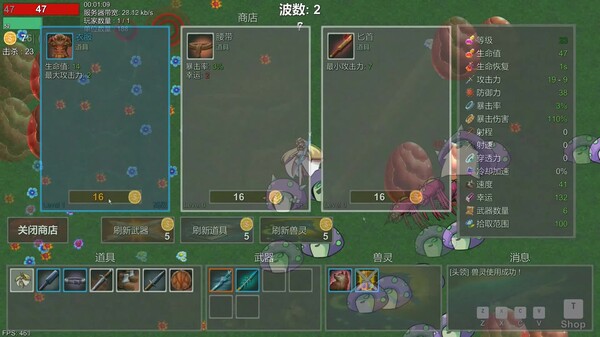
There isn’t much to see in this survivors game, and all it delivers is the generic gameplay you’d usually expect from the genre. You move your character, kill enemies, and earn money. Attacking is automatic, but you also have a sprint and dash to move around faster, as well as an area attack. There’s no experience system, but you can open the shop at any time and spend your money on three random perks. Unfortunately, there’s only a basic translation on the main menu that lets you start the game. After that, there’s absolutely no translation to help you understand what you’re buying. Nothing in the store, or anywhere else in the game, is translated. Your best option is to look for green numbers indicating improvements and ignore the perks marked with red numbers. On the other hand, since this genre is known for its simplicity, it isn’t hard to figure out what to do. When you pick a stage, your goal is to survive enough waves to reach the final boss. Once you defeat it, you unlock the next stage in the stage select menu. Each stage features a different character, but it doesn’t make any meaningful difference. The price is a bit too high for the amount of content it offers. There are no unique mechanics, and the art is simple. While most similar games fall within the same price range, they at least attempt to introduce something unique.
幸存者like
标题看走眼还以为是吸血鬼的叫床哈哈哈 游戏潜力巨大,请原厂商不断发掘吧,相信有一天不会辜负我们的期待。
经典的类幸存者玩法,自动攻击,不支持WASD控制方向走位,得上下方向控制,或者鼠标右键按住位移,游戏节奏比较快,30分支左右一把,打怪掉落经验和金币,可以商店刷新合适道具强化自己,还额外支持4个动作键位。
Related
Related
Trends
Concurrent players on Steam, sampled daily since tracking started.
Related
| Where Rabbits 兔子在哪里 | $795.6 | 116 | 94% | $0.49 |
| Bottle | $797.6 | 77 | 84% | $0.74 |
| The Backrooms | $797.9 | 58 | 22% | $0.79 |
| 1+1=? | $799.6 | 62 | 90% | $0.59 |
| Sakura Mirror | $789.8 | 57 | 75% | $0.99 |
| Skinny | $789.6 | 80 | 59% | $0.71 |