
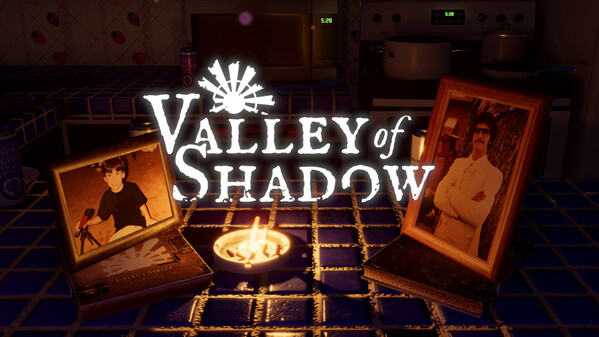
Valley of Shadow is a narrative puzzle game that tells a poignant true story of loss and grief through the discovery of real-life home videos and photographs. Harness mysterious abilities to solve puzzles and heal a broken family.
Modeled estimate, not a reported figure. How we estimate →
Media

About

Welcome to the Valley of Shadow. In it, you will experience a REAL harrowing journey of loss through the eyes of the developer. Experience the depth of grief as he visits the places of his childhood and discovers where love and acceptance come together.


Experience the dramatic retelling of a traumatic event in the lives of the developers, three siblings, through the eyes of one as he attempts to heal. REAL VHS tapes, photographs and answering machine audio piece together the fall and redemption of a once broken family.

Unlock some of the most iconic magical abilities from the fantasy genre as you make your way through the Valley and beyond: Light, Force Missile, and Fireball. Engage in increasingly complex challenges that require a mastery of each spell, both individually and in conjunction with the others.

Cast Light to not only find your way around dark areas, but also solve mind-bending puzzles revolving around Light & Shadow. Strategically manipulate your environment to control the shadows indirectly.

Force Missiles always find their target, but which target is up to you. Destroy obstacles, manipulate the environment, and reposition yourself to control the route that your missiles take.

Fireball opens new avenues to explore while you progress deeper into the icy cold Valley of Shadow. Carve through ice to make a path for Force Missile, or melt snow to shine Light on the other side.


The Valley of Shadow is both a treasure and a tomb of nostalgia from the 80's, 90's and the 2000's. Each piece is significant, and each one familiar to the player. Some of the most popular pieces even have their own puzzles designed for them.
Stats
All-time low is the lowest price we've recorded for this game since we started tracking it.
Languages: English**languages with full audio support
Reviews
I am no longer walking through the Valley of Shadow and I feel like I’ve completed a marathon. With tricky puzzles, no option to skip, and no walk through, this is an accomplishment! Woohoo!!! At times, I wanted to quit, but I am so glad that I persevered to the end of this deeply emotional experience. Valley of Shadow has two aspects. On the one hand, it is a journey through multiple temples with many gates that are opened by using light, shadow, color, fire, and timing. You have a wand with 3 spells (light, force, fire) that is used to craft solutions. Each temple introduces a new mechanic, and towards the end, you are using a combination of spells. On the other hand, it is a walking simulator that documents a path out of the trauma of family dysfunction. This is narrated as a conversation between Anthony and his therapist and includes exploring his childhood home and memories. There are collectibles along your path (family photos, floppy disks, VCR tapes) and clue-based puzzles to retrieve classic game cartridges. The game auto saves on exit. While your collectibles from your current location are saved, your progress on the specific gate is not. I was very careful to make sure that I was through an opened gate before exiting. Your wand indicates when you enter an area with collectible(s). Completionists should pay attention to this. If you miss a collectible, there is a way at the end to circle back (without reopening gates). Access to this is obtained by solving more puzzles! Just remember that the game does NOT end at the credits! Some achievements need to be earned while playing because they are not available later. There is a hint for this in the forum discussions. Valley of Shadow is a game that has been crafted, with love, and is deeply personal for the developer and his family. It is real and it is raw. I could relate to much of it based on my own childhood. It is also obvious that the developer is a skilled puzzle master. Each gate and clue-based search is brilliantly designed and usually, simplicity wins even in the most complex areas. As a bonus, most of the text in the Temples is in an unknown language. Later in the game, I had mapped about 80% of the alphabet and was able to read most of what I encountered. While circling back, I translated the quotes and messages that had eluded me before. Very cool… I only got roadblocked one time because I did not fully understand the capabilities of my wand. Luckily, the developer gave me a hint that got me moving forward. I also lost hours of time when I repeatedly fell into the trap of overthinking (something about Occam’s Razor comes to mind here). I initially thought that the game might be improved by allowing the player to skip a gate. In the absence of a walk through or forum conversations, it is easy to get overwhelmed by some of the more challenging gates. This puts a support burden on the developer. However, after finishing Valley of Shadow, I’ve come to see the game as perfectly put together. When faced with the damage caused by childhood trauma, we have two options. We can let it destroy our future, or we can ‘do the work’ to move past it. After much lonely struggle, we reach our own Valley of Shadow… that bottom point where we recognize that we need help and we reach for a lifeline. The journey out of the pit is hard, frustrating, and must be intentional. Sometimes we are faced with impossible situations and must find a way around them. Other times, the only path available is to face problems, head on, and break through. By the time Anthony reached his lowest point, I was fully engaged emotionally and shared the joy of his upward trajectory. Valley of Shadow will not appeal to everyone. You must be willing to ‘do the work’ to make it to the mountain top. Your reward is to participate in a journey that begins with despair and ends with hope and love. If you are that type of gamer, then I highly recommend this game. If you don’t care about emotional involvement, but seek environmental puzzles like those in The Turing Test or Portal, then I’d still recommend playing Valley of Shadow. Your reward will be the challenge of some well designed puzzles, coupled with the satisfaction of solving them. ADDED NOTE: At the time I wrote this review, I had ‘finished’ the game but was still missing some achievements. In my quest for 100%, I discovered a whole new section of the game that has new puzzles, some lovely surprises, and insights into the development team and process. Definitely worth continuing to play on past the credits! [quote][url=https://store.steampowered.com/curator/32732116-IndieGems/]Follow [b]IndieGems[/b] if you enjoyed this review and want to see more like it.[/url][/quote]
At its core, [i]Valley of Shadow[/i] plays as a blend between a walking simulator and a puzzle game, with most of the time being spent on solving room-sized puzzles while traversing through several temples with unique mechanics. The game is narrated from the perspective of a patient during a cognitive behavioral therapy session. This patient, Anthony, is the main author of the game and at the same time its main protagonist, the character who the player controls as they solve puzzles, and whose tragic past is slowly unraveled as the player goes deeper into the temples. Just like it often happens when exploring the various rooms of the subconscious mind during a therapy session, different fragments of memories resurface, some of them being comforting, while others being, as expected from a therapy session, quite traumatic. Anthony’s journey through the temples of his mind is a symbol of his journey of dealing with these childhood traumas, a way of learning how to embrace past experiences and finding how to heal from them. [i]Valley of Shadow[/i] was created together with Anthony’s two siblings, Nicholas and Maria, who we often see in the hundreds of childhood pictures attached to the walls of the temples' rooms or in snippets from old VHS tapes. These act as collectibles that the player can gather throughout the game. Of the four different types of collectibles, only two of them are tracked in the main hub, which the player can access only at specific points during gameplay, when the memory stream becomes too difficult to overcome, Anthony needs a place to “anchor”. Sadly, the ones that are tracked are only those that have few collectibles (acting as “special” / “rare” ones). The majority of them (hundreds of pictures and floppy disks) remain untracked, despite the game having achievements for finding all of them. While there is an indicator of a nearby collectible, the fact that you cannot go back to a previous room after you solved it or revisit previous temples makes obtaining 100% completion a colossal task. For achievement hunters, the combination of having to hunt for hundreds of missable collectibles and the heavy story is also not very optimal, as most of the focus goes into searching for them instead of being immersed in the story. The puzzle mechanics revolve around using and combining the three abilities of the staff that Antony holds during his journey: creating a light sphere at a specific point and directing light beams to light up different types of receptors, shooting colored crystals at specific targets, launching a fireball that disintegrates ice. Color prisms, requirements of shining direct light on sockets or keeping them in shadow, performing actions in a specific order or finding the correct standing position to do so, all combined and with some platforming bits (later in the game) gradually make the puzzles more and more complex. The game is entirely linear, with the downside being that there’s no way to go to a different room / sublevel if you’re stuck on the current one. There’s also no hint system available to help you progress. A few optional puzzles will have you decrypt a sequence of characters. These are used to gather game cartridge collectibles that reference classic video game franchises and their mechanics. One way it does this is that there is typically something to find behind the player when they arrive in a new area. It’s rather clear that for the devs of [i]Valley of Shadow[/i], the game is a deeply autobiographical experience, created as a cathartic process to overcome childhood traumas. For the player though, this journey might give them the uncomfortable feeling of intruding into someone's personal space, even more so considering that they are the witness of a private therapy session where someone else is dealing with their inner demons and whose deepest secrets and vulnerabilities are exposed. Players who have had similar experiences with alcoholic parents, domestic abuse or the loss of a family member at a young age can perhaps relate to the references given here, or even empathize with the protagonist. For me though, as someone lucky enough to not experience any of these, the game lacked an element to make me invested in its story. What the game does really well is the voice acting. I don’t know if the voiceovers are live recordings from therapy sessions, but they feel hauntingly real. You can clearly hear the tremor in Anthony’s voice when dealing with a traumatic memory or how his whole being calms down at the guidance of his therapist using standard phrases to help him overcome the heightened levels of anxiety triggered by some of these memories [i]Valley of Shadow[/i] is certainly not a bad game, but specific design decisions make it unsuitable for just any fan of puzzle games or of the puzzle mechanics that the game uses. If you are sensitive to emotional triggers or if you feel uncomfortable with the idea of digging into someone’s soul or experiences, you might not enjoy the game in its fullness. If you dislike the pressure of having to solve a certain puzzle without having other alternatives or hints, then this is probably not the right game for you. If you loathe missing out on one out of hundreds of collectibles, without any way to go back for it, then this is surely not a good match for you. If, on the other hand, none of these aspects bother you in the slightest and you feel that you can relate to the story of the main character, then you’re the right choice for the game. [quote]💜 If you like this review, please consider following [url=http://store.steampowered.com/curator/11354094]Lilly's Corner Curator page[/url] 🌸 [url=https://lillycorner.com/]Website[/url] [/quote]
Valley of Shadow finds itself somewhere between the "Portal" style of chamber-based puzzles and a "Walking Simulator" style game that has a heavy focus on a very personal and clearly very real story for the developers of the game. It definitely trends more towards the puzzle aspect (maybe 80% puzzle), with many different challenges that use a variety of tools and ideas, combining them all to create some very unique moments, especially in the final quarter of the game. I am a big fan of puzzle games, and the puzzles in Valley of Shadow use the game's mechanics well. The ways of manipulating the world that you have at your disposal start out simple, and then get more interesting and complicated as you progress. I'd recommend it for that alone. When it comes to the story, which is the other 20% of the game's formula, I could tell that it meant a lot to the developers. Without spoiling anything you won't learn in the first few minutes, the game has a heavy focus on a type of therapy session, and in a way it feels like making the game was partially a therapy session as well. It offered them a way of unpacking some of the less pleasant parts of their lives. This can make it uncomfortable at times to experience as an outsider, though not enough that I didn't want to continue puzzling. If you're looking for a puzzle game recommendation and are not afraid of the very personal nature of the story, I'd definitely say that you should check it out. But at the same time I think it's important to know what you're getting into.
Valley of Shadow is a really unique game. The narrative is one big, exposed, vulnerable beating heart that dives deep into loss, generational trauma, and nostalgia. The story here is more personal than anything I've seen before in a game, as it uses real family photos and home movies to unpack the history of the people that the game is centered on. Ultimately the story deals with a deeply realized, nuanced portrayal of a son trying to understand his father, and wondering if he isn't already too late. There was a lot here that moved me. Gameplay-wise, this is a puzzle game through and through. I felt the same high highs and frustrated head scratches here that I felt when playing through a game like portal back in the day. I'm not normally a puzzle gamer, but here I think they nailed a balance of challenge with reward. There are extra puzzles hidden along the way for people looking for even more of a challenge and I even spent extra time even figuring these out. If anything this game has kind of gotten me more into the genre in general. Even when I was stuck, the narrative pushed me forward. There is a nice ebb and flow between the two. Without spoiling anything, the endgame merges this flow in a surreal and surprising way. This is definitely a game that sticks with you. Its challenging, both emotionally and from a gameplay perspective. But it rewards patience with satisfying puzzle solutions and a really meaningful narrative that left me on a feeling of hope. Here's hoping we all get out of the Valley in our own time.
This game is important. The idea of an autobiographical game - either explicitly autobiographical or just based on the events/life/feelings of the developer(s) - isn't new, but this is the first and only game I've ever seen that is explicitly biographical not just for an individual but for a whole family. This game moved me deeply. You 'play' as Anthony - a real person! named Anthony! - as he works through his feelings about his family and a death of one of the members. You meet his younger brother Nick and sister Maria via photographs and home movies, and these are real photos and videos from Anthony, Nick, and Maria's childhoods. You work through puzzles involving light, etc, that feel very "classic video game" in environments that recall games of the 90s-00s, with lots of little references to games of that time. The oscillation between the challenge of these puzzles (and they get difficult!) and psychological themes of addiction, neglect, and suicide gave me a little whiplash, but in a way that made me think of escaping into games as a kid, when my time wasn't my own, and parents and school yanked my right of whatever book or game I'd escaped to. Playing through this game with the knowledge that this story is real, that Anthony is a real person - and Nick, and Maria - I'm not sure I've ever experienced something like it. You can read someone's story in their own words but this is walking through Anthony's childhood home, as imagined BY HIM, watching actual videos of him as a kid. Hearing his genuine description of how he felt and feels. It's hard not to be moved. Add onto this that we're of similar ages - we played the same games, I grew up somewhere a lot like where he did, and knew people in the same situations - let's just say I cried a lot. This game is really special. If you're looking for biography, of looking for games that interact with the real world beyond just what you input, or are in your 30s or early 40s, or just like The Talos Principle or The Witness (but it never gets that infuriating - I haven't gotten every floppy, though ...), this is the one.
Valley of Shadow is a thoughtful, introspective puzzler as well as a journey of self-discovery. It is a deeply personal story that I, as a father, husband, and son, can relate to even though my life is a generation and half a world away from the protagonists of the story. Anyone who has grown up with video games, particularly puzzlers, will delight in following the journey of self-reflection as well as the subtle and not so subtle nods and homages to games we've all played (or watched being played). Come for the puzzles and stay on for the journey.
I'm on the border for this one, but overall the game was compelling enough for me to finish it and it was a decent experience. I would only recommend this game to someone who is interested in this genre to start with. It is a combination of puzzle game and a emotional walking simulator. The puzzles get challenging eventually, but by no means are they going to challenge veteran puzzler enthusiasms. There were a few times a I quit in frustration at a puzzle, but was able to eventually solve them all except one that I needed help on. The story is a very personal one and it gets quite emotional as you progress. The story is probably what kept me going to the end. The production quality felt a bit low when I was first playing. The 3d models and textures aren't that great, and voice acting felt really flat to me at first. I eventually realized this was probably intentional as it is intended to be a therapy session. As it goes, it certainly gets better, or maybe I became accustomed to it.
If Talos Principle and What Remains of Edith Finch had a baby, it would be Valley of Shadow. I've been waiting a few years for this to come out (I played it at MAGfest a while back), I'm a few hours in at the time of writing and loving it. So far, the focus of the puzzles seems to be on view based puzzles. e.g. the first world's mechanic involves placing a light such that it casts shadows (or doesn't) in the right places. This gets fleshed out surprisingly well. The next world introduces a related mechanic that I won't spoil that adds a lot of depth, I'm anticipating eventually using them both together. The narrative is well done, I don't think I've played a game this personal before. I'm not sure what it is about this type of atmosphere that feels so condusive to puzzle solving, but it works really well. Overall, based on what I've played so far I highly recommend this to people who like puzzle games!
Valley of Shadow is great for fans of puzzle games who also like to experience and immersive story. THE PUZZLES This game has three types of puzzles: 1) Use various powers to escape rooms. The main mechanic of the game is using a staff with a series of gems, all with different powers to manipulate the room. There was a good balance of easier and harder levels and the mechanics were introduced at a good pace. 2) Unravel the story, with hidden clues throughout in the forms of the developers' actual home movies and childhood photos. You don't need to find all these clues to progress, but the more you find the more story you get. No matter what, I bet the mid-game reveal will surprise you! 3) Decode a secret language. You could finish the game without cracking the code and translating anything, but I recommend getting out a pen and paper and translating throughout the game. THE STORY The main characters are self-inserts for the developers and the story is based on their own family trauma. The authenticity of this game shines through because of how personal and how honest it is. There are no heroes or villains. The characters are complex because they are real. Heavy topics that are often treated in a vacuum in media are instead mashed together with all the messiness of real life. Have a tissue on hand and be ready to cry toward the end of the game and maybe a few times in between too. ACCESSIBILITY Clear speech and subtitles, limited bright visuals, and puzzles that could be completed without fast reflexes
Let me tell you... This game would have had a significantly less emotional impact on me a year ago. 10/10 would recommend a good cry.
Related
Related
Trends
Modeled estimate over time, reconstructed from Steam's monthly review histogram.
Momentum
Pace estimated from the game's recent review growth (our daily snapshots) at its own sales-per-review ratio — a momentum signal, not booked sales.
Related
| Killer Chambers | $5.2K | 56 | 88% | $4.99 |
| Vindilis | $5.2K | 77 | 94% | $2.99 |
| Puzzle - LINES AND KNOTS | $5.2K | 261 | 87% | $1.99 |
| Wirewalk()↳ | $5.2K | 85 | 96% | $2.99 |
| Rush for gold: Alaska | $5.2K | 52 | 79% | $3.99 |
| Ghost Road Awakening | $5.2K | 92 | 84% | $2.59 |
