Two Digits, developed and published by Cleverweek, is a minimalist puzzle game that takes an elegantly simple idea and transforms it into a surprisingly engaging test of logic and mental precision. At its core, the concept is disarmingly straightforward: you are presented with a set of numbers, and your task is to divide them into two groups whose sums are equal. There are no timers, no elaborate mechanics, and no complex tutorials—just numbers, balance, and the quiet satisfaction of finding order within simplicity. Yet, beneath its humble surface lies a system of puzzles that gradually intensifies in difficulty, inviting players to think critically, test combinations, and appreciate the beauty of symmetry and mathematical reasoning.
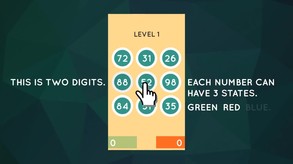
The structure of Two Digits is what gives it its charm. Each level presents a collection of numbers that must be split into two equal sums. Early puzzles are almost meditative, easing you into the logic of balancing small values, but as the numbers increase, so does the complexity. The challenge doesn’t come from any trick or gimmick—it emerges naturally from the mathematics itself. As larger numbers are introduced, the possible combinations multiply exponentially, and what once seemed intuitive becomes a methodical exercise in calculation and experimentation. The simplicity of the interface makes this process accessible, but the underlying logic ensures that the satisfaction of solving each puzzle feels hard-earned. The game is designed in such a way that it never overwhelms the player with unnecessary mechanics, keeping the focus purely on the puzzle at hand.
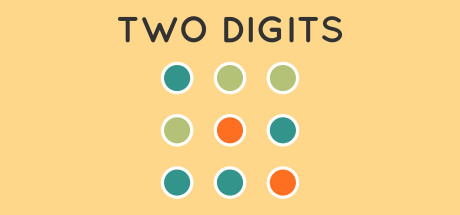
Visually, Two Digits is deliberately restrained. Its design relies on clean lines, soft colors, and minimalistic typography that evoke a sense of calm. There’s an almost meditative rhythm to its presentation, as if it’s encouraging you to slow down and think. The interface is uncluttered—just a handful of numbers on the screen, highlighted and selectable with simple mouse clicks. This restraint is intentional; it keeps you focused on problem-solving rather than presentation. While some might consider the minimalism too bare, it aligns perfectly with the game’s philosophy. The sparse visuals are complemented by subtle background music that loops quietly without distraction. The overall aesthetic fosters a sense of relaxation even as the puzzles grow more demanding, making Two Digits feel less like a stressful brainteaser and more like a quiet intellectual exercise.
The pacing of difficulty is carefully structured, providing a gradual learning curve. The first few sets of puzzles ease you into the process, giving you time to understand the logic and patterns behind successful pairings. As you progress, the game begins to test not just your arithmetic, but your pattern recognition and spatial reasoning. There’s a pleasing sense of escalation—the realization that what once took seconds now requires deeper concentration. For players who enjoy methodical puzzle-solving, this progression is deeply rewarding. Each completed level delivers a small but satisfying burst of accomplishment, the kind that comes from knowing you’ve out-thought the numbers rather than simply stumbled upon the solution.
Despite its strengths, Two Digits does have limitations that might narrow its appeal. The lack of variety in its core mechanics means that the experience can begin to feel repetitive over long sessions. Since every puzzle adheres to the same rule set, the only difference from one level to the next is the arrangement and value of the numbers. There’s also little in the way of narrative or thematic framing—no story, no characters, and no reward beyond the intrinsic satisfaction of solving problems. For some players, this purity of design will be a virtue; for others, it may feel too stark. The absence of features like level selection or the ability to skip difficult stages can also be frustrating, as the game requires linear progression through its hundreds of puzzles.
On the technical side, Two Digits runs smoothly on virtually any system, a reflection of its minimal demands. It loads quickly, never crashes, and offers responsive controls that make interaction intuitive. Its lightweight design and affordable price make it an accessible choice for puzzle enthusiasts looking for something they can dip into for a few minutes at a time. It’s the kind of game that doesn’t demand long play sessions—it rewards focus and short bursts of concentration. The inclusion of a random mode that generates new puzzles extends its longevity, providing additional challenges for those who crave more once they’ve finished the main set. Still, the core loop remains the same, and while it offers replayability in concept, the experience remains fundamentally uniform.
Where Two Digits truly succeeds is in its ability to engage the mind without overcomplicating its structure. It’s a game that trusts the player’s intelligence and curiosity rather than guiding them with hints or flashy distractions. The clean interface, the logical challenges, and the steady pacing combine to create something almost therapeutic. There’s a quiet joy in finding equilibrium, in watching two columns of numbers balance perfectly after a series of careful decisions. That sense of balance—both literal and figurative—is what defines the experience. It’s not about spectacle or speed; it’s about clarity, patience, and the satisfaction of precise thinking.
In the end, Two Digits stands as a reminder that games don’t need elaborate visuals or complex systems to be engaging. It’s proof that a simple concept, executed thoughtfully, can hold a player’s attention purely through design and challenge. While it may lack the variety or flair of flashier puzzle titles, its elegance lies in its restraint. For those who find beauty in logic and calm in structure, it offers a rewarding and contemplative experience. Two Digits isn’t a game that shouts for attention—it quietly earns it, one balanced equation at a time.
Rating: 7/10